Frequently Asked Questions

Tag: Help

  • Frequently Asked Questions

    Frequently Asked Questions

    Here is a selection of our frequently asked questions. Most answers to help you understand how Trackmate works can be found in the Guides & Instructions pages, but if you have a question that isn’t answered below then click here to ask us your question.

    If you are looking for the meaning of terms we use throughout the site, then please check out our TrackMate Terminology page.

    How do I sign up for the Free 7 day trial?

    You can find the promotional code on the membership page. Select the membership package you want to sign up for and enter the code when entering your card details in the purchase form at the bottom. You will then get the first 7 days for FREE.

    How do I see Today’s FREE Race Card?

    You will need to register for a FREE Account and be logged in. Then there will be notification at the top of the page to direct you to “Today’s FREE Card”. If you are a subscribing member then “Today’s FREE Card” is renamed “Card of the Day”. There is also a link on your myTrackmate page.

    Can I use TrackMate on my Phone or Tablet?

    TrackMate has been designed to work on all devices, but will work best on a computer or tablet. As long as your device can connect to the internet you can view the TrackMate race cards and ratings.

    How much does TrackMate cost?

    You can join TrackMate for FREE by registering for a FREE Account. Free members can view the “Today’s FREE Card/Card of the Day” and as many historical race cards as you want. You can also see our subscription membership options on the Membership Options page.

    I’m new to racing… will I find it too complicated?

    Maybe at first, but then that is true for anything new to you. But TrackMate has been specifically designed to make selecting your horses easy and most of all fun. The simple colour coded ratings make it easy to spot the contenders in seconds.

    Find out more about how easy TrackMate is to use in our Guides & Instructions.

    I need some help… what do I do?

    No problem… we are available 7 days a week. Contact us with any questions you may have on our contact us page and we will get back to you as soon as possible.

    Why can’t I see the ratings?

    FREE Account members can view all race cards but will only get ratings on “Today’s FREE Card”. You must be logged in and a subscribing TrackMate member to see the live race cards.

    There are four ways to view the TrackMate ratings. Top right of your page on the menu you will see three icons:

    • The “Races & Results” button.
    • The “Today’s Races” button.
    • The “Race Picker” button which i an icon that looks like a clock.
    • The “Date Picker” button which i an icon that looks like a calendar.

    Click here to view the Guides & Instruction page for more information about what each button does.

    How does TrackMate work?

    You can find all the information you need on the Guides & Instructions pages.

    What are mySlips?

    mySlips are the TrackMate version of a betting slip. The difference is that the information you input is stored in your personal myTrackMate database where you can monitor your selections profit and loss figures, strike rates and more.

    Check out the Guides & Instructions pages to find out more about mySlips and myTrackMate.

    Should I bet on the Contenders?

    That is entirely up to you. The contenders are selected to give our members an idea of how to read the ratings. You will soon see a pattern in the “picture” we select. These selections should run well and are generally profitable to follow.

    Why do the colours change when I make alterations in the Race Card Filter options?

    The colours on the race card represent the order in which the horses are rated based on the conditions of today’s race and any historical form under similar conditions. When changes are made to the race card default settings such as the ground conditions, the system will re-rate the race based on the new filtered options. This will often change the ratings of the runners and consequently, the colours will change to reflect those changes. Similarly, if you remove a runner or a race from the rating calculation the colours will also change.

    Click here for more information on the Race Card Filters.

    Why do you only rate the last 8 races?

    At TrackMate we are firm believers that the most important form is recent form. The last 8 runs should be more than enough data to gauge what sort of form a horse is capable of achieving.

    Why can I only see soft ground form?

    This will be because the race you are rating is to be run under similar conditions. The TrackMate ratings are set by default to only rate form over the last 200 days and under similar conditions.

    If a horse has form on good to firm ground and today’s race is on soft ground there is no point in rating the horses Firm ground form. It will be totally irrelevant. If however, you want to see all the form from this horse this season you can alter the settings in your myAccount page.

    For a full explanation see our Guides & Instructions pages.

    I don’t understand the STACK. What is it exactly?

    The STACK is a graphical representation of a horses’ form. There is a full explanation of how to understand the images on the Guides & Instructions pages.

    What’s the difference between Bright Green and Green rating boxes?

    Both greens indicate a “TOP” rated horse, but bright green signifies that the horse is “CLEAR TOP” rated. Clear Top means that the horse in question is comfortably better rated by a few points for that rating category.

    Why are there so many GREY boxes on the race cards?

    The grey boxes on the race card will indicate one of 3 things:

    • The horse has not raced this season so is technically unrated.
    • The horse has no “relevant” form to rate for this contest
    • The horse is rated “in the middle” of the pack. There is no need to “colour” a rating worse than 3rd

    Why is this horse that ran last week not rated?

    This is probably because it doesn’t qualify (which could be for various reasons) for the race card race you are currently looking at. Reasons could be that it didn’t run on the same ground or in the same race type.

  • TrackMate Terminology

    TrackMate Terminology

    Whether you are new to horse racing or a seasoned punter, you may have a limited or vast understanding of horse racing phrases or TrackMate Terminology and what they mean. Either way this page is here to help explain what each phrase means.

    FORM

    A list of positions a horse placed in its previous runs.

    QUALIFYING FORM

    Races that the TrackMate algorithms deams “qualifying” depending numerous factors like; type of race and surface. These races are then included in the TrackMate ratings as each runner’s “qualifying form”.

    PLACE / PLACING

    The position a horse comes in a race.

    RATING / RATINGS

    TrackMate’s advanced rating algorithms rate all runners in each race. These ratings produce numerical scores to help rate multiple aspects for each runner so they can be compared to other runners in the same race.

    TrackMate’s latest rating algorithm which rates horse differently from the advanced ratings which provides a greater variety of ratings to help create each race card picture.

    mySLIPS

    A popup sidebar feature containing all your race card betting selections so you can keep track of them easily. (read more about mySlips)

    myTRACKER

    This feature allows you to add a horse to your myTRACKER so each tracked horse will be highlighted with a yellow star on every race card it’s entered in. (read more about myTracker)

    PICTURE

    This is a term used to explain what the race card looks like when there are colour-coded ratings and graphs. The “picture” is how the card looks at a glance. It is a quick reference to which horses are most likely to be winners.

    LAY / LAYING

    A betting type where you back a horse to NOT do something. Basically it’s a opposite bet.

    TREND

    A feature found on race cards. It is a horizontal and vertical graphical representation of a horse’s form. Vertically it changes colour from red to green from top to bottom respectively… with top and green meaning a better placing/rating.

    TREND LINE

    The horizontal coloured graphical line which represents the trend.

    TREND POINT

    Each dot on the horizontal coloured trend line represents a race… with is a “trend point”.

    STACK

    A feature found on race cards. It is a horizontal graphical representation of a horse’s ratings from it’s form. Left (red) is a lower rating and right (green) is therefore a higher ratings. Each stack for all runners can be compare vertically, therefore giving you a performance comparison between all the runners.

    RACE CARD FILTER

    When viewing a race card there is a Race Card Filter popup which can be customised to change the settings for the race card. You can alter things like the quantity of races, the type of races and the to be included. Changing these settings will re-rate the race card and show a new picture.

    CLEAN / CLEANING

    The term clean is used to explain the process of ignoring races and runners from race cards to expose hidden value.

    VALUE

    This is a type of bet with a good return/profit. For example, a £10 stake at 20/1 would be better “value” than at 2/1.

    HIDDEN VALUE

    The term hidden value means that you found a better race card picture from a race that didn’t have an obvious winner. It is what you are looking for when using the Race Card Filters and/or cleaning process.

    …have we missed anything?

    Please contact us if you are having trouble understanding any TrackMate Terminology that we have missed from above. We are more than happy to help… in fact you would be helping us expand the above TrackMate Terminology.

  • I’m NEW to Horse Racing & Confused… HELP!

    I’m NEW to Horse Racing & Confused… HELP!

    If you are new to horse racing and confused? Don’t be scared or intimidated… TrackMate is here to help you understand how to be successful using TrackMate’s Advanced Horse Racing Ratings.

    There has been a huge increase in interest in horse racing along with an increased presence on television. Anyone new to this incredible sport can be completely flummoxed by the task of unraveling a winner. Apart from the information provided by the excellent TV pundits, you have little or no idea where to start.

    Confused?

    Newcomers can be easily confused and find it hard to fathom out all the ins and outs. Only a few ever really take investing their hard-earned cash seriously.

    There is so much information available for you to make your choices it just gets so confusing.

    Race cards are available in newspapers, in the dedicated press, or online. Nobody ever teaches you how to read them properly and actually understand what they are telling you.

    The Old Days

    If you are not new to the game then you might remember the old days. When looking through the racing papers for form and information was so complicated it literally took years to interpret.

    It was the norm for punters to spend hours trolling through form books and stats trying to find an edge. The truth is only people in the know were really in with a chance of beating the bookies.

    When looking for help with making selections for horse racing there seems to be a huge amount of “experts” willing to share their knowledge with you… but at a price! Where is the fun in just getting a tip?

    Win or lose the real fun is the whole experience of making your selection and watching it run to see how well you and your selections have performed.

    Modern Racing Data

    Now in modern times there is just so much information and statistics! In fact maybe too much. There is so much data available to the racing enthusiast these days that it can sometimes have the same effect as the lack of data from many moons ago.

    The age of the computer has allowed us to go crazy with data and data-driven stats. Even though the availability of this data is great for some, for most of us it’s just too much information.

    So what do you do with all of this modern data? This is where TrackMate come to the rescue.

    TrackMate to the Rescue!

    The TrackMate Systems takes all of the information available and make thousands of calculations for each horse and every race. TrackMate does all the hard work so you don’t have to!

    There is no need to baffle punters with endless lists of numbers and stats to digest. Simply look at a TrackMate race guide and get all of that knowledge at a glance.

    The TrackMate Team

    All of the data analysed by the TrackMate rating algorithms are processed and displayed in an easier to understand format. Everyone understands a basic traffic light system. Green is go, amber is wait and red is stop. TrackMate’s Rating System uses a similar format. Green is good all the way to red which is bad. Ratings are then portrait in simple block form for the ratings and line graphs for the stack and trend.

    If you want to learn more about the ratings and their colours, read the post called The Ratings Explained.

    TrackMate has many more in-depth features that can be incorporated into your personal selection processes. As you learn to use the TrackMate Ratings System you will find these features amazingly easy to use. In no time you won’t be confused and will be using the interactive race guides quickly and easily to make your racing enjoyable and hopefully profitable.

    Easy to use, easy to understand and gain an EDGE that 99% of other punters do not have!

    The mere fact that you have taken the time to read this article shows that you are sensible enough to know that the best chance you have of enjoying horse racing is to try and get yourself an “EDGE”.

    TrackMate’s Ratings are integrated into our easy to read race cards. Quickly zoom in on the colour-coded likely contenders. It’s really simple to use… don’t be confused. Green is best and you want as many green ratings as possible. No endless lists of numbers and tables that make you go goggle-eyed after 5 minutes.

    Let’s have a look at a real TrackMate race card ratings…

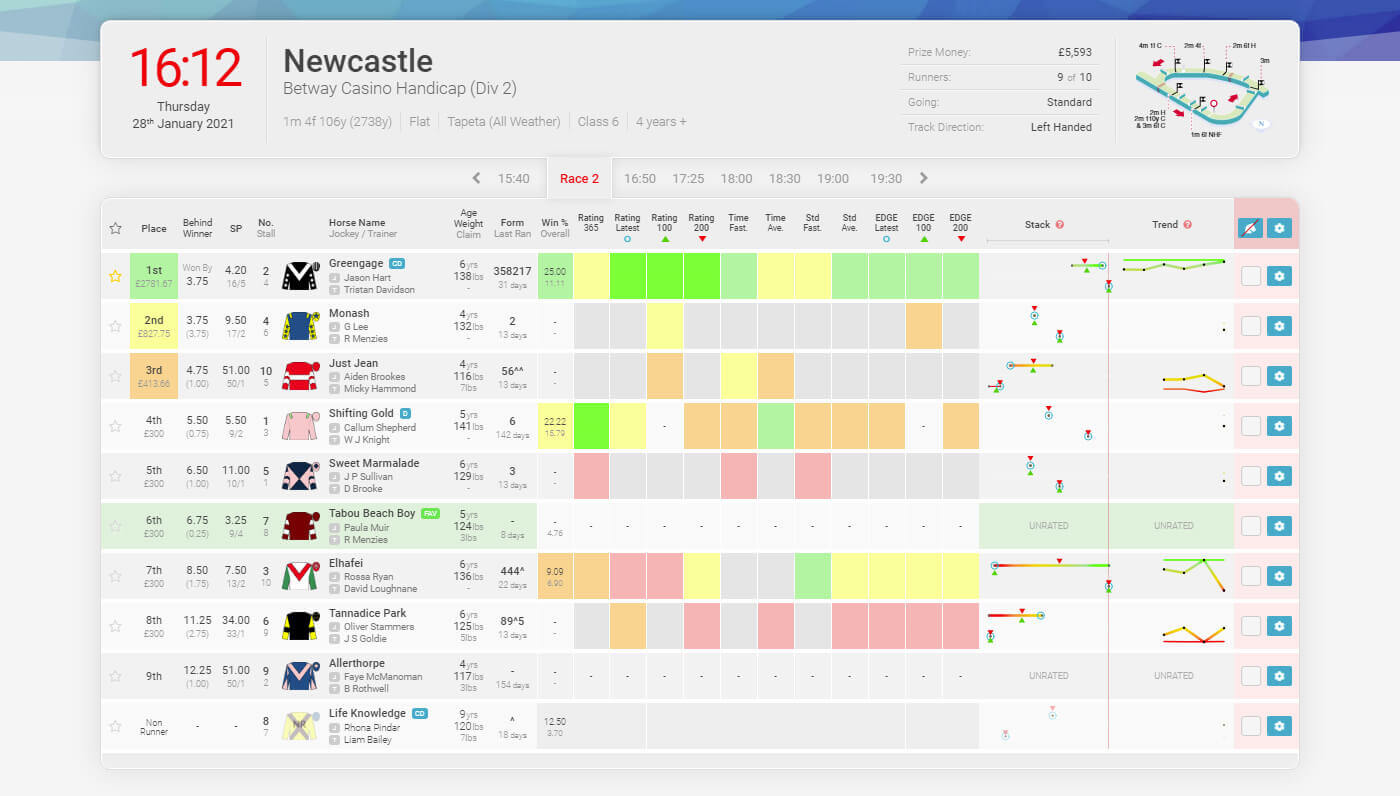
    This image is the race card from Newcastle on 28th January 2021 at 4:12pm. Let’s have a look at the colour-coded ratings… remember GREEN is GOOD and the more the better!

    Sample Green is Good Ratings (Before Race) - TrackMate
    TrackMate Race Card showing lots of Green – Newcastle, 28th January 2021 at 4:12pm

    You can see from the above race card that the horse “Greengage” has lots of green… green is even in the horse’s name!

    • 9 green ratings (3 are clear top rated)
    • 3 yellow ratings (which is the second best rating)
    • The stack and trend also have lots of green

    So looking at this race only using the colour-coded ratings, you could expect “Greengage” to be a good contender.

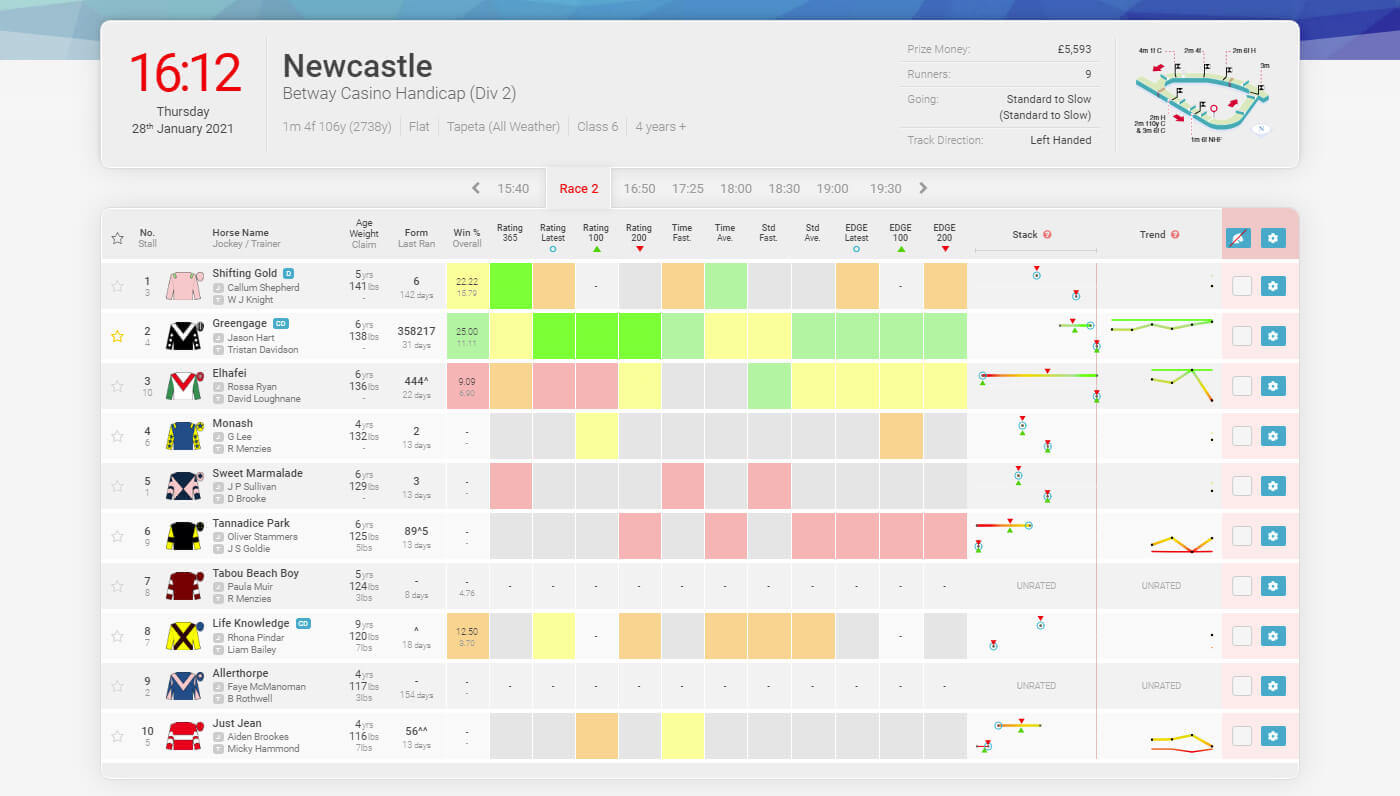
    Now let’s see how it ran… The image below is the same race card but from after the race had run.

    Sample Green is Good Ratings (After Race) - TrackMate
    TrackMate Race Card after the race – Newcastle, 28th January 2021 at 4:12pm

    Wouldn’t you believe it… “Greengage” actually won the race! On this occasion TrackMate identified the winner perfectly. At the same time made the race card easy to understand so you could select the eventual winner.

    Did you also notice that “Tannadice Park” was heavily red rated (red identifies the worst ratings). You don’t always back a horse to win, there are plenty of different types of bets you could wager on. On this occasion the TrackMate Ratings System also identified a good horse to back to NOT win.

    Conclusion

    Obviously just because a horse has lots of green ratings doesn’t mean it is always going to win. TrackMate, time after time, identifies potential winners and gives you an easy to understand way of selecting contenders.

    It doesn’t matter whether you are new to racing and confused or a well oiled “old timer”. With TrackMate you have found the best ratings system available anywhere to help you gain your edge.

    TrackMate’s race cards are the easiest to read and the most accurate ratings you are likely to find. Years of endless development and our unique algorithms give you the most powerful rating system available anywhere today.

    Take the stress out of horse racing is to make it about having fun and not winning money. The money may come or not but by visiting this page it shows you are at least willing to learn. Make your bets affordable, in other words if you do lose it doesn’t matter. There will always be another race to bet on.

    Please ALWAYS remember… if you have or think you might have any issues with gambling PLEASE STOP. Do not join TrackMate and please get some help as soon as possible.

  • Be Cautious When Seasons Change

    Be Cautious When Seasons Change

    Unless you are new to this wonderful sport then you will be aware that there are two definite seasons to the horse racing calendar. Each of which is preceded by a “settling in period”. This period is dangerous to all punters and should be treated with caution.

    Table of Contents:

    Summer Season

    You will see three types of racing during the summer season which kicks of in April with the early flat turf racing and end in November. Here are the types:

    • Flat Racing on Turf (Flat)
    • All-Weather Flat Racing (AW)
    • Summer Jumps Racing (National Hunt / NH)

    The Change-Over Period

    As mentioned the summer season for flat turf racing starts in April and runs until November (a long summer!). This means that for the early part of the season (at least 4 weeks) the ratings will be few and far between and form will be limited until the majority of horses have started running on a fairly regular basis.

    The TrackMate ratings are predominantly based on recent form and the more form the system has the better and more accurate the ratings will be.

    We understand this can be frustrating but it is very important we make use of this time by making notes, tracking horses who run well and maybe going over historical races and test your ratings systems on past races. This is a great way to get a feel for the race cards and ratings for reading future cards.

    There is no point in backing a horse in an 8 runner race when only 2 of the runners have any recent form. You do not know how fit the horses are and generally, horses will improve for their first race and sometimes will not reach peak race fitness for at least a couple of races. When looking to invest in a race you should make sure there is enough available form to make a reasonable assumption that most of the horses in the race have valid rateable form.

    We generally advise that it is best to only back horses after they have had at least 2 runs during the current season. This will normally mean they are fit and raring to go and there will be meaningful form to compare with the other runners in the race. This is not a rule though. Quite often horses are fit and ready when the season kicks off and if this is the case then a well-rated horse might well be worth considering if its first run of the season is trustworthy in the context of the race you are looking at.

    Change-Over Danger Periods

    These are times of year to be cautious… read on to learn why for each type.

    Flat (Turf)

    Early Season – April / May:
    • Lack of current form for flat turf analysis
    • Horse race fitness concerns
    Late Season – Oct / Nov:
    • Inconsistent ground conditions
    • Horses who have “Had enough” or gone over for the season

    National Hunt (Jumps)

    Early season – Oct / Nov:
    • No real form yet for analysis
    • Race fitness concerns
    Late season – April / May:
    • Horses who have “Had enough” or gone over for the season
    • Poorer quality “summer” jumpers starting to appear.

    Every race is different but we should be aware that the more races we choose to invest in that have little or no form will only harm our strategy in the long run. It is not a winning strategy. There is so much racing available to us these days that patience will always be rewarded.

    Be as selective as you can when there are lots of races to choose from.

    Use sensible bankroll management and you will reap the long term rewards. Start “gambling” on races with no recent form and you will quickly become disillusioned with the whole thing and just make more mistakes.

    Be aware of the time of year and make your investments with that knowledge firmly at the front of your decision making process.

    Winter Season

    The national hunt season starts for real at the beginning of November and runs until the end of April. There are two types of racing in the UK during the winter months:

    • National Hunt Racing (Jumps)
    • All-Weather Racing (Flat – Artificial Surface)

    It is a similar story to the flat racing in the summer. At the start of the season the vast majority of horses will need their first couple of runs to reach peak race fitness. There is no need to jump in early and start betting in races with no form. Wait, watch and enjoy the spectacle until there is plenty of form available for you to use your edge.

    All Weather Racing

    We are very fortunate that we have a full and regular schedule of all-weather racing in this country. These tracks race all year round and have some good quality racing to keep you amused during the “off-peak” periods for turf racing. This type of racing can be very profitable. Generally, especially during the winter months, the same group of horses tend to run on the same tracks. This makes it easier to get a grip on the form and can be very profitable. Some of the big yards now regularly send quality horses to the better meetings and most All-Weather tracks offer very fair surfaces that tend to suit most horses.

    There are similar periods of time to be a little cautious with the all weather ratings and form.

    Early season – Nov / Dec

    From about November through to December the new batch of winter all-weather horses start to appear. Some of them will be fit from the flat but this also means that they might be a little “jaded” after a long season. Fresher horses that have been prepared for a winter all-weather campaign will be in the same position as the flat turf horses in the spring and will need a little time for the form to settle down.

    Late season – April / May

    Many trainers will send their horses to the local All-Weather track early in, or just before the start of, the new season to warm them up for the coming months. This can be a difficult time of year for the punter as these horses coupled with the ones who have now passed their best and are thinking of their summer break make reading races a lot harder. So please be careful.

    Conclusion

    Always know your seasons. Also what period you are in of that season. Early or late can make a difference to performance. Being caution in these seasons can help you make the right choices at the right times.