
Should I bet to Win, Place or Both?

Author: TrackMateHQ

  • Should I bet to Win, Place or Both?

    Should I bet to Win, Place or Both?

    When thinking about what to bet on… DO NOT bet on ANTHING unless you can afford to. Betting on horses should be fun and pressure free. If it is not then please do not bet at all.

    There are no rules when it comes to how you should invest your hard-earned cash when having a bet.

    We strongly believe, the only real way to have any chance of making a profit, is to have a solid staking plan and proper bankroll management.

    It also helps to have a great rating system such as TrackMate to steer you in the right direction when deciding what to invest in.

    Here’s what this page will discuss:

    Win or Place?

    We have many members who bet in all sorts of different ways in order to gain an edge when backing horses.

    Some back mostly “place only” and prefer lower returns but with more consistent and regular “winning” bets. Others bet “win only”, preferring to have slightly lower strike rates but larger returns. Both methods will work and can be very profitable if staked correctly.

    At TrackMate we like to mix it up a bit and we use a combination of the above when making our investments.

    Our standard stake is 1% of our current bankroll with incremental stake increases at pre-set targets. We also set minimum price targets for our investments. For us, this is a minimum price of 2/1 (3.0) on Win bets and Evens (2.0) for Place bets. We have more information on these methods if you read the bankroll management article.

    Win Only Bets

    Many people prefer to only place “win only” bets. This is fine as long as you are staking properly and your bankroll and you can handle long losing runs. This will happen and you need to be prepared.

    We suggest that you place “win only” bets when the selection is too short (low odds) in the market and there is no value in a place bet. Normally these selections will fall into the 2/1 – 4/1 price range.

    Once the price of your selection reaches 4/1 and above you might decide that “win & place” is the way to go.

    Place Only Bets

    There are more options for punters available these days and the betting exchanges are a good option for using a more cautious approach with your bets.

    The number of runner in a race determines the number of places that will be paid. 7 or less runners will normally pay out for top 2 places. 15 or less will normally pay out on the top places. Over 15 runners normally pays out on the top 4 places.

    The ability to back horses to “place only” gives us the opportunity to play a more cautious game when protecting our bankroll.

    Win & Place Bets

    If you think your selection can win the race and the price offered is large enough you might decide to back your selection both to “win” and to “place”.

    This is similar to an “each/way” bet except that if you so desire you can place more on the place side of the bet than on the win side. Potentially locking up a profit as long as your selection places.

    For example:

    If your stake is £5 (recommended with a £500 bankroll) A more cautious approach to backing your 10/1 shot would be to stake £3 to place and £2 to win. You can change the ratio to suit your style of betting. Maybe 80/20 or 70/30 suits you more.

    myTrackMate Profit & Loss Statistics

    Remember you can follow your stats and your “profit & loss” figures in your myTrackMate page where your stats are automatically updated daily.

    This is an incredible tool for you to monitor your bets, streamline your betting techniques, and spot leaks in your strategy. Just add the odds taken and your stake and TrackMate will do the rest! You can read more about how myTrackMate works here.


  • Be Cautious When Seasons Change

    Be Cautious When Seasons Change

    Unless you are new to this wonderful sport then you will be aware that there are two definite seasons to the horse racing calendar. Each of which is preceded by a “settling in period”. This period is dangerous to all punters and should be treated with caution.

    Table of Contents:

    Summer Season

    You will see three types of racing during the summer season which kicks of in April with the early flat turf racing and end in November. Here are the types:

    • Flat Racing on Turf (Flat)
    • All-Weather Flat Racing (AW)
    • Summer Jumps Racing (National Hunt / NH)

    The Change-Over Period

    As mentioned the summer season for flat turf racing starts in April and runs until November (a long summer!). This means that for the early part of the season (at least 4 weeks) the ratings will be few and far between and form will be limited until the majority of horses have started running on a fairly regular basis.

    The TrackMate ratings are predominantly based on recent form and the more form the system has the better and more accurate the ratings will be.

    We understand this can be frustrating but it is very important we make use of this time by making notes, tracking horses who run well and maybe going over historical races and test your ratings systems on past races. This is a great way to get a feel for the race cards and ratings for reading future cards.

    There is no point in backing a horse in an 8 runner race when only 2 of the runners have any recent form. You do not know how fit the horses are and generally, horses will improve for their first race and sometimes will not reach peak race fitness for at least a couple of races. When looking to invest in a race you should make sure there is enough available form to make a reasonable assumption that most of the horses in the race have valid rateable form.

    We generally advise that it is best to only back horses after they have had at least 2 runs during the current season. This will normally mean they are fit and raring to go and there will be meaningful form to compare with the other runners in the race. This is not a rule though. Quite often horses are fit and ready when the season kicks off and if this is the case then a well-rated horse might well be worth considering if its first run of the season is trustworthy in the context of the race you are looking at.

    Change-Over Danger Periods

    These are times of year to be cautious… read on to learn why for each type.

    Flat (Turf)

    Early Season – April / May:
    • Lack of current form for flat turf analysis
    • Horse race fitness concerns
    Late Season – Oct / Nov:
    • Inconsistent ground conditions
    • Horses who have “Had enough” or gone over for the season

    National Hunt (Jumps)

    Early season – Oct / Nov:
    • No real form yet for analysis
    • Race fitness concerns
    Late season – April / May:
    • Horses who have “Had enough” or gone over for the season
    • Poorer quality “summer” jumpers starting to appear.

    Every race is different but we should be aware that the more races we choose to invest in that have little or no form will only harm our strategy in the long run. It is not a winning strategy. There is so much racing available to us these days that patience will always be rewarded.

    Be as selective as you can when there are lots of races to choose from.

    Use sensible bankroll management and you will reap the long term rewards. Start “gambling” on races with no recent form and you will quickly become disillusioned with the whole thing and just make more mistakes.

    Be aware of the time of year and make your investments with that knowledge firmly at the front of your decision making process.

    Winter Season

    The national hunt season starts for real at the beginning of November and runs until the end of April. There are two types of racing in the UK during the winter months:

    • National Hunt Racing (Jumps)
    • All-Weather Racing (Flat – Artificial Surface)

    It is a similar story to the flat racing in the summer. At the start of the season the vast majority of horses will need their first couple of runs to reach peak race fitness. There is no need to jump in early and start betting in races with no form. Wait, watch and enjoy the spectacle until there is plenty of form available for you to use your edge.

    All Weather Racing

    We are very fortunate that we have a full and regular schedule of all-weather racing in this country. These tracks race all year round and have some good quality racing to keep you amused during the “off-peak” periods for turf racing. This type of racing can be very profitable. Generally, especially during the winter months, the same group of horses tend to run on the same tracks. This makes it easier to get a grip on the form and can be very profitable. Some of the big yards now regularly send quality horses to the better meetings and most All-Weather tracks offer very fair surfaces that tend to suit most horses.

    There are similar periods of time to be a little cautious with the all weather ratings and form.

    Early season – Nov / Dec

    From about November through to December the new batch of winter all-weather horses start to appear. Some of them will be fit from the flat but this also means that they might be a little “jaded” after a long season. Fresher horses that have been prepared for a winter all-weather campaign will be in the same position as the flat turf horses in the spring and will need a little time for the form to settle down.

    Late season – April / May

    Many trainers will send their horses to the local All-Weather track early in, or just before the start of, the new season to warm them up for the coming months. This can be a difficult time of year for the punter as these horses coupled with the ones who have now passed their best and are thinking of their summer break make reading races a lot harder. So please be careful.

    Conclusion

    Always know your seasons. Also what period you are in of that season. Early or late can make a difference to performance. Being caution in these seasons can help you make the right choices at the right times.

  • The Perfect Picture

    The Perfect Picture

    Is this what the ideal potential bet should look like ? We think so!

    There is a horse running today that seems to fit the ideal profile of a TrackMate investment.

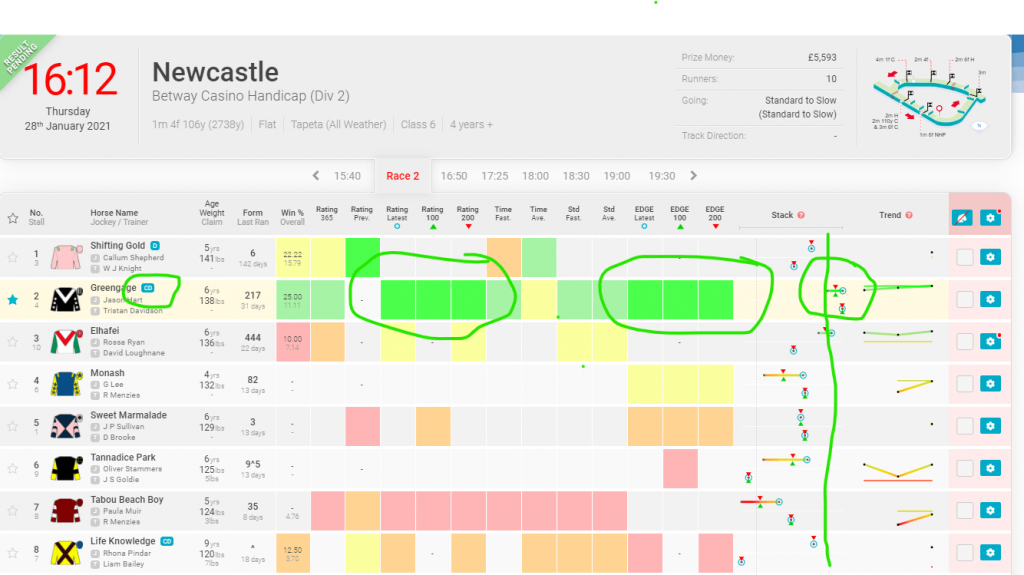
    In the above race, the 16.12 at Newcastle Greengage is clearly the one to be interested in.

    Clear top-rated over all 3 time periods in the EDGE ratings he is also clear top-rated in the TM ratings.

    His TM speed ratings “stack” is clear of the field indicating that his latest run is better than the rest of the field’s best run! He is consistent and has form in the same conditions as today’s race.

    The only negative here is the fact that the race is a class 6 which are generally contested by poor, inconsistent horses.

    Greengage is a course and distance winner and in fine form which is more than can be said for the rest of the field.

    At the time of writing this one is 3/1 so looks like a great value investment.

    Either way and win or lose a picture like this is definitely one you should all be looking out for.

  • Rain rain go away

    Rain rain go away

    You will hear me go on about this on a regular basis. Not just to help our members with sound advice but also to remind me that just because a horse is well rated does not mean that it will win the race.

    TrackMate is a great tool for just looking at the colours and picking the one with the best ratings but as with anything in life you will miss opportunities and make unnecessary mistakes or losses that could be avoided with just a little investigation.

    All the information you need is available on the TrackMate racecard including the forecast ground conditions.

    Racing League: New $2.3 million series to introduce whip ...

    The Going and the weather

    There are many reasons why well rated horses don’t run to their best all the time.

    Sometimes they just have an off day. We all have them and horses are no different. They could be poorly drawn and literally have no chance from their starting stall or they could meet trouble in running which means they just couldn’t get there in time.

    The main reason for horses not performing at their best is that the ground conditions on the day of the race were unsuitable for the horse.

    Some horses (not many) will be able to perform to their best on most surfaces or ground conditions but the vast majority have a “favoured” surface for them to perform at their best.

    Most horses will go well on a turf surface when the ground is anywhere from “Good” to “Good to Firm” some will prefer it a bit quicker (Firm) and some will appreciate a little bit of juice in the ground (Good to Soft or Yielding).

    The Majority of the time the horses are declared for races that will be suitable for the animal and the Trainers will have normally checked the forecast ground conditions as a matter of course.

    You should always check the ground conditions before you invest. Often the Weather changes and with it the ground conditions.

    It is not unheard of for the going to change from “good to firm” to “Soft” in the space of a couple of hours when it rains heavily.

    If your selection has never run well with the ground softer than “good” then it is highly unlikely that today will be any different.

    Sometimes it will be beneficial for the trainer to still run the horse under conditions that are not suitable but will help with the horses’ fitness. This is not great for the punters.

    As a Trainer, sometimes it is a good idea to run a horse with conditions less than ideal in order to allow the handicapper to reduce the horse’s official rating which means that in the future the horse will carry less weight.

    Conclusion

    Rain sucks !

    In my experience and from many years of observation it is the best policy in the long run to stop all betting activities while the ground conditions are worse than good to soft. Period.

    The majority of horses will act on ground in the range from “good to soft” to “good to firm” and this is the range of ground conditions we should be betting in.

    This is particularly important on days when the going has changed during the course of the meeting.

    “Heavy” ground is the Devils spawn and should be avoided at all costs during the Flat racing season

    We would even suggest no bets during the National Hunt season when the ground is “Heavy”.

    TrackMate Tip

    Make use of your Notebook / Horse Tracking system that is provided for TrackMate members.

    Very often, well rated horses who run poorly on unsuitable ground will run a big race next time out even if not so well rated.

    Each race is rated individually in the TrackMate system and ratings will differ depending on the form of the other horses in the race.

    Have a look at the Trend, is there an obvious bad rating that is affecting the horses overall rating? If there is, try removing the race from the ratings (click race in trend to remove run) and see how this changes the “Picture” of the race.

  • Don’t Over Complicate Things

    Don’t Over Complicate Things

    TrackMate has been designed to make your selection process quick and easy whether you are new to horse racing or a seasoned pro. To help make sure you don’t over complicate your selection process.

    Many services that offer similar platforms to TrackMate are often so desperate to impress that they invent new ways of representing what is essentially the same information with a new name.

    They publish confusing lists of numbers. Statistics that are nearly always unnecessary and time-consuming to digest and therefore just complicate things.

    At TrackMate we keep what is an incredibly complex ratings system simple.

    TrackMate’s ratings and visual aids are integrated into our unique race guides so each and every race can be assessed within seconds.

    Anything Can Happen!

    There are literally hundreds of variables in the preparation of a race horse. It starts with the trainer and the stable staff:

    • Have they done their job well?
    • Is the horse ready to race?
    • Is it fit?
    • Has it had any problems with its training schedule?
    • How much does it weigh?
    • Did it eat its breakfast this morning?
    • Did it have a good journey to the track?
    • The list goes on and on…

    The truth is, the vast majority of these factors must be taken on trust. It would be almost impossible for anyone to take all of these factors into consideration.

    Horse racing is a very expensive business to be in. Owners and Trainers do not send their horses to the track unless they are in good enough condition to do themselves justice in the race and stay fit and injury free.

    Contrary to popular belief, and we speak with experience, that the costs involved in owning and training a racehorse far outweigh the vast majority of any scullduggery that some people theorise exists in all racing.

    You will never stop horses running that will improve for the run. It’s not often that all the factors are perfect for all the horses in any given race.

    Some may prefer a different surface to race on and some may prefer a different distance.

    So… with all that in mind, what can we summise from the above statements?

    • Most horses in most races are running on their merits. They want to win and definitely want to try and pay for the costs involved in getting to the race.
    • The fitness and well-being of any horse must be taken on trust.
    • Horses will generally improve after one or two runs.

    It is important to realise that there are a lot of poor horses in training.

    They are generally inconsistent performers.

    They rarely win races so the best way to avoid these animals is to try and stay away from poor quality races.

    Read our TrackMate Warning System page for great advice… if you haven’t done so already!

    We have simplified the process of picking value investment opportunities.

    We don’t over complicate the selection process.

    You will quickly spot the most likely contenders in each race using the simple to read, colour-coded ratings on each race card.

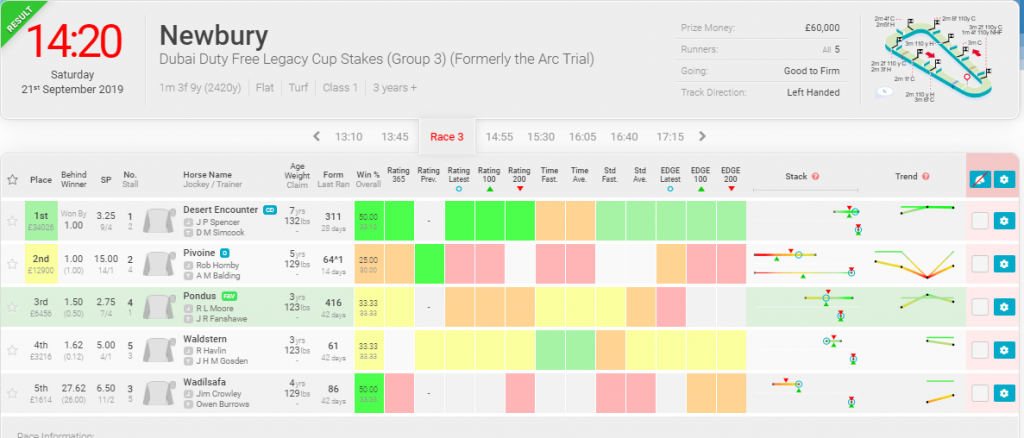
    Here’s a sample race card… so let’s put what we have just learnt in to practice.

    Sample TrackMate Race Card

    It’s not a difficult choice in this race. Green is best… simple.

    But before we jump in blindly there are still a few simple checks we should make before betting our hard-earned cash.

    • Is the price good value? In the race above the answer is clearly yes as it is approx 9/4 (3.25).
    • Will the horse act on the prevailing ground conditions?
    • Has the horse got form at the distance of today’s race?
    • Has the horse won or placed before under the same conditions?
    • Is the race suitable for investment?
    • Is the horse reliable enough in this grade of race?
    • Are enough of the runners in the race rated to make a clear assessment of the race?

    All of this information is available on your race card along with the ratings for each horse.

    Stick to what you have learnt above. Find a system that works for you and don’t waiver from it without good reason. Keep it simple, don’t over complicate things and you won’t go far wrong!

  • Staking & Bankroll Management

    Staking & Bankroll Management

    Many members ask us what is the best method for bankroll management and implementing a good solid staking plan. We will provide with you all the information you need to make good decisions with your staking and bankroll management.

    If you are investing your hard-earned money into horse racing you should be doing it for fun. At the same time, you should treat it as an investment that you would rather not lose. By doing this you will already have an advantage against most punters out there.

    • Bankroll Management – Increase profitability and reduce risk by staking correctly
    • Bankroll size – How big should your bankroll be.
    • Staking Plans – Decide correctly and strategically how to stake your investments
    • Losing runs – learn how to stake correctly for risk reduction
    • Bet tracking – Use your MyTm page as a base for bankroll management and bet analysis.

    Bankroll Management

    A Common Mistake

    The first and most important thing to understand is that you must be prepared to lose your WHOLE KITTY.

    If you are not, you cannot stake correctly.

    You would be amazed at how many people, when asked how much of their bankroll they are prepared to lose say anything other than 100%.

    It should be about enjoying the experience and having fun without pressure.

    There is no point in a staking plan that allows for a 100 bet losing sequence if you are not mentally prepared to lose 100 points.

    Having a £100 bankroll but only being prepared to lose £50 is just silly.

    Decide how much you are prepared to invest into a Horse racing Kitty with the knowledge that you could lose it all.

    Bankroll Size

    Firstly. You should not bet on anything if you cannot afford to lose the money in the first place. Please, please think before you bet and if you feel you have a problem do not join our service. Betting on the horses is not an exact science and you are highly likely to lose.

    Betting should be fun. Even if you take it seriously, as many of our members do. Feeling the pressure of every losing bet is no good for you or your profitability.

    We strongly suggest that you use a betting bank of at least 100 bets (points).

    You must be willing to continue with your staking plan. Even if you have lost half or even most of your kitty.

    Losing runs happen. If at the start of your journey, you are prepared to lose your whole bankroll, this should not affect your staking strategy. Remember you can always start again.

    If you lose your entire bankroll due to a terrible run, you should have the ability to shrug it off and start again.

    Take the opportunity of looking back at your selection processes and or staking plan and try to figure out why your selections have not been performing.

    Staking Plans

    There are literally hundreds of staking plans available out there these days.

    At TrackMate we advocate a simple but highly effective staking plan strategy of betting 1% of our initial betting bank on each selection.

    There are two highly effective strategies you can use when deciding when to increase stakes.

    • Set your stake at 1% of your bankroll every day. Keep all bets the same size for that day and reset to 1% of the new balance the following day.
    • Set your stakes at 1% of initial bankroll and only increase stakes when your bankroll hits preset milestones.

    For example:

    Conservative compounding staking plan

    Starting bankroll is £200

    Bet size should be £2 per race and you should stick to this until your kitty reaches £300 or busts (100 bets)

    When your bankroll hits £300 you increase stakes to £3 (still 1% of the kitty) when your kitty hits £400 you start staking at £4 and so on.

    If you hit a losing run and your kitty hits the starting point of £200 again you drop back to £2 stakes.

    In this strategy as your bankroll increases so does your ability to absorb longer losing sequences. By the time you have made 50% profit. Your balance is now 150 bets deep.

    This is a sensible and structured approach to staking.

    Aggressive compounding staking plan

    Although this is still a fairly conservative staking plan as your bankroll should still start at at least 100 bets it is just slightly different to our more cautious approach above.

    This staking plan allows for daily stake sizes to be determined by the daily balance as long it’s above your bankroll starting size.

    As long as you are in profit the stake is set daily at 1% of current bankroll balance.

    If you are not in profit you level stake 1% of starting balance.

    For example:

    Starting balance is £200

    Bet size should be £2 per race and you should stick to this until you are in profit or your kitty busts (100 bets).

    As soon as you are in profit, your stakes increase in line with your balance but stay at 1%.

    If your kitty reaches £210. Your stakes the following day would be £2.10

    If your kitty drops back to £200 or below you resort to level staking £2 until you are in profit again.

    This is an incredibly profitable staking plan.

    These rules are not set in stone but if you follow this practice you will get a lot of fun for your small initial investment.

    Who knows maybe next season you will be able to start with a much larger starting kitty!

    losing runs

    There are so many variables to consider and endless unforeseen events occur which could alter the outcome of a horse race so bankroll preservation should be top of your list.

    You can see from the below table the potential losing sequences you can have with the specified strike rates. It is always best to have as big a bankroll as possible and start with small stakes.

    This image has an empty alt attribute; its file name is Estimated-Longest-Losing-Run-Ready-Reckoner.jpg

    As you can see. Even a 35% strike rate, which is incredibly high can endure losing sequences of up to 20 consecutive bets and we would always double this number at least in order to comfortably cover these inevitable runs.

    It happens. Get used to it.

    Bet Tracking

    One of the most important ways to maintain a proper bankroll management strategy is to incorporate a strict routine for logging your bets and results.

    How else can you keep track of all your investments.

    By keeping a record of all your bets you have the ability to spot “leaks” in your strategy and correct them when you spot them.

    You will find on your personal myTrackMAte page that all bets and stakes that you log in your MYslips are trannsfered automatically into and logged into your bet history page.

    All bets in this log are automatically updated daily with results and will keep a record of your profit/Loss figures as well as your strike rate and ROI.

    This incredible tool is available for all TM members and will help you manage your bets better than ever before.

  • Race Card Filter

    Race Card Filter

    Every race card has a Race Card Filter popup. This features gives you the ability to customise each race using the changeable options; Rated Quantity, Visible Races, Race Distance, Race Types, Surface Types and Going Types.

    Ignore Horse feature

    A great way to clean up messy races.

    You can remove any runner from any race for any reason and re-rate.

    On the right-hand side of the racecard, you will see two pink columns with options **** buttons.

    The column below the racecard filter/options button contains the remove horse function.

    The **** button enables the remove all function so you can remove more than one horse from the race at the same time. Below this button the boxes allow you to tick as many horses as you want.

    How to open Race Card Filters

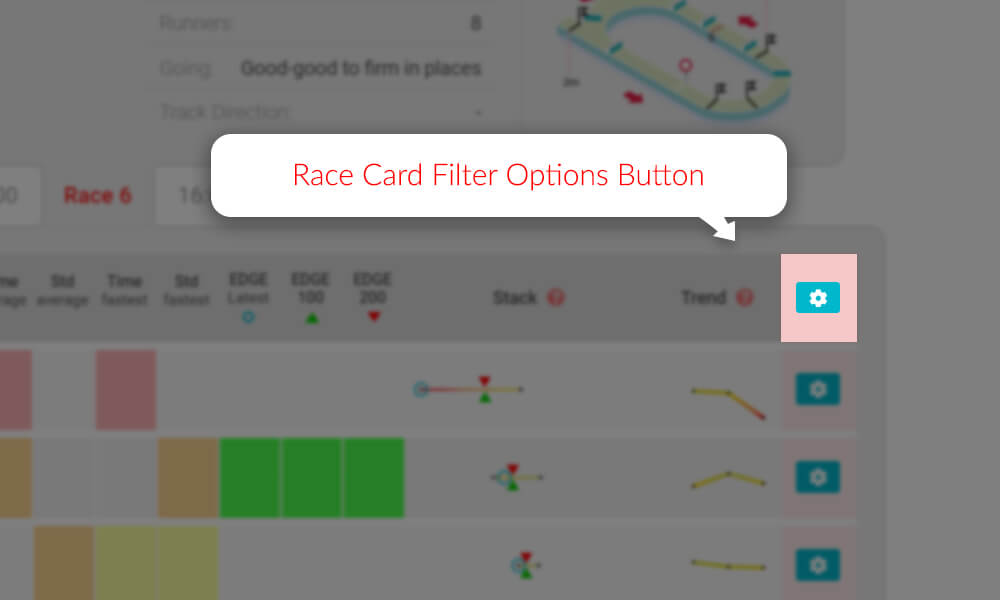
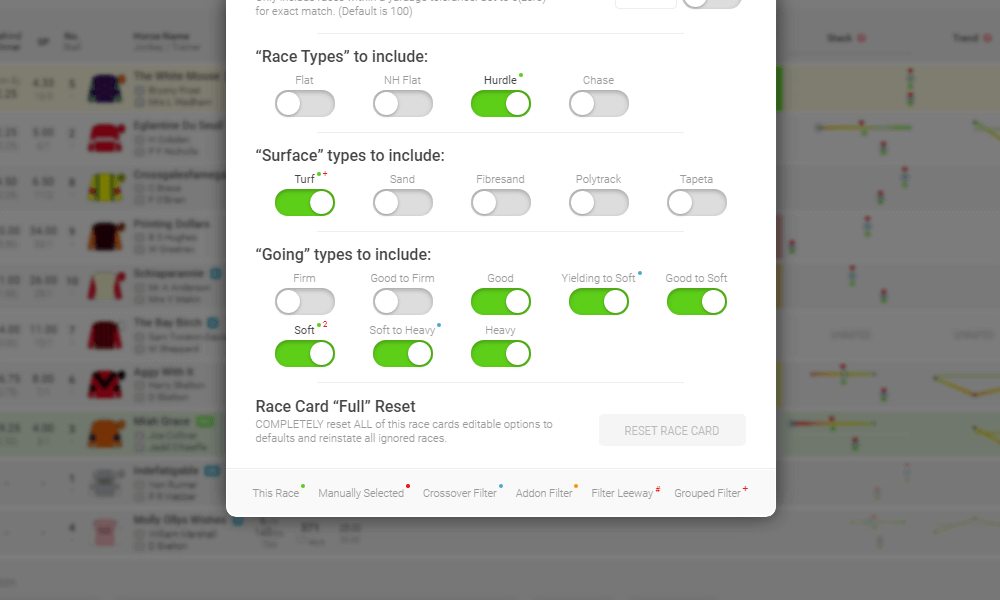
    On the top right hand side of the race cards (see Fig. 1) you will see the “Race Card Filter Options” button. If you click the button you will see a popup with all the filter options so you can customise the ratings for each interactive race card (see Fig. 2).

    Sample Race Card Filter Options Button - TrackMate
    Fig. 1 – Race Card Filter Option Button
    Sample Race Card Filter Options 1 - TrackMate
    Fig. 2 – Race Card Filter Options Menu

    Quantity of Rated Races

    TrackMate’s default quantity of rated races is set to All qualifying runs. This means after the algorithm filters out all non-qualifying runs it will use all the remaining races.

    This option allows you to re-rate the race using either the last 3, 5, 8 or All qualifying runs. Remember the rating is the average of all runs in the rating time period. By changing the quantity of runs included in the ratings could drastically change the race card picture.

    If you set this option to 8 then a maximum of 8 previous runs will be included in the ratings… and so on.

    If the horse has less than the maximum quantity of rated runs it will be rated only on the qualifying runs for this period. So if the option is set at 8 runs but the horse has only had 3 runs, the system can only rate those 3 runs. On the other hand… if the horse has had 10 runs then only the last 8 runs will be included.

    Quantity of Visible Races

    This sets the maximum quantity of visible races to show in the form, stack and trend for this race card. The default setting for this feature is 8, but you can choose between 3, 5, 8 or All.

    Race Distance Tolerance

    This feature allows a tolerance range in yards for race distances to be included in the ratings algorithms.

    • This option is set to OFF as default.
    • If you turn it ON then a the race distance tolerance is set to 100 yards as default.

    When OFF this allows all qualifying race distances to be included in the algorithms. When ON and you don’t change the default distance from 100 then all races within 100 yards shorter or 100 yards longer than the race card distance you are filtering will be included… and so on.

    Race Type Indicators

    Sample Race Card Filter Legend - TrackMate
    Sample Race Card Filter Legend

    At the bottom of the Race Card Filters popup you’ll see the filters legend which explains all the different indicator types. There are 6 filter indicators to understand, but they are very useful once you get used to them.

    This Race

    “This Race” is a green dot to indicate which is the current race card’s type.

    Manually Selected

    “Manually Selected” is a red dot to indicate which options that you have selected yourself.

    Crossover Filter

    “Crossover Filter” is a blue dot which indicates that equivalent types have been automatically selected by the system. An example of this (see picture above) would be when the current race card “This Race” going is an English going term, in this case Soft, so the equivalent Irish going types are added; Soft to Heavy and Yielding to Soft.

    Addon Filter

    “Addon Filter” is an orange dot which indicates that additional types have been automatically selected by the system. An example of this would be when the current race card is an English track so Irish equivalent going types are added and vice-versa.

    Filter Leeway

    “Filter Leeway” is a red number to indicate the leeway quantity either side of “This Race” type. This customisable user setting can be altered on the myAccount page.

    Grouped Filter

    “Grouped Filter” is a red plus (+) symbol which indicates that a customisable user setting is active.. This customisable user setting can be altered on the myAccount page.

    Race Types

    TrackMate will automatically identify the current race card “Race Type” and as default will only include races of the same type in the ratings algorithms.

    You can include other race types from a selection of “Flat”, “NH Flat”, “Hurdle” and “Chase”, but be careful as you could be adding race types that aren’t relevant and re-rate the race card with inaccurate ratings.

    Surface Types

    TrackMate automatically selects the current race card “Surface Type” and as default will only include races of the same type in the ratings algorithms.

    There is a customisable user setting available for this option. If the current race is all weather then you can decide whether to include all other all weather types or not. When ON you’ll see a red + next to the “This Race” type so

    You can include other race types from a selection of “Turf”, “Sand”, “Fibresand”, “Polytrack”, “Tapeta” and “Dirt”, but be careful as you could be adding race surfaces that aren’t relevant and re-rate the race card with inaccurate ratings.

    Going Types

    TrackMate automatically selects the current race card “Going Type” and as default will only include races of the same type in the ratings algorithms.

    You can include other race types from a selection of “Turf”, “Sand”, “Fibresand”, “Polytrack”, “Tapeta” and “Dirt”, but be careful as you could be adding race surfaces that aren’t relevant and re-rate the race card with inaccurate ratings.

    Reset Race Card Filters

    The “Reset” button at the bottom of the filter options popup box enables you to completely reset the racecard to the original settings and start again. This will light up red when you have made changes to the original race card.

    The adjustments made will stay in play until cancelled and if you re visit this race in your historic racecard library it will stay in the mode you were last using the card in.

  • The Trend Explained

    The Trend Explained

    The Trend is an incredibly useful tool from the TrackMate rating system. Quickly analyse the Rating profile of all contenders in any race. If your potential selection is improving, declining or consistent in it’s performances you will be able to spot this in no time at all.

    Here are the features explained on this page:

    Sample Trend - TrackMate
    Example “Trend” – Showing trend points, Speed Rating and EDGE Ratings.

    Trend Line

    The TrackMate Trend is a visual representation of the horses ratings to date. This makes it easy to spot form of an improving, consistent or declining contender. Incredibly useful for spotting runs that are “Out of character”

    Trend Points

    Each trend point represents a run with the first rated run being the dot furthest to the left. Information for each race is available by clicking these points/dots.

    How to read the Trend

    The trend displays each horse’s form in the horizontal graphical line or “trend line“. It has been designed so you can easily and speedily ready form. Utilizing an easy to read graphic which clearly shows if the horse’s form is improving, declining, consistent or inconsistent.

    Improving Trend

    When the horizontal trend line is going upwards this is what we refer to as an “improving tend” meaning the result was better than the previous race.

    Declining Trend

    When the horizontal trend line is going downwards this is what we refer to as a “declining tend” meaning the result was worse than the previous race.

    Consistent Trend

    When the horizontal trend line doesn’t go up or down very much this is what we refer to as a “consistent tend” meaning the results are pretty similar. This can be true for part of the line, but the greater proportion represents greater consistency.

    Inconsistent Trend

    When the horizontal trend line goes up and down a lot then this is what we refer to as a “inconsistent tend” meaning the results are erratic. This can be true for part of the line, but the greater proportion represents greater inconsistency.

    Trend Point Information Popups

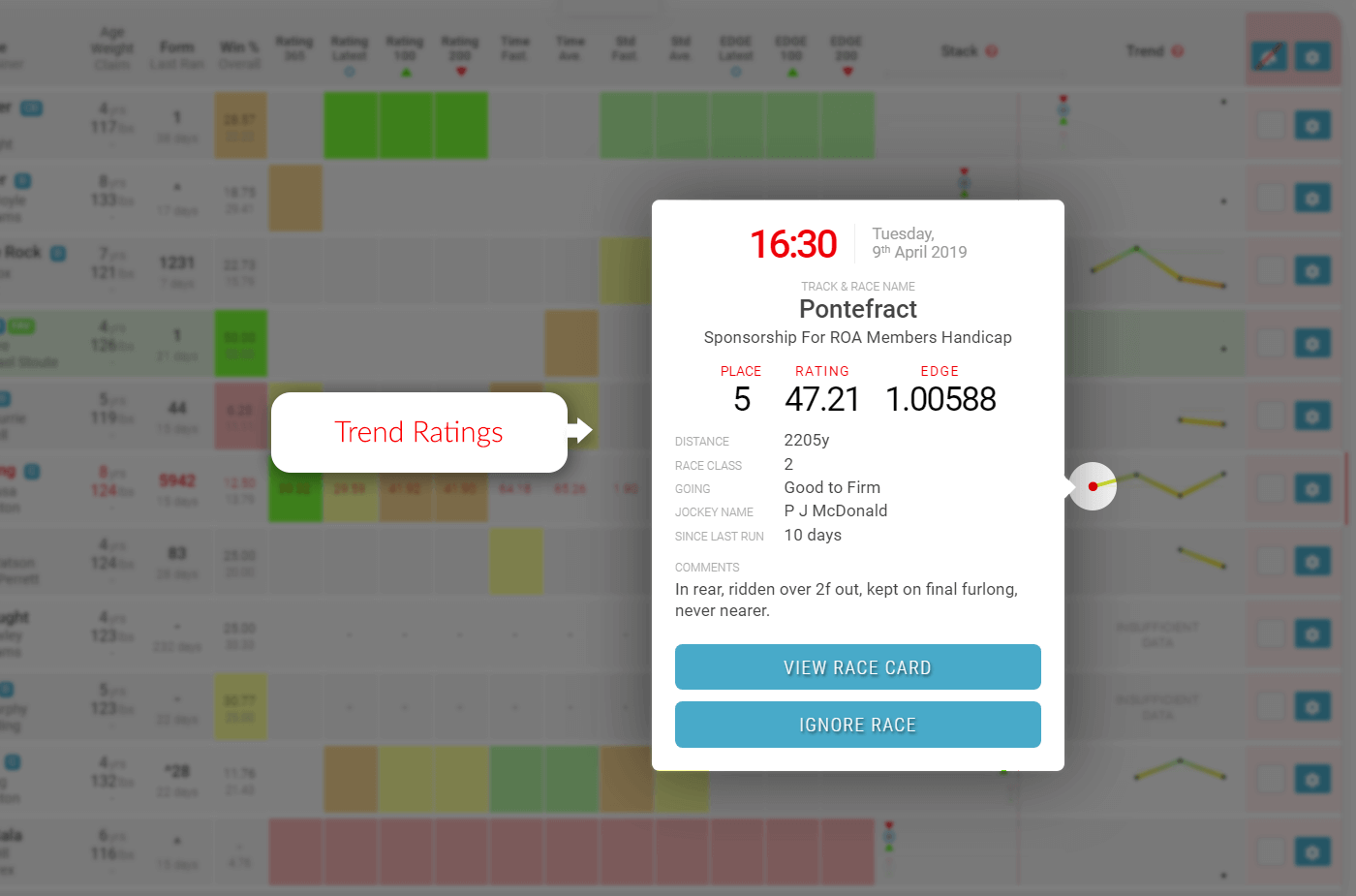
    Each dot or “trend point” represents a race that the horse has taken part in. On hover these points will change to red dots and when clicked will open the information popups.

    Samples Trend Popup - Trackmate
    Sample Race Card Trend Popup

    By clicking on these points you will see a popup with all the details of that particular race. You will have all the information you need; race conditions, race distance, jockey and many more including TrackMate Speed and EDGE ratings achieved for that run.

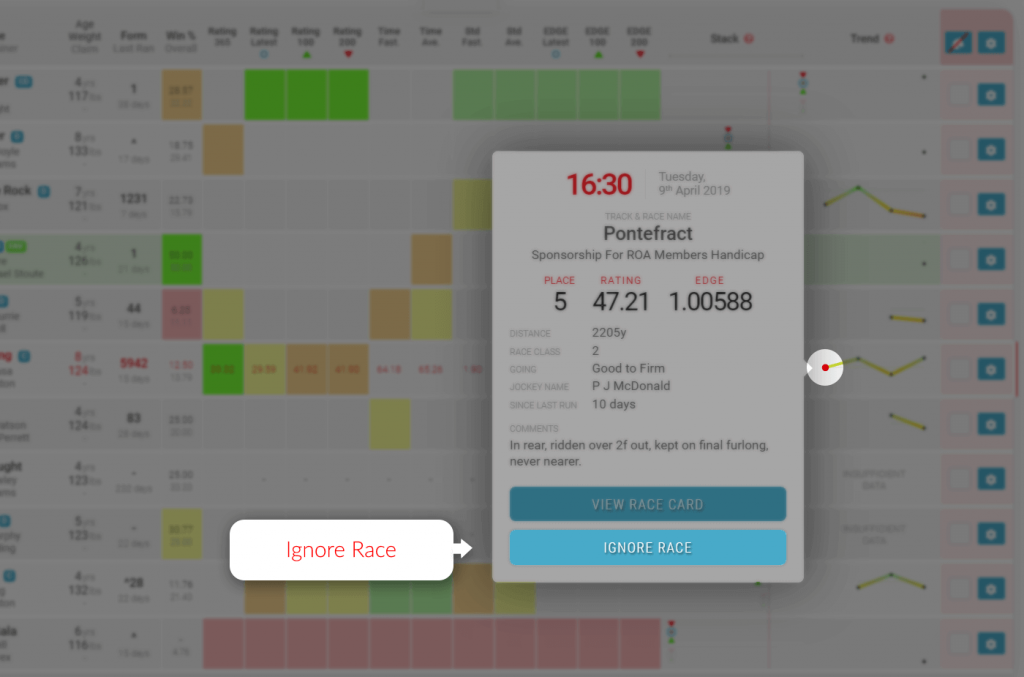
    Ignore Race Feature

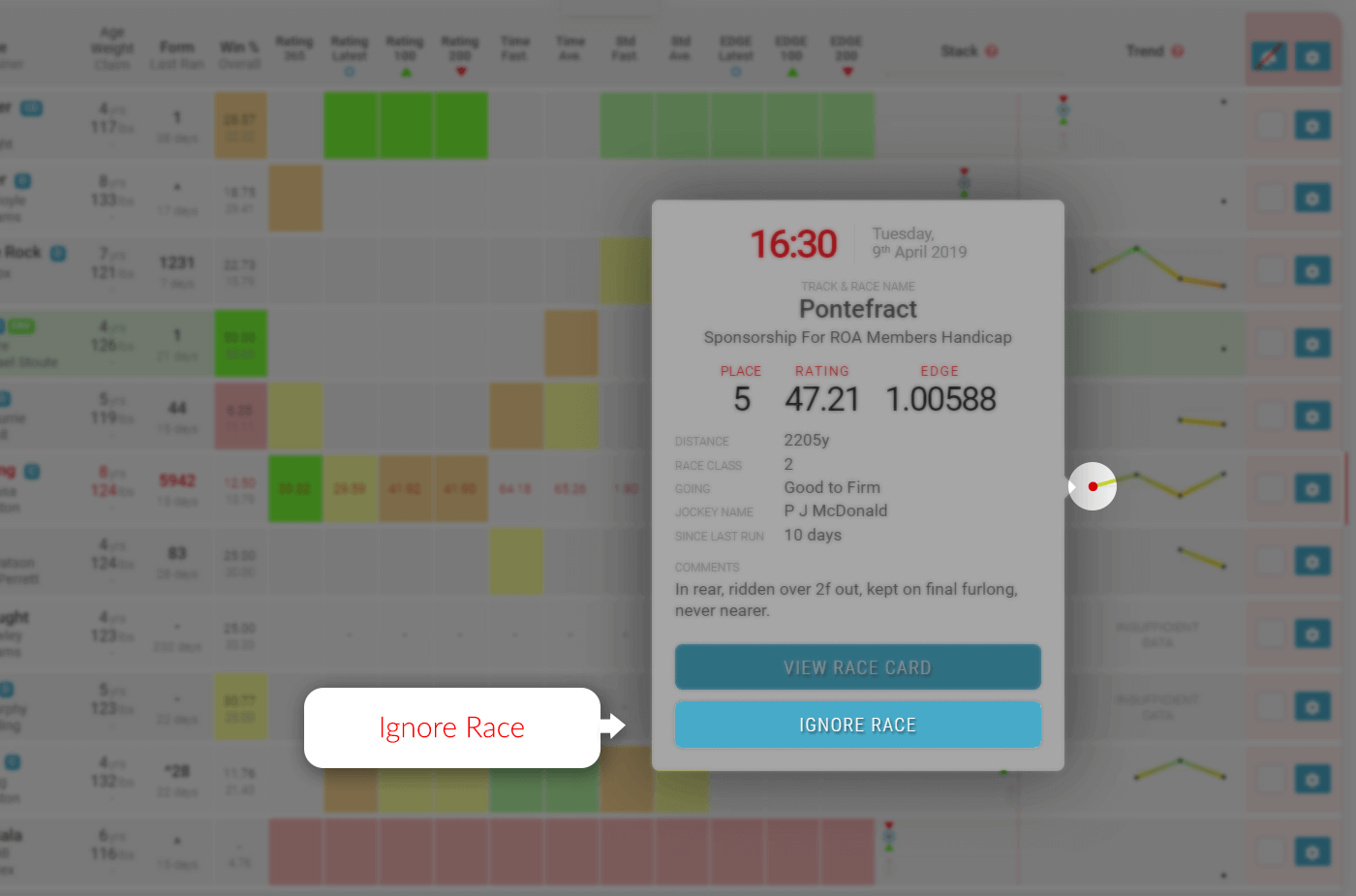
    One of the great features of the TrackMate race card is the ability to “ignore” any of the horses runs for any reason you may have.

    Samples Trend Popup - Ignore Race - Trackmate
    Sample Race Card Trend Popup – Ignore Race Button

    If you decide that you are prepared to forgive a bad run or you know that the race distance just didn’t suit the animal or even if you think the jockey was no good in that race. Just click the trend point and then remove race from the popup.

  • The Stack Explained

    The Stack Explained

    One of the most exciting features of the TrackMate rating system is the stack. An incredible tool for the speedy analysis of the ratings in relation to the other runners in the race. It has many uses and can be an incredibly powerful tool when analysing races. There is a stack for both sets of ratings on every race card.

    On this page you will find explanations for the following:

    The “Stack” is a graphical representation of each horse’s range of performance from the qualifying form.

    • The top stack is speed ratings and is a thicker line.
    • The bottom stack is EDGE ratings and is a thinner line.

    Both stacks have the same rating markers for each horse’s qualify form.

    Sample Stack - TrackMate
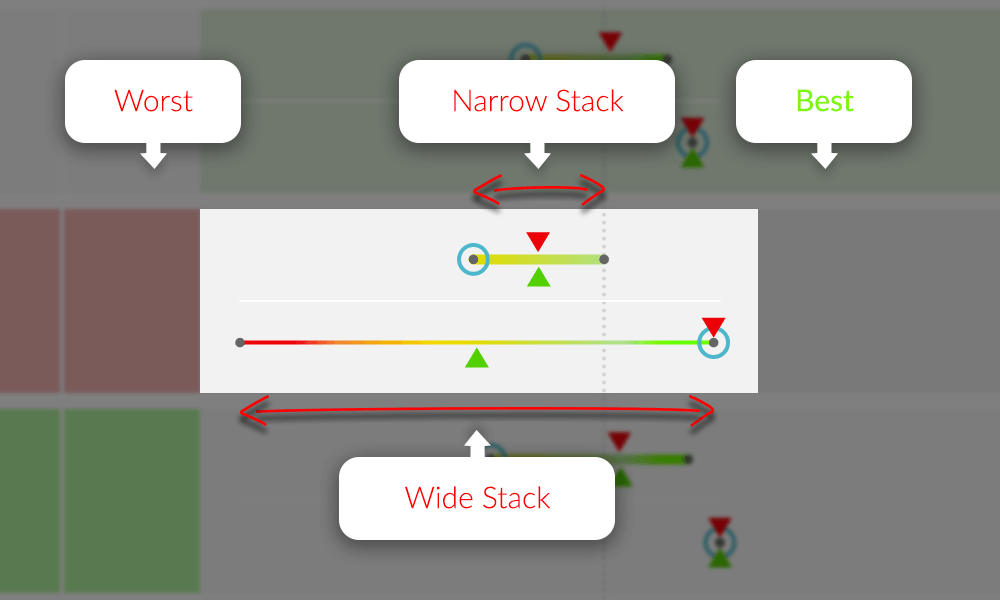
    Sample “Stack” – Showing 100, 200 and most recent ratings and the range between worst and best.

    Range of Performance

    The narrower the line is, the more consistent the horse has been as the range between worst and best is less.

    The wider the line, the less consistent the horse has been as the range between worst and best is greater.

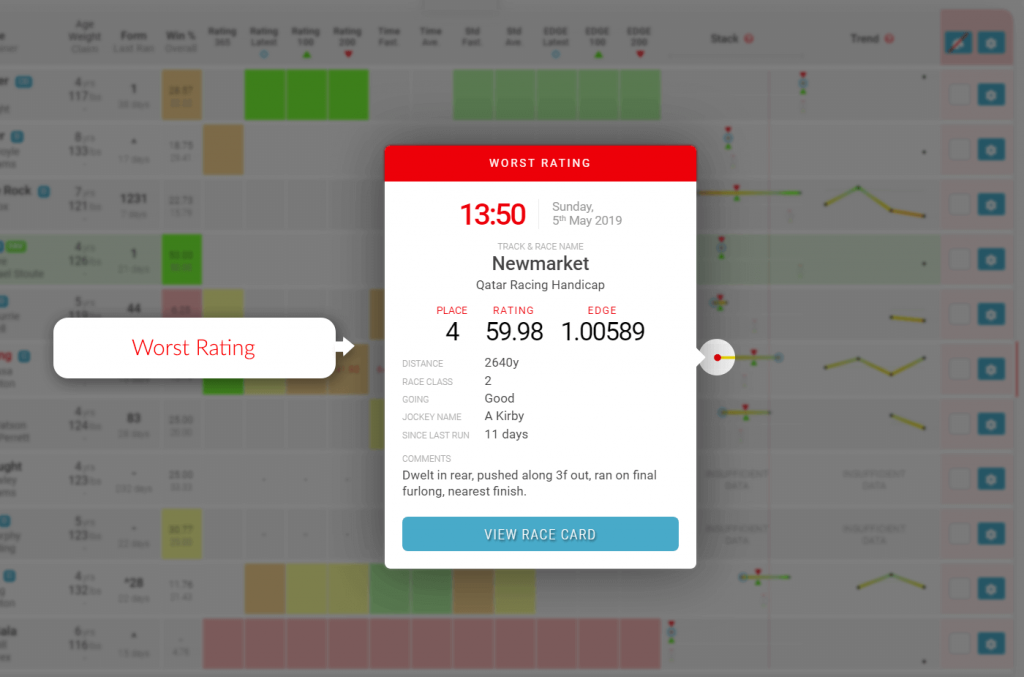
    Worst Rating

    The dot on the far left of each horizontal line is the horses worst rating for the qualifying form period.

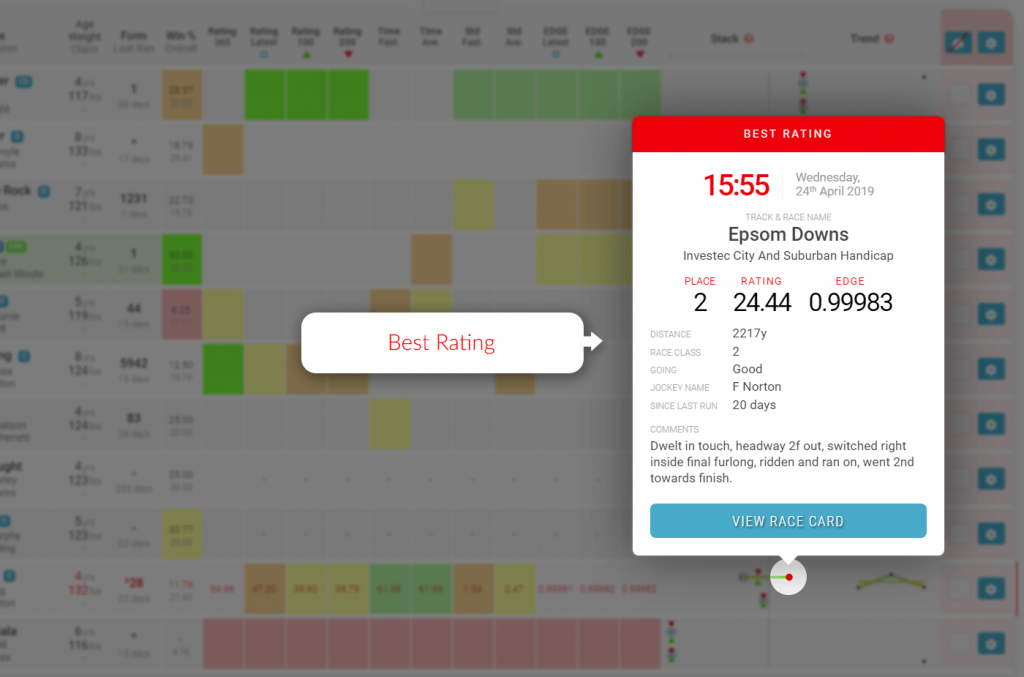
    Best Rating

    The dot on the far right of each horizontal line is the horses best rating for the qualifying form period.

    100 Day Rating Icon

    The green triangle is the average speed rating for qualifying races for the last 100 days.

    200 Day Rating Icon

    The red triangle is the average speed rating for qualifying races for the last 200 days.

    Latest Rating Icon

    The blue circle is the rating for the last qualifying race.

    Vertical Guide Line

    There is a vertical guide line feature that appears when you hover over the grey guide bar under the stack column title. The line will be red when active as you move left and right over the guide bar. It will then stop moving and change to a grey dotted line when you move off the guide bar.

    This line is extremely useful to get a vertical comparison between all runners stacks in the race making it easier to visualise where the stacks and icons are in relation to each other.

    Great Stacks

    The stack can identify opportunities where horses could be deemed as well above the standard of the rest of the field.

    Here are two example of how to identify a “great stack”

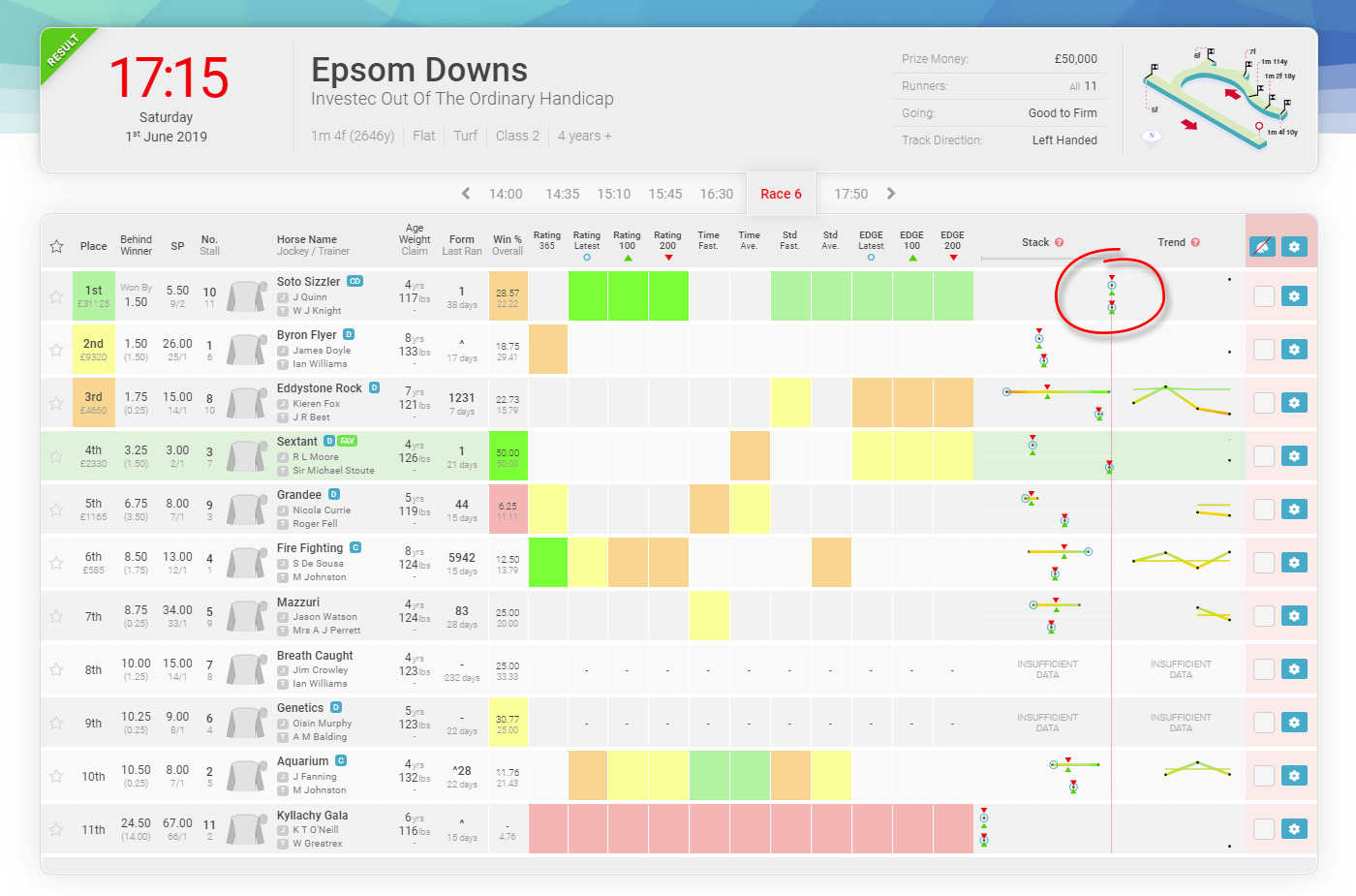
    “Great Stack” Example 1 – 1st June 2019, Epsom Downs at 5:15pm

    In this example 1, you will clearly see that the stack for Soto Sizzler indicates that his form is way out in front of the rest of the field in both Speed and EDGE ratings.

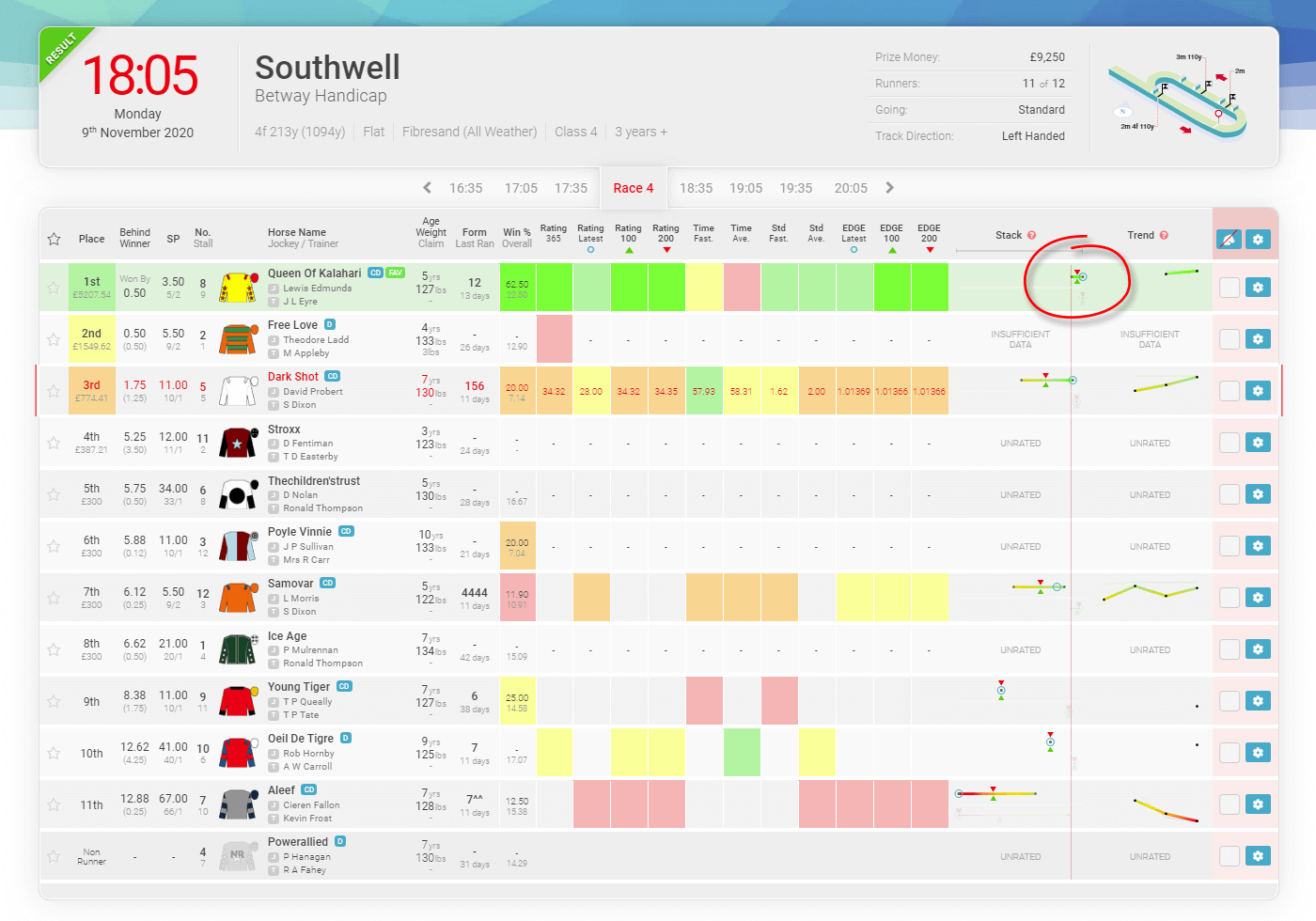
    Sample Great Stack - 2020-11-09 Southwell at 18.05 - TrackMate
    “Great Stack” Example 2 – 9th November 2020, outhwell at 6:05pm

    You will see in example 2 that Queen Of Kalahari’s “worst” run is as good as any of the other runners “best” run and its best run is clearly best of all.

    The stack can also be used to find “poor value” horses and opportunities to “Lay” horses on the exchanges.

    Stack Point Information Popup Examples

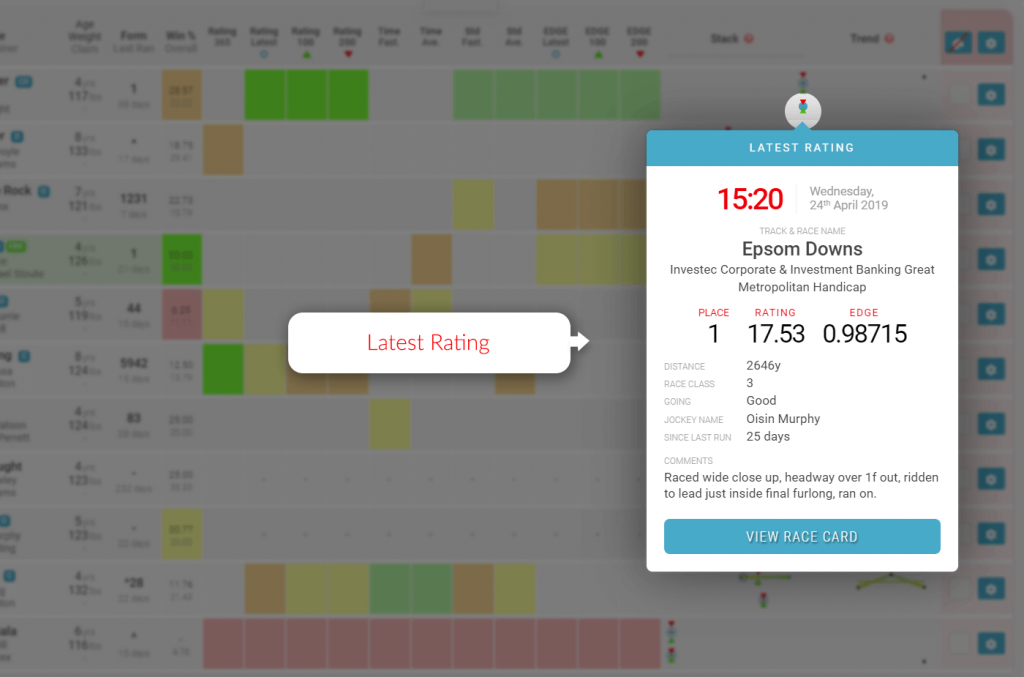
    Latest Rating (blue circle)

    Samples Stack Popup - Latest Rating - Trackmate
    Sample Stack Point Information Popup – Latest Rating

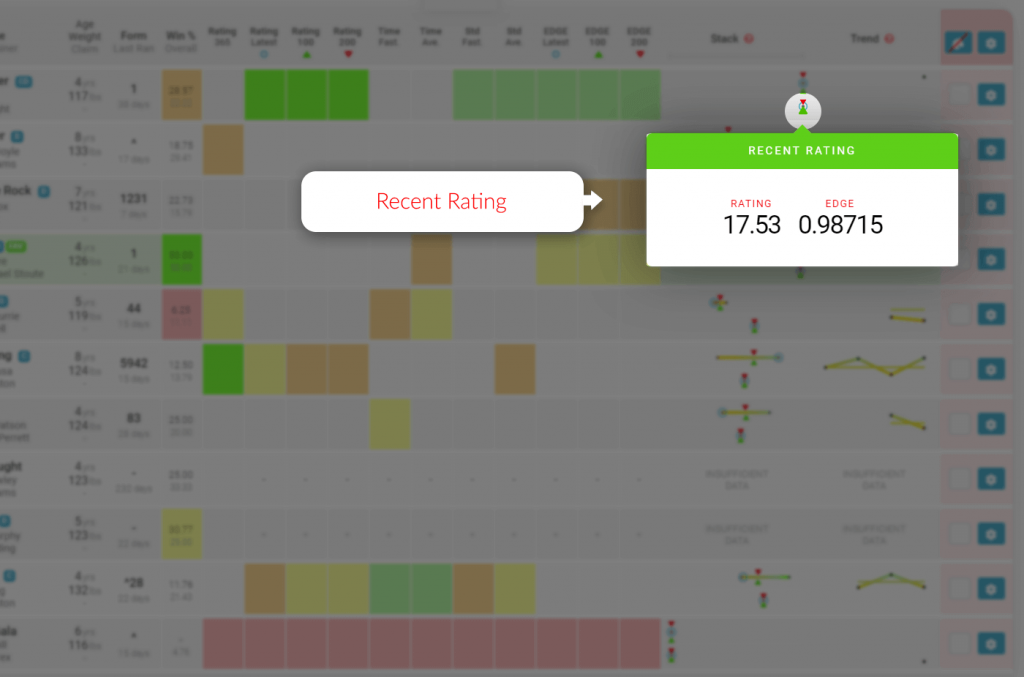
    100 Day Rating (green triangle)

    Samples Stack Popup - Recent Rating - Trackmate
    Sample Stack Point Information Popup – Recent Rating

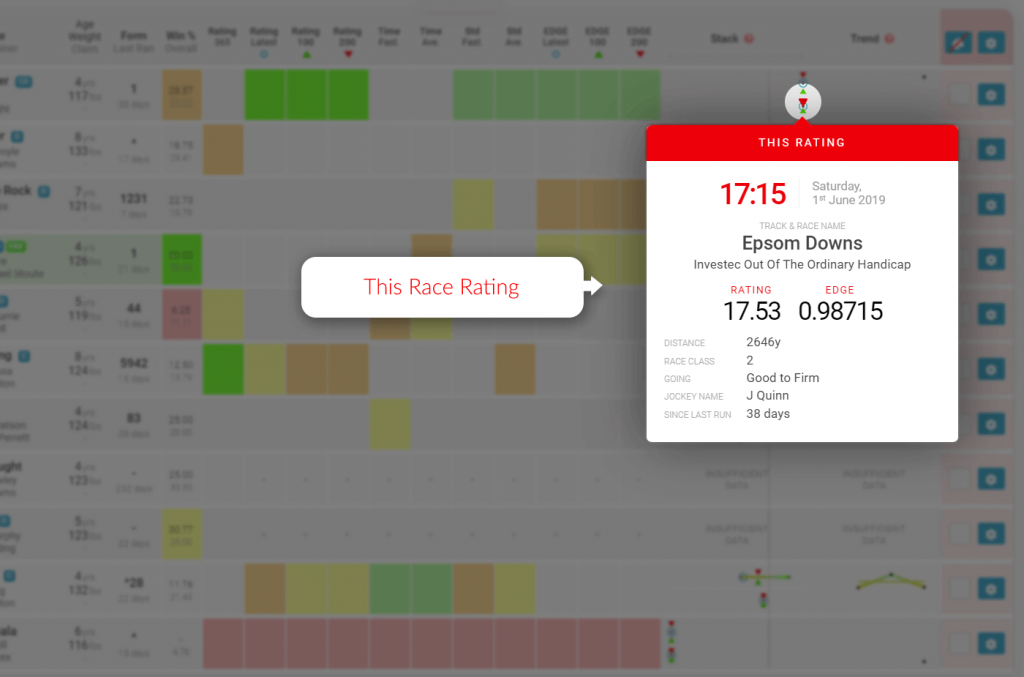
    200 Day Rating (red triangle)

    Samples Stack Popup - This Rating - Trackmate
    Sample Stack Point Information Popup – This Rating

    Best Rating (far right dot)

    Samples Stack Popup - Best Rating - Trackmate
    Sample Stack Point Information Popup – Latest Rating

    Worst Rating (far left dot)

    Samples Stack Popup - Worst Rating - Trackmate
    Sample Stack Point Information Popup – Latest Rating
  • The Ratings Explained

    The Ratings Explained

    This page gives you an overview of the TrackMate ratings, what they mean and how to understand them. The ratings are colour coded for ease of use, eliminating the need for confusing tables of numbers and unnecessary racing jargon.

    Assuming you have already familiarised yourself with the race card, it is time to have a look at the ratings. If you need to know more about the race cards then have a look at the ADD LINK TO RACE CARD INFO PAGE page.

    This is a list of what this page includes:

    Rating Colours Explained

    We need to start with explaining what the rating colours mean before trying to explain anything else. TrackMate race cards display the top 3 rated and bottom rated horses in a traffic light style colour scheme as shown below.

    Clear Top
    Top Rated
    2nd Rated
    3rd Rated
    4th Rated
    Rated Last
    No Colour
    Non-Runner
    Not Rated

    Bright green is “Clear Top” meaning they are rated comfortably ahead of 2nd best. Green is “Top Rated” but not by a comfortable margin like clear top would be. “2nd”, “3rd” and “Last” rated continue in a familiar traffic light colour scheme.

    Horses rated “in the middle” are grey or have no colour as are horses without a rating. We only rate the top 3 and bottom as we do not need to know which horse is rated 7th and would void the point of our rating colours. If you hover over the rating boxes you will see the numerical rating. This will not be visible if the horse has no relevant rated form for the qualifying period.

    Now you understand what the different colours represent… let’s move on to the ratings themselves.

    The Ratings

    There are two ratings systems; the TrackMate Speed Ratings and the TrackMate unique EDGE Ratings. Each column for both sets of ratings are colour-coded to help simplify reading the race cards.

    Speed Ratings

    The first 10 ratings boxes are the TrackMate Speed Ratings calculated using our advanced algorithms and unique racecourse standards. Ideally, you are always looking for these boxes to be as well coloured as possible. Remember… green is best.

    The TrackMate race cards display all the rated relevant runs (up to the last 8 runs) in a 200 day period We produce a speed rating for every run and the final speed rating is the average of all ratings combined.

    Win Percentage

    There are two percentages in this column. The top percentage is the win rate from for this exact type of race and the bottom is the overall win rate from all qualifying races.

    Rating 365

    This TrackMate average Speed rating is for the previous 365 days before the current race card you are viewing. We concentrate mostly on recent form so this rating indicates potential dangers from runners who have little or no form in the current season.

    Rating Prev

    TrackMate average Speed rating for the current time period in the previous season. This rating is most helpful for runners who have little or no form for the current seasons latest, 100 or 200 periods, like with Rating 365 but over a shorter period.

    Rating Latest

    The latest speed rating achieved by this horse. Very often an important indicator of the horses current form. A good speed rating for its latest run means that the horse should be fit and well and that the conditions of that last run suited the horse. This rating is also indicated on the stack as the blue circle.

    Rating 100

    This is the TrackMate Speed rating for this horse averaged over the last 100 days. The best indication of recent form. The more runs the more accurate this rating will be.

    Rating 200

    A slightly longer-term speed rating. This Rating is the overall Speed rating for the last 200 days. A good indicator of the horses’ consistency.

    Fastest Time

    The best time rating achieved in the last 200 days.

    Time Average

    This rating is achieved using our standardised race distance and represents the horses’ average time over said distance.

    Standard Average

    The runners average time from the TrackMate standard vs field.

    Fastest Standard

    This is the closest this runner has come to the TrackMate course standard time for this distance.

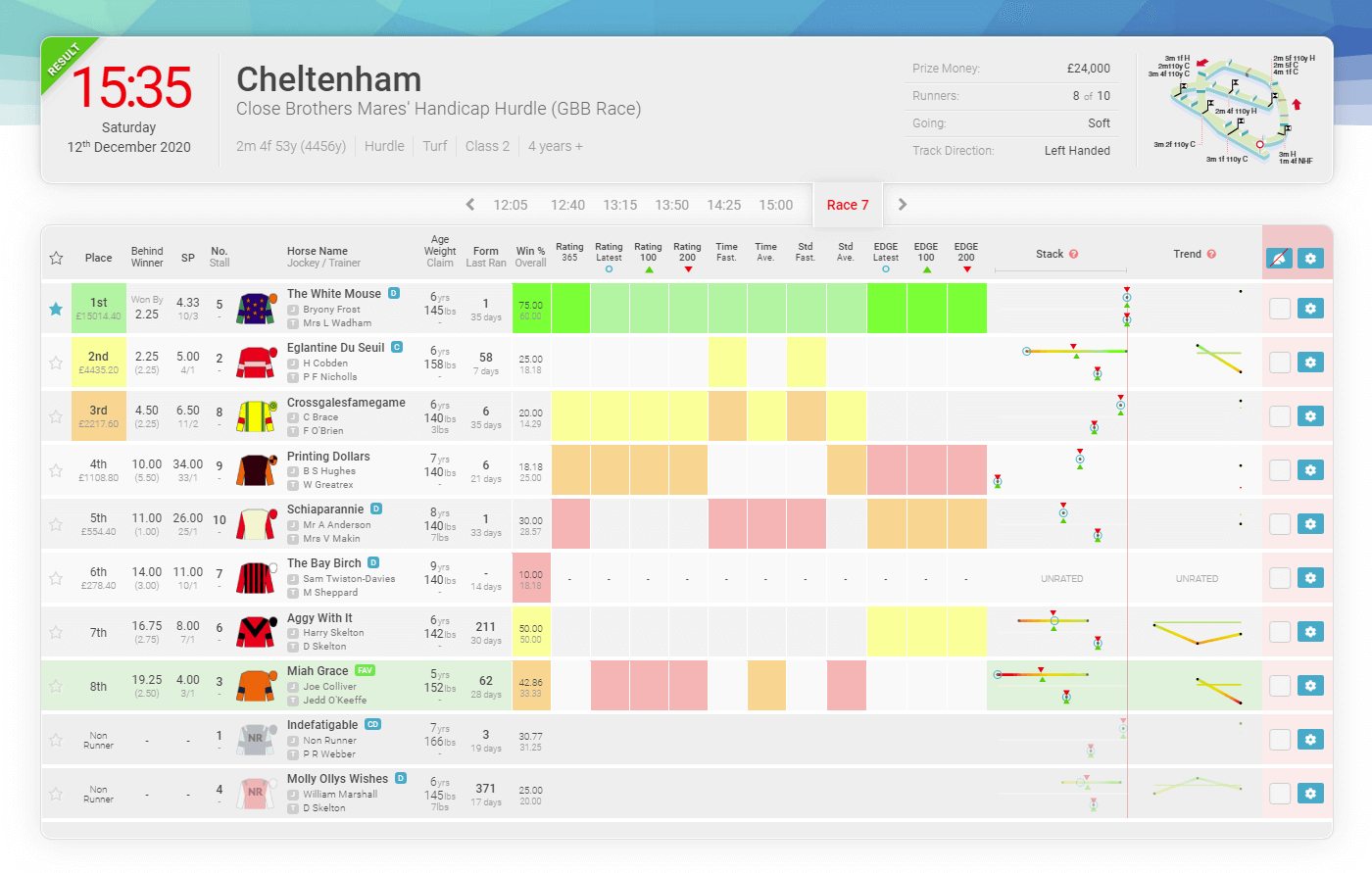
    Cheltenham - 2020-12-12 - 15-35
    Sample Race Card – Cheltenham, 12th December 2020 at 3:35pm

    It is not always the fastest horse that wins a race nor does it have to be. Some horses win races easily so do not run as fast as they could at the end of the race simply because they don’t have to. Well beaten horses will often leisurely cross the line in 10th place without a care in the world.

    Only good horses can run good times, but both good and bad horses can run bad times.

    The TrackMate Team

    In the scenarios above, no speed rating system can accurately rate this type of run.

    TrackMate speed ratings are no different and it would be ridiculous for us to claim otherwise. What we do claim however is that we believe that they are about as good as it gets.

    EDGE Ratings

    The last 3 boxes are the TrackMate Edge Ratings calculated using TrackMate’s unique algorithms.

    The TrackMate Edge Rating is the result of many years of development. The unique evolutionary algorithms run simulations with thousands, if not millions of iterations per race. Making EDGE a very powerful tool.

    The EDGE ratings are completely different from the speed based ratings and sometimes they will have conflicting assessments of a race. Being a form-based rating, the edge will sometimes find form lines that are better than the rest of the field but the speed ratings do not agree.

    EDGE Latest

    The most recent edge rating achieved.

    EDGE 100

    The Edge rating for the last 100 days.

    EDGE 200

    The edge rating over the last 200 days

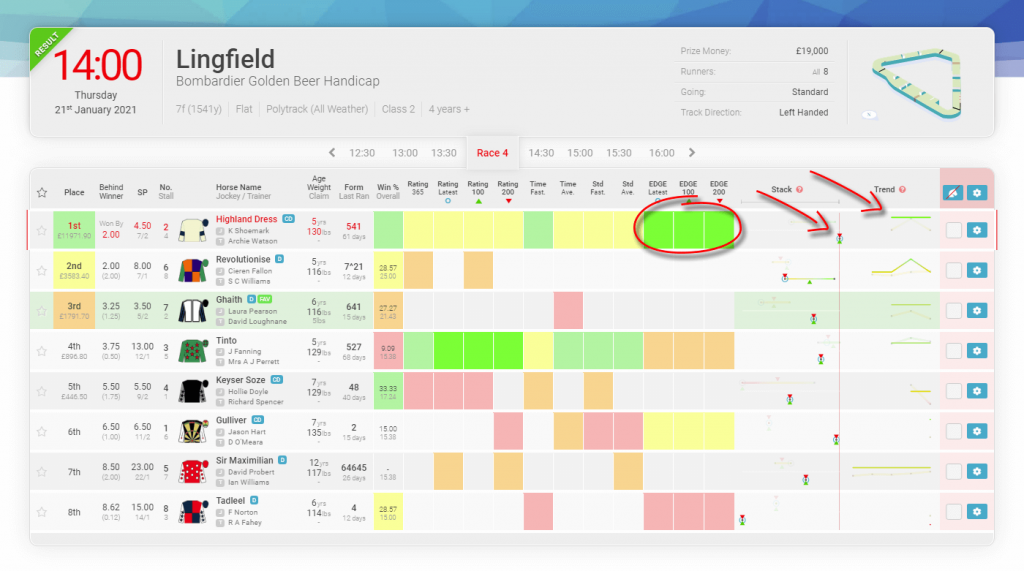
    Sample EDGE Rating - Clear Top - Lingfield - 2021-01-21 - 14-00
    Sample Race Card – EDGE Rating Clear Top

    The race card shows that the EDGE ratings have the winner “Highland Dress” as the clear top rated horse in the race. Ideally, we would look for some backup from good speed ratings but it is not always the case.

    Using the Stack and Trend are a couple of ways to back up the ratings.

    Interactive Ratings

    If you feel that one poor race is ruining a rating, the interactive race cards give you the ability to “forgive/ignore” this run by removing it from the race card. This will improve the rating.

    This feature is available by clicking on the trend point for the race you want to remove and then the remove race option is in the pop-up.

    Samples Trend Popup - Ignore Race - Trackmate
    Sample Ignore Race Filter

    Equally, if you feel that as a horse has had only one really good run this season which might be enhancing a rating then you can also remove that run and re-rate the race.

    You can also remove a runner from the race card completely as if it wasn’t running at all. Please see our Race Card Filter guide for more information on how to use the interactive race card options.