TrackMate ratings and going changes

Category: TrackMate News

  • TrackMate ratings and going changes

    TrackMate ratings and going changes

    The ground conditions for any race are the most important factor when deciding if you are to make an investment in your chosen race.

    If your horse is unlikely to act on the prevailing ground then you should not bet on it.

    The TrackMate ratings are calculated based on the prevailing conditions of each race.

    This is a very important feature of the TrackMate ratings and will save you an incredible amount of time when looking for a worthwhile investment.

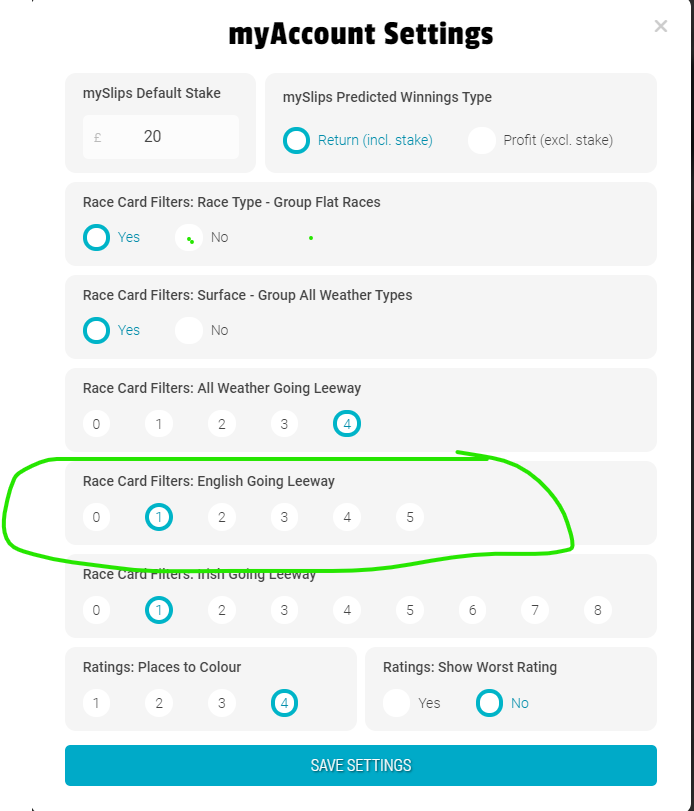
    The default settings for your racecards can be seen on your Myaccount page.

    These settings can be set to display any range of ground conditions you would like displayed on your racecards as default.

    For example:

    Todays ground conditions at Newmarket are described as ‘good’.

    The system will display form achieved only on…

    Good/Firm – Good – Good/soft

    If the horse has form on ground softer than ‘Good/Soft’ it will not be displayed as it is probably not relevant to today’s race.

    You can refine your ratings further if you so wish.

    For example, if the ground conditions are Good – Good/Firm in places you may want to re-rate the race without form on good/soft ground ?

    Equally, if you so wish you can see all form (Max last 8 runs in last 12 months) on all ground/Going conditions by setting your cards that way in your default settings in Myaccount or using your race card options.

    IMPORTANT NOTE:

    We strongly suggest you use the default settings for filtering going conditions.

    If you would like to refine or widen your ratings for ground / going conditions you can do so quickly and easily in the race card option tab on all race cards.

    Beware Going changes

    If you are taking your betting seriously and as we strongly suggest, utilising the TrackMate bet tracking software you should always be aware of the conditions of the days’ races and the potential for them to change, sometimes very quickly.

    It is not unheard of for a beautiful summer’s days and Firm racing ground to change to Soft ground in the space of a couple of hours!

    We strongly suggest that if at all possible you do not bet on these days.

    Horses are entered in races with ground conditions that are ‘expected’ but not guaranteed.

    So a horse entered on Good/Firm-ground on a Monday might be facing much softer ground by the time racing starts.

    The ground conditions are incredibly important when it comes to assessing the merits of your potential investments and you should always be aware of the prevailing conditions.

    The TrackMate ‘Race Factors’ gives you a quick view and assessment of all the runners’ abilities to act under the current racing conditions. Please see the Race Factor guide here.

    WARNING

    Changes in going will alter TrackMate ratings.

    As each race is individually rated to the current race conditions they will invariably alter if and when the ground conditions change.

    The ground conditions are updated periodically in the TrackMate system and will be updated as and when possible during racing.

    You should always double-check your selections before investing if there has been a change in the ground conditions.

  • Betting For Value

    Betting For Value

    If you are serious about making racing pay you should be betting for value.

    There should only be two reasons why you are betting on the horses and they are:

    1/ To have fun and enjoy the sport

    2/ To make money (or at least not to lose)

    In order to make money investing in horse racing the single most important thing you must do is bet for value.

    You should be looking for horses that look ‘Overpriced’

    It’s not the ‘Buzz’ of winning short-term that should get you excited but the expectation of building your bankroll in a steady and organised structure.

    The Math is important.

    Ok. So you have a really respectable strike rate of about 30%. That is a pretty impressive wine rate and not easy to achieve.

    The reality though, is that even with a strike rate as good as this, you are unlikely to be a long-term winner !

    Why ?

    Because unless you are regularly backing winners with a price of at least 3/1 and higher you will struggle to make a profit.

    That changes everything or at least it should.

    We are not saying that you should not back shorter-priced horses. What we do suggest though is that you monitor your win rates closely in order to find any potential leaks in your strategy

    By utilizing the TrackMate bankroll management and bet tracking software you can track your profit and loss, strike rates and win rates as well as your ROI.

    These stats are so important to your success and should be used religiously in order to maintain an accurate record of your bets and returns.

    It’s better to miss a winner than back a loser !

    Remember. You should be betting for value.

    It is very tempting to back the really well-rated horses regardless of price. They just look so good !

    But before you back that juicy-looking 2/1 favourite you need to know if it is a long term profitable play?

    What is your strike rate with horses in this price range?

    Is it high enough to warrant an investment or is it best to just let it run?

    By monitoring your ROI and win rates you will over time learn your most profitable angles and price ranges.

    So what should you be looking for when you are making your selections ?

    There are a few criteria that you should be looking for when making your selections.

    • Well rated horses – Use TrackMate ratings to find well-rated horses
    • Choose well-rated races. – Try to select horses in races with plenty of form on offer
    • Try to avoid ‘Dodgy’ races – Races such as Amateur jockey races should be avoided
    • Look for horses with all the race factors in their favour – Does your selection act under the prevailing conditions?

    Once you have made your list of selections we suggest you then check the prices on a site such as oddschecker or your betting exchange of choice.

    This is your opportunity to thin your list based on ‘VALUE’

    Is your 6/4 favourite really worth an investment or do you just let it run?

    Remember you need a very high strike rate to even have a chance of breaking even by backing 6/4 shots !

    We suggest that you try to make as many of your selections as possible Win/Place bets. You should aim for a minimum price of approx evs (2.0) as a target for your place bet and the best price you can achieve in the win market if you can achieve your place bet target.

    Betting for Value – Back to Win and Place for maximum profits

    The best way to profit from horse racing is to back your value selections to both Win and Place and preferably with a betting exchange to achieve the best prices available.

    There is nothing more frustrating than seeing your horses just getting beaten time after time so why not try to profit from these situations?

    Horse racing is after all not an exact science and we are after all dealing with animals!

    The margins between winning and losing are very often very small and you can often miss out by the smallest of margins. In these situations, we firmly believe that the way to combat this is to back as many of our selections with a minimum place price requirement.

    By betting this way and as long as your selections have a fairly good strike rate you will, more than often at least cover your win bet with the place bet.

    Very often, although small in terms of overall profit, the place side of the bet will be profitable in its own right and long term profits are very achievable just from the Place “savers”.

    Over time, this method will almost inevitably result in shorter losing streaks and steady long term profits.

    Use the extra place markets to reduce variance.

    We strongly suggest that you use a betting exchange for your horse racing betting. You are almost guaranteed to achieve much better value on your selections than you would with a bookmaker.

    One of the benefits of the exchanges is the ability to bet on your selections to place only.

    Very often you will find horses that can be backed at very good prices in the place market and we strongly suggest that you should be backing your horses to both win and place.

    Depending upon your level of “tolerance” to losing streaks it is a good idea to sometimes take a look at the extra place markets.

    The exchanges will usually have an extra places market which gives you the ability to cover your win bets with an extra place on offer.

    For example, a 10 runner race would normally pay 3 places. Very often there will be a 4 place market giving you the opportunity to cover your win bet with even less long-term risk.

    Treat your Place bets as full bets.

    When backing a horse to win and place we like to treat the place bet as a full bet rather than part of an E/W bet.

    So for example.

    You are currently staking £10 per ‘point’ on your selections on the betting exchange.

    Your selection is 6.0 (5/1) for the win and 2.2 (5/4) to place.

    You should back this selection £10 to win and £10 to place which is ‘2 points’

    If you are backing to win only you should be staking at 1% of current bankroll or 1 point.

    We strongly suggest that you have a bankroll of at least 100 points (bets) but preferably at least 200.

    A 200 point kitty will give you a bankroll of 100 win/place bets and should be comfortable with a good strategy and selection process.

    A more cautious approach to win/place staking.

    There is a more cautious approach to this form of betting. Remember you should always be betting for value.

    This method places more of your stake in the place market than the win market and the inevitable higher place strike rate becomes more profitable.

    The most common way to split these stakes are 60/40 – 70/30 – 80/20

    This approach is exactly the same as the straight win/place method but uses a slightly more cautious approach to the staking.

    When backing your value selections you should be looking for horses with prices from about 4/1 and higher. These selections will normally have a place price in the 1.8-2.0 + range.

    You will invariably get many more selections that place than win and you should stake accordingly.

    This will reduce your losing streaks and increase returns on your placed selections.

    When betting for value your aim should always be to keep losses to the minimum. By making your place bets as profitable as possible you will see long term growth in your bankroll.

    For example:

    Instead of staking £10 win and £10 place, you would stake £12 to place and £8 to win.

    The place side of these bets will win more often than the win side of the bet.

    This method will improve your place returns but slightly decrease your win returns.

    An even more cautious approach to your staking would be to use just one point per bet and ‘split’ the stake.

    So, when staking 1% of your total bankroll per bet you would just split the stakes as above.

    If your bankroll is £1000 and your stake is 1% or £10 you can split the £10 stake into

    £5 win and £5 place

    £4 win and £6 place

    £3 win and £7 place.

    This will obviously reduce the returns and increase the time it takes to grow your kitty but will be much easier to ‘handle’ the inevitable losing streaks you will encounter.

    Does it really matter how long it takes to grow your bankroll?

    The secret to enjoying your betting is comfort. You cannot and will not win if you are worried or stressed about your bankroll.

    Only bet what you are fully prepared to lose (all of it!)

    Stake your bets in such a way that losing runs are easy to handle and comfortable in terms of losses.

    Read all about losing streaks and how to handle them here.

  • Warning – New Flat season starts

    Warning – New Flat season starts

    BE CAREFUL !

    You may have read my previous post When seasons change. If not, it might be worth having a look as it is highly relevant to today’s post.

    This is a funny time of year and one of the times in a season to be very cautious with your investments.

    There are now a huge amount of horses that are starting their new flat turf racing campaigns and have no recent form.

    They are predominantly summer horses and have been trained specifically to run in the summer on turf.

    Many have not raced for the best part of six months and many will need the race to get to full race fitness, equally, others are coming to the end of both the winter all-weather racing and the National Hunt jumps racing season.

    It always takes time for the current seasons form to settle in.

    So What’s changed ?

    The the majority of flat turf races will now start to include horses with no recent form. This makes reading a race much harder.

    Other reasons why early season races should be treated with caution.

    • The horses that have been running all season in both National Hunt and All-Weather races will potentially be ‘over the top’ or basically, they have had enough for the season.
    • There will always be a well-rated horse in every race but not every race is worth a bet.
    • Many horses that are running in the next 4-6 weeks will improve for the run.
    • There will be many races with unrated horses that have yet to run this season.
    • All-weather form does not always translate well to turf form and vice versa.

    What should I do?

    Be careful!

    For the next month or so the flat turf season will be gaining momentum and there will be more and more relevant form for the system to devour and analyse as the days and weeks go by.

    We ALWAYS suggest that at the start of a new season bets should be kept to a mimimum in order to protect your bankroll.

    Weird things happen early in the season when there is little or no recent form.

    Be selective and protect your bankroll

    There is so much racing these days that you can afford to wait. Just because we rate every race does not measn we have to bet in every race.

    One of the hardest things to do is to pick which ones of the many well rated horses there will inevitably be on a daily basis.

    These are a few things you can do when making your decision whether to bet in a race or not.

    Is the race adequately rated?

    How many horses in the race are rated by TrackMate with preferably more than one recent outing?

    We suggest that any race should have a TrackMate rating for at least 2/3 of the field.

    Are any unrated horses prominent in the betting market?

    Unrated horses will always be a danger. More so when well fancied in the market. If unrated horses are in the top 2 in the market we suggest no bet or caution with staking. Maybe a place higher portion of your stake to place.

    Is your horse rated on recent form or older form?

    It is always worth noting how long your horse has been off the track. If there are fitness doubts, be careful. There is no form like recent form.

    What price is your selection in the market?

    We rarely put our members off backing selections at big prices. They do win sometimes!

    But…..

    Not many horses win at odds of over 25/1 and even these are fairly rare and definitely hard to find!

    When picking horses at long odds make sure you are happy to do so with the attached risk. They will not win very often.

    We have had winners at all sorts of crazy prices as have our members but it doesn’t happen very often and in this day and age the market really is a true indication of your horse’s chance of winning.

    The most profitable price range to be betting in is the 2/1 – 16/1 range and definitely to win and place if the place price allows it in terms of value. We try our hardest to make even money a minimum price on any bet we make.

  • TrackMate Warning System™

    TrackMate Warning System™

    The TrackMate Warning System identifies all races deemed as “High Risk” and flags them so you can immediately identify such races and treat them with caution.

    NEW TRACKMATE WARNING SYSTEM FEATURE IS COMING SOON!

    Races will be clearly indicated on the race card when implemented.

    There are no hard and fast rules. There will be plenty of well rated horses that win in all of the race types listed.

    Take extra care when selecting investments from race cards which have been identified as “High Risk”. Do a little extra research into your selection before jumping in.

    The TrackMate Team

    Risk is part of the game, but we try as often as possible to make sure we have the best chance of winning… regularly!

    We try to keep losses as small and infrequent as possible and one of the best ways to do that is to avoid “High Risk” races.

    Here are some of the factors the TrackMate Warning System analyses when identifying “High Risk” races:

    Low-Class Races – Class 6-7 (45-65 in Ireland)

    There is a lot of low-class racing in the UK and there are many more low-grade performers than high-class ones. These races are generally contested by poor quality horses. These animals are likely to be inconsistent and will rarely run two races alike.

    However, there are well handicapped horses out there as well as improvers and course specialists etc.

    Essentially you should be more selective if choosing to invest in this sort of race and we suggest you try to concentrate on very well-rated runners with one of the top jockeys riding who are more likely to get the best performance from the horse.

    “Selling & Claiming” Races

    A “selling race“, or seller, is one in which the winner is put up for auction immediately after the race.

    All of the horses in a Selling Race except the winner, which is auctioned on the racecourse, and all of the horses in a Claiming Race are able to be claimed at a value set against the horse by the trainer when making the entry.

    Usually fairly poor horses. Not really races to be investing in.

    Amateur Riders Races

    Very often both poor horses AND poor jockeys.

    Races with “Little or No Form”

    If a race has little or no form, the runners that are rated will obviously look better than they potentially are.

    Be careful, there can always be a better-unraced or un-rated horse in the mix. We have a top-rated horse who looks great, but can it beat a horse with no form at the top of the betting market? Is it worth the risk?

    Competitive “Big Field” Races

    We are not saying that you should not bet in big field races. There is an old saying in racing… “The bigger the field the bigger the incertainty” this can definitely be true. We just advise a bit of caution when looking at these highly competitive races.

    These races are very difficult to win and even more difficult to predict the winner.

    Races like these vary often have a significant draw bias and there are also many “bad luck” stories from runners who get blocked in their run.

    Again, we are not saying don’t bet in these races but if you do be aware that they are not easy to predict.

    Split stakes win/place or just wait for a better opportunity and enjoy watching the race. You might even find a future winner to stick in your notebook.

    Group 1 & Championship Races

    This might look like a strange one but is highly relevant.

    These days many of the big group races in both the Uk and Ireland have foreign horses running in them.

    These horses will be unrated if they haven’t run in the UK before. They are very difficult to rate against the European horses without the form from previous races.

    Be careful when looking at these races and note any unrated horses in the market for a clue to the chance it has in the race. Big races are also very highly competitive and are contested by only the top horses in the world. Again, not impossible but very hard to pick horses in these races.

    Hunter’s Chases

    Hunter Chases take place at national hunt racecourses, but are only open to horses that have hunter certificates.  Hunter certificates are issued to horses that have hunted for at least four days in the season before racing starts in January.

    National Hunt Flat Races (NH Flat)

    These are generally educational races for future jumpers. They are all young, immature and inexperienced horses.

    Jumpers Bumpers Meetings

    A recent innovation. These meetings are run on All-Weather tracks and were introduced to enable National Hunt horses to race when the weather has been bad and we have lost many meetings due to the weather.

    Definitely NOT races to be betting in.

    If you have any questions or comments with regards to the TrackMate Warning System or ratings click here to contact us and we will get back to you as soon as we can.

    TrackMate does not encourages reckless and unaffordable gambling. We recommend that readers who engage in gambling do so responsibly and set financial limits. If you have a concern about problem gambling, you can contact GamCare on 0845 6000 133 or gamcare.org.uk.

  • I’m NEW to Horse Racing & Confused… HELP!

    I’m NEW to Horse Racing & Confused… HELP!

    If you are new to horse racing and confused? Don’t be scared or intimidated… TrackMate is here to help you understand how to be successful using TrackMate’s Advanced Horse Racing Ratings.

    There has been a huge increase in interest in horse racing along with an increased presence on television. Anyone new to this incredible sport can be completely flummoxed by the task of unraveling a winner. Apart from the information provided by the excellent TV pundits, you have little or no idea where to start.

    Confused?

    Newcomers can be easily confused and find it hard to fathom out all the ins and outs. Only a few ever really take investing their hard-earned cash seriously.

    There is so much information available for you to make your choices it just gets so confusing.

    Race cards are available in newspapers, in the dedicated press, or online. Nobody ever teaches you how to read them properly and actually understand what they are telling you.

    The Old Days

    If you are not new to the game then you might remember the old days. When looking through the racing papers for form and information was so complicated it literally took years to interpret.

    It was the norm for punters to spend hours trolling through form books and stats trying to find an edge. The truth is only people in the know were really in with a chance of beating the bookies.

    When looking for help with making selections for horse racing there seems to be a huge amount of “experts” willing to share their knowledge with you… but at a price! Where is the fun in just getting a tip?

    Win or lose the real fun is the whole experience of making your selection and watching it run to see how well you and your selections have performed.

    Modern Racing Data

    Now in modern times there is just so much information and statistics! In fact maybe too much. There is so much data available to the racing enthusiast these days that it can sometimes have the same effect as the lack of data from many moons ago.

    The age of the computer has allowed us to go crazy with data and data-driven stats. Even though the availability of this data is great for some, for most of us it’s just too much information.

    So what do you do with all of this modern data? This is where TrackMate come to the rescue.

    TrackMate to the Rescue!

    The TrackMate Systems takes all of the information available and make thousands of calculations for each horse and every race. TrackMate does all the hard work so you don’t have to!

    There is no need to baffle punters with endless lists of numbers and stats to digest. Simply look at a TrackMate race guide and get all of that knowledge at a glance.

    The TrackMate Team

    All of the data analysed by the TrackMate rating algorithms are processed and displayed in an easier to understand format. Everyone understands a basic traffic light system. Green is go, amber is wait and red is stop. TrackMate’s Rating System uses a similar format. Green is good all the way to red which is bad. Ratings are then portrait in simple block form for the ratings and line graphs for the stack and trend.

    If you want to learn more about the ratings and their colours, read the post called The Ratings Explained.

    TrackMate has many more in-depth features that can be incorporated into your personal selection processes. As you learn to use the TrackMate Ratings System you will find these features amazingly easy to use. In no time you won’t be confused and will be using the interactive race guides quickly and easily to make your racing enjoyable and hopefully profitable.

    Easy to use, easy to understand and gain an EDGE that 99% of other punters do not have!

    The mere fact that you have taken the time to read this article shows that you are sensible enough to know that the best chance you have of enjoying horse racing is to try and get yourself an “EDGE”.

    TrackMate’s Ratings are integrated into our easy to read race cards. Quickly zoom in on the colour-coded likely contenders. It’s really simple to use… don’t be confused. Green is best and you want as many green ratings as possible. No endless lists of numbers and tables that make you go goggle-eyed after 5 minutes.

    Let’s have a look at a real TrackMate race card ratings…

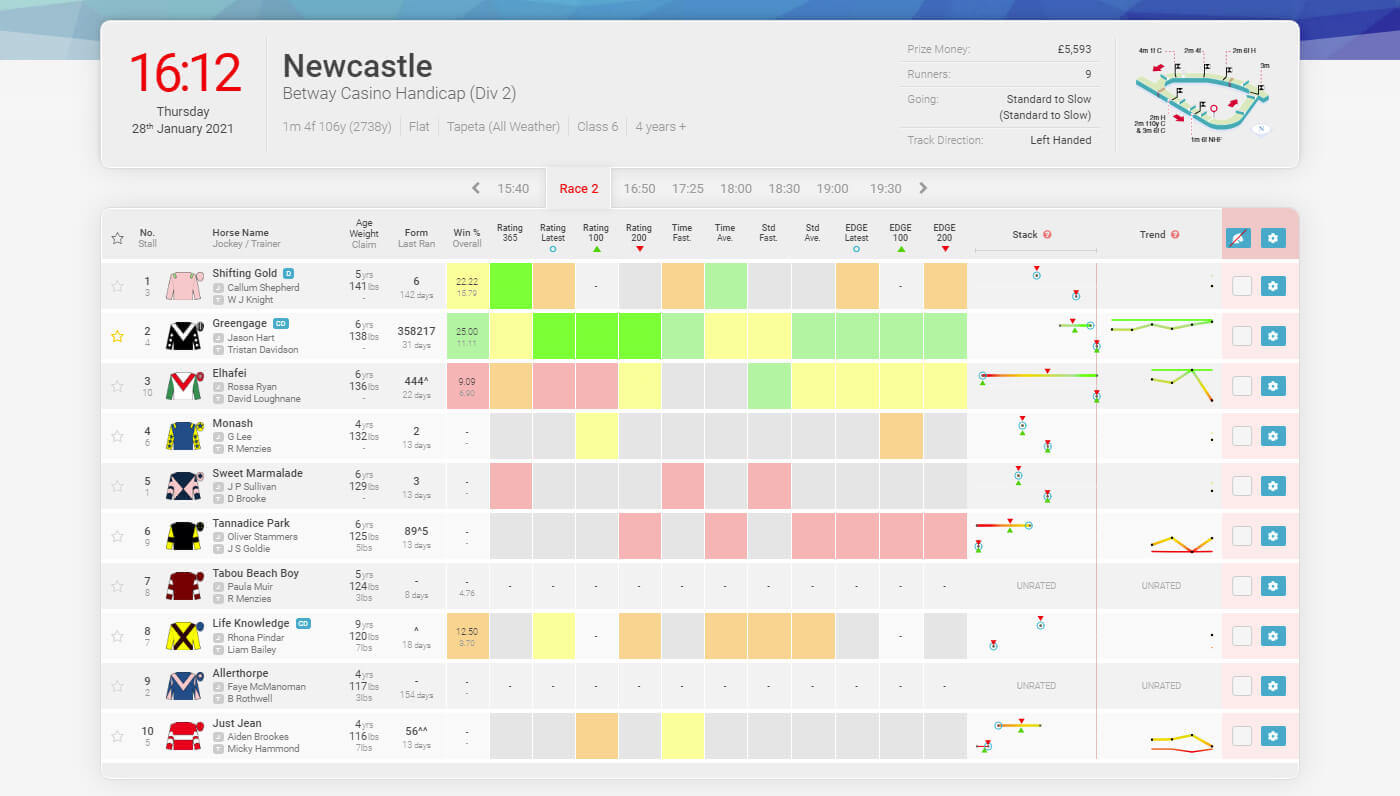
    This image is the race card from Newcastle on 28th January 2021 at 4:12pm. Let’s have a look at the colour-coded ratings… remember GREEN is GOOD and the more the better!

    Sample Green is Good Ratings (Before Race) - TrackMate
    TrackMate Race Card showing lots of Green – Newcastle, 28th January 2021 at 4:12pm

    You can see from the above race card that the horse “Greengage” has lots of green… green is even in the horse’s name!

    • 9 green ratings (3 are clear top rated)
    • 3 yellow ratings (which is the second best rating)
    • The stack and trend also have lots of green

    So looking at this race only using the colour-coded ratings, you could expect “Greengage” to be a good contender.

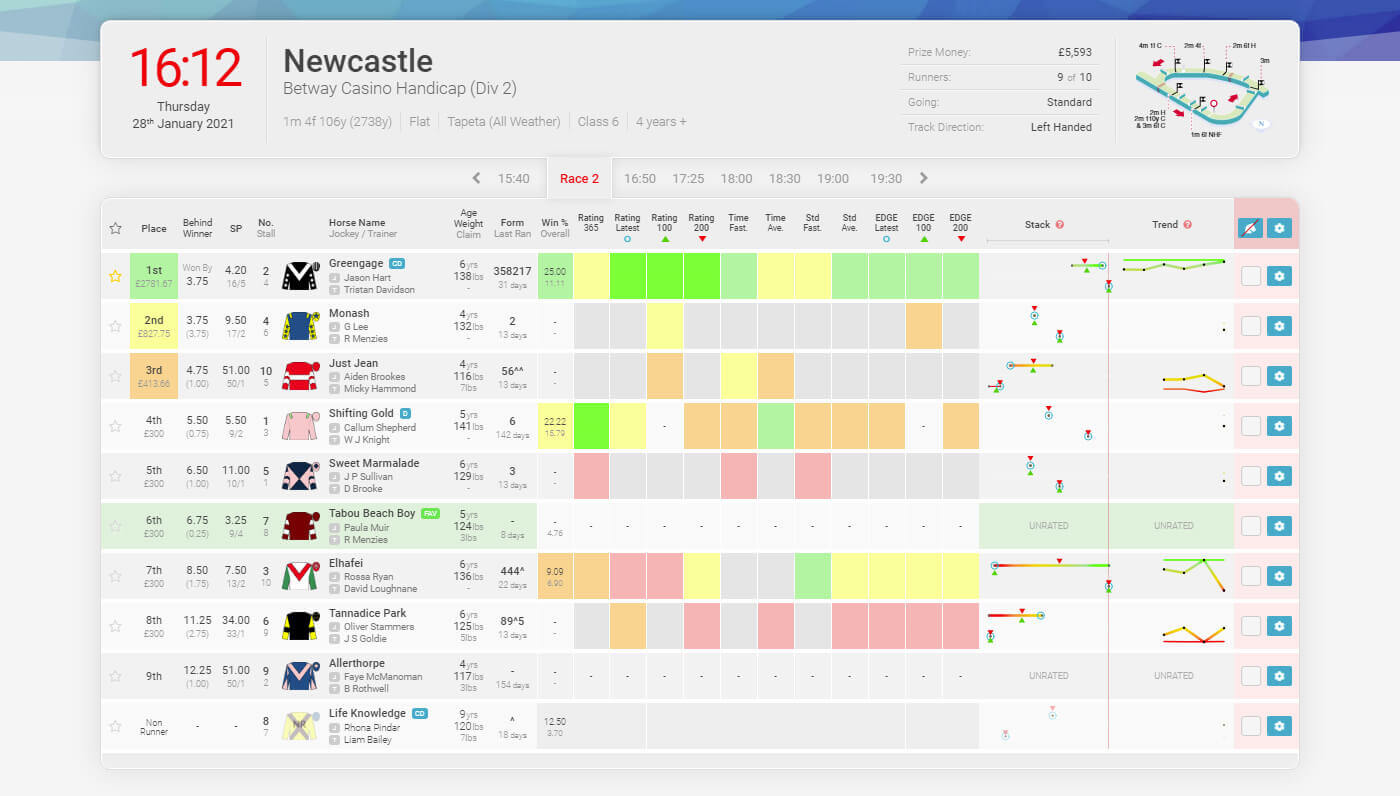
    Now let’s see how it ran… The image below is the same race card but from after the race had run.

    Sample Green is Good Ratings (After Race) - TrackMate
    TrackMate Race Card after the race – Newcastle, 28th January 2021 at 4:12pm

    Wouldn’t you believe it… “Greengage” actually won the race! On this occasion TrackMate identified the winner perfectly. At the same time made the race card easy to understand so you could select the eventual winner.

    Did you also notice that “Tannadice Park” was heavily red rated (red identifies the worst ratings). You don’t always back a horse to win, there are plenty of different types of bets you could wager on. On this occasion the TrackMate Ratings System also identified a good horse to back to NOT win.

    Conclusion

    Obviously just because a horse has lots of green ratings doesn’t mean it is always going to win. TrackMate, time after time, identifies potential winners and gives you an easy to understand way of selecting contenders.

    It doesn’t matter whether you are new to racing and confused or a well oiled “old timer”. With TrackMate you have found the best ratings system available anywhere to help you gain your edge.

    TrackMate’s race cards are the easiest to read and the most accurate ratings you are likely to find. Years of endless development and our unique algorithms give you the most powerful rating system available anywhere today.

    Take the stress out of horse racing is to make it about having fun and not winning money. The money may come or not but by visiting this page it shows you are at least willing to learn. Make your bets affordable, in other words if you do lose it doesn’t matter. There will always be another race to bet on.

    Please ALWAYS remember… if you have or think you might have any issues with gambling PLEASE STOP. Do not join TrackMate and please get some help as soon as possible.

  • Should I bet to Win, Place or Both?

    Should I bet to Win, Place or Both?

    When thinking about what to bet on… DO NOT bet on ANTHING unless you can afford to. Betting on horses should be fun and pressure free. If it is not then please do not bet at all.

    There are no rules when it comes to how you should invest your hard-earned cash when having a bet.

    We strongly believe, the only real way to have any chance of making a profit, is to have a solid staking plan and proper bankroll management.

    It also helps to have a great rating system such as TrackMate to steer you in the right direction when deciding what to invest in.

    Here’s what this page will discuss:

    Win or Place?

    We have many members who bet in all sorts of different ways in order to gain an edge when backing horses.

    Some back mostly “place only” and prefer lower returns but with more consistent and regular “winning” bets. Others bet “win only”, preferring to have slightly lower strike rates but larger returns. Both methods will work and can be very profitable if staked correctly.

    At TrackMate we like to mix it up a bit and we use a combination of the above when making our investments.

    Our standard stake is 1% of our current bankroll with incremental stake increases at pre-set targets. We also set minimum price targets for our investments. For us, this is a minimum price of 2/1 (3.0) on Win bets and Evens (2.0) for Place bets. We have more information on these methods if you read the bankroll management article.

    Win Only Bets

    Many people prefer to only place “win only” bets. This is fine as long as you are staking properly and your bankroll and you can handle long losing runs. This will happen and you need to be prepared.

    We suggest that you place “win only” bets when the selection is too short (low odds) in the market and there is no value in a place bet. Normally these selections will fall into the 2/1 – 4/1 price range.

    Once the price of your selection reaches 4/1 and above you might decide that “win & place” is the way to go.

    Place Only Bets

    There are more options for punters available these days and the betting exchanges are a good option for using a more cautious approach with your bets.

    The number of runner in a race determines the number of places that will be paid. 7 or less runners will normally pay out for top 2 places. 15 or less will normally pay out on the top places. Over 15 runners normally pays out on the top 4 places.

    The ability to back horses to “place only” gives us the opportunity to play a more cautious game when protecting our bankroll.

    Win & Place Bets

    If you think your selection can win the race and the price offered is large enough you might decide to back your selection both to “win” and to “place”.

    This is similar to an “each/way” bet except that if you so desire you can place more on the place side of the bet than on the win side. Potentially locking up a profit as long as your selection places.

    For example:

    If your stake is £5 (recommended with a £500 bankroll) A more cautious approach to backing your 10/1 shot would be to stake £3 to place and £2 to win. You can change the ratio to suit your style of betting. Maybe 80/20 or 70/30 suits you more.

    myTrackMate Profit & Loss Statistics

    Remember you can follow your stats and your “profit & loss” figures in your myTrackMate page where your stats are automatically updated daily.

    This is an incredible tool for you to monitor your bets, streamline your betting techniques, and spot leaks in your strategy. Just add the odds taken and your stake and TrackMate will do the rest! You can read more about how myTrackMate works here.

  • Be Cautious When Seasons Change

    Be Cautious When Seasons Change

    Unless you are new to this wonderful sport then you will be aware that there are two definite seasons to the horse racing calendar. Each of which is preceded by a “settling in period”. This period is dangerous to all punters and should be treated with caution.

    Table of Contents:

    Summer Season

    You will see three types of racing during the summer season which kicks of in April with the early flat turf racing and end in November. Here are the types:

    • Flat Racing on Turf (Flat)
    • All-Weather Flat Racing (AW)
    • Summer Jumps Racing (National Hunt / NH)

    The Change-Over Period

    As mentioned the summer season for flat turf racing starts in April and runs until November (a long summer!). This means that for the early part of the season (at least 4 weeks) the ratings will be few and far between and form will be limited until the majority of horses have started running on a fairly regular basis.

    The TrackMate ratings are predominantly based on recent form and the more form the system has the better and more accurate the ratings will be.

    We understand this can be frustrating but it is very important we make use of this time by making notes, tracking horses who run well and maybe going over historical races and test your ratings systems on past races. This is a great way to get a feel for the race cards and ratings for reading future cards.

    There is no point in backing a horse in an 8 runner race when only 2 of the runners have any recent form. You do not know how fit the horses are and generally, horses will improve for their first race and sometimes will not reach peak race fitness for at least a couple of races. When looking to invest in a race you should make sure there is enough available form to make a reasonable assumption that most of the horses in the race have valid rateable form.

    We generally advise that it is best to only back horses after they have had at least 2 runs during the current season. This will normally mean they are fit and raring to go and there will be meaningful form to compare with the other runners in the race. This is not a rule though. Quite often horses are fit and ready when the season kicks off and if this is the case then a well-rated horse might well be worth considering if its first run of the season is trustworthy in the context of the race you are looking at.

    Change-Over Danger Periods

    These are times of year to be cautious… read on to learn why for each type.

    Flat (Turf)

    Early Season – April / May:
    • Lack of current form for flat turf analysis
    • Horse race fitness concerns
    Late Season – Oct / Nov:
    • Inconsistent ground conditions
    • Horses who have “Had enough” or gone over for the season

    National Hunt (Jumps)

    Early season – Oct / Nov:
    • No real form yet for analysis
    • Race fitness concerns
    Late season – April / May:
    • Horses who have “Had enough” or gone over for the season
    • Poorer quality “summer” jumpers starting to appear.

    Every race is different but we should be aware that the more races we choose to invest in that have little or no form will only harm our strategy in the long run. It is not a winning strategy. There is so much racing available to us these days that patience will always be rewarded.

    Be as selective as you can when there are lots of races to choose from.

    Use sensible bankroll management and you will reap the long term rewards. Start “gambling” on races with no recent form and you will quickly become disillusioned with the whole thing and just make more mistakes.

    Be aware of the time of year and make your investments with that knowledge firmly at the front of your decision making process.

    Winter Season

    The national hunt season starts for real at the beginning of November and runs until the end of April. There are two types of racing in the UK during the winter months:

    • National Hunt Racing (Jumps)
    • All-Weather Racing (Flat – Artificial Surface)

    It is a similar story to the flat racing in the summer. At the start of the season the vast majority of horses will need their first couple of runs to reach peak race fitness. There is no need to jump in early and start betting in races with no form. Wait, watch and enjoy the spectacle until there is plenty of form available for you to use your edge.

    All Weather Racing

    We are very fortunate that we have a full and regular schedule of all-weather racing in this country. These tracks race all year round and have some good quality racing to keep you amused during the “off-peak” periods for turf racing. This type of racing can be very profitable. Generally, especially during the winter months, the same group of horses tend to run on the same tracks. This makes it easier to get a grip on the form and can be very profitable. Some of the big yards now regularly send quality horses to the better meetings and most All-Weather tracks offer very fair surfaces that tend to suit most horses.

    There are similar periods of time to be a little cautious with the all weather ratings and form.

    Early season – Nov / Dec

    From about November through to December the new batch of winter all-weather horses start to appear. Some of them will be fit from the flat but this also means that they might be a little “jaded” after a long season. Fresher horses that have been prepared for a winter all-weather campaign will be in the same position as the flat turf horses in the spring and will need a little time for the form to settle down.

    Late season – April / May

    Many trainers will send their horses to the local All-Weather track early in, or just before the start of, the new season to warm them up for the coming months. This can be a difficult time of year for the punter as these horses coupled with the ones who have now passed their best and are thinking of their summer break make reading races a lot harder. So please be careful.

    Conclusion

    Always know your seasons. Also what period you are in of that season. Early or late can make a difference to performance. Being caution in these seasons can help you make the right choices at the right times.