The Stack Explained

Tag: Stack

  • The Stack Explained

    The Stack Explained

    One of the most exciting features of the TrackMate rating system is the stack. An incredible tool for the speedy analysis of the ratings in relation to the other runners in the race. It has many uses and can be an incredibly powerful tool when analysing races. There is a stack for both sets of ratings on every race card.

    On this page you will find explanations for the following:

    The “Stack” is a graphical representation of each horse’s range of performance from the qualifying form.

    • The top stack is speed ratings and is a thicker line.
    • The bottom stack is EDGE ratings and is a thinner line.

    Both stacks have the same rating markers for each horse’s qualify form.
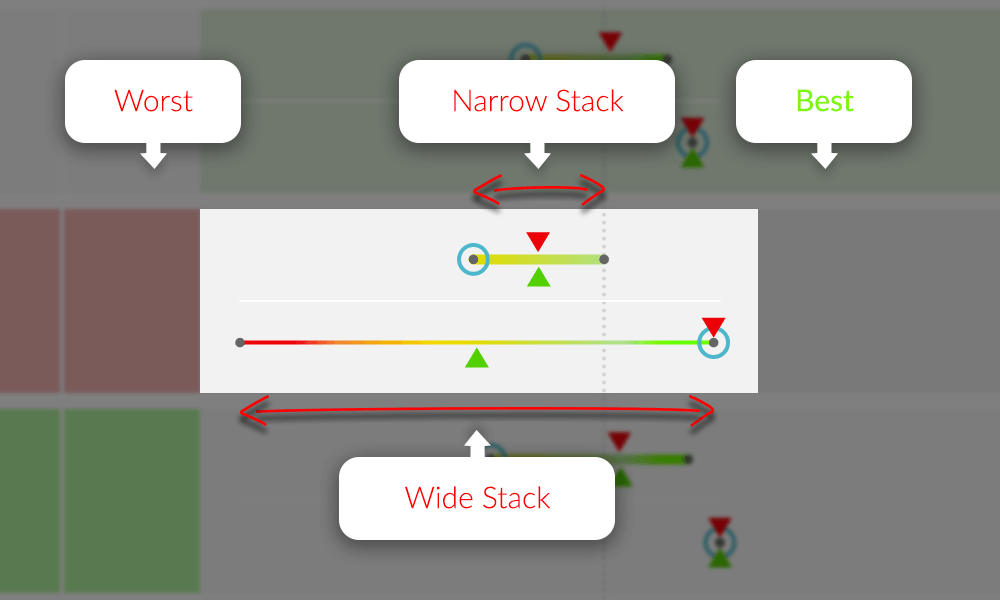
    Sample Stack - TrackMate
    Sample “Stack” – Showing 100, 200 and most recent ratings and the range between worst and best.

    Range of Performance

    The narrower the line is, the more consistent the horse has been as the range between worst and best is less.

    The wider the line, the less consistent the horse has been as the range between worst and best is greater.

    Worst Rating

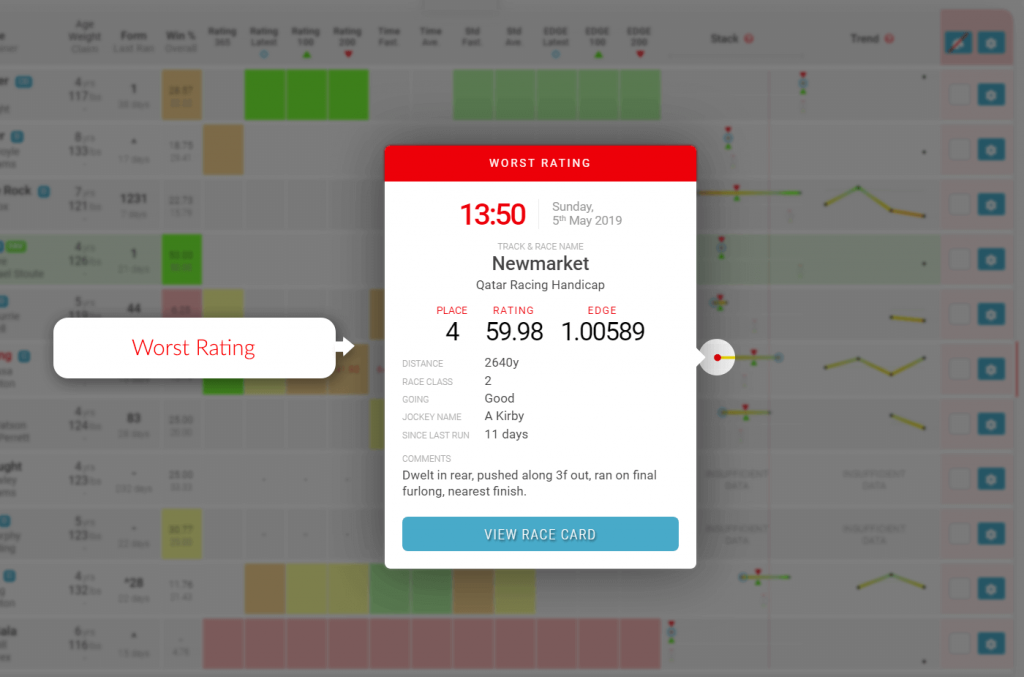
    The dot on the far left of each horizontal line is the horses worst rating for the qualifying form period.

    Best Rating

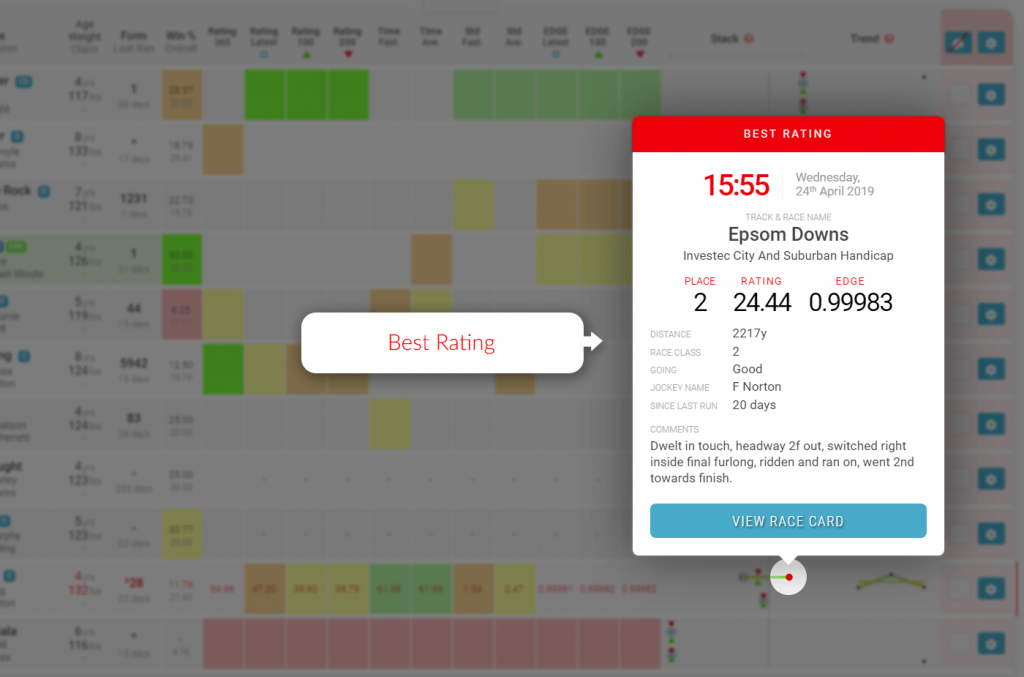
    The dot on the far right of each horizontal line is the horses best rating for the qualifying form period.

    100 Day Rating Icon

    The green triangle is the average speed rating for qualifying races for the last 100 days.

    200 Day Rating Icon

    The red triangle is the average speed rating for qualifying races for the last 200 days.

    Latest Rating Icon

    The blue circle is the rating for the last qualifying race.

    Vertical Guide Line

    There is a vertical guide line feature that appears when you hover over the grey guide bar under the stack column title. The line will be red when active as you move left and right over the guide bar. It will then stop moving and change to a grey dotted line when you move off the guide bar.

    This line is extremely useful to get a vertical comparison between all runners stacks in the race making it easier to visualise where the stacks and icons are in relation to each other.

    Great Stacks

    The stack can identify opportunities where horses could be deemed as well above the standard of the rest of the field.

    Here are two example of how to identify a “great stack”
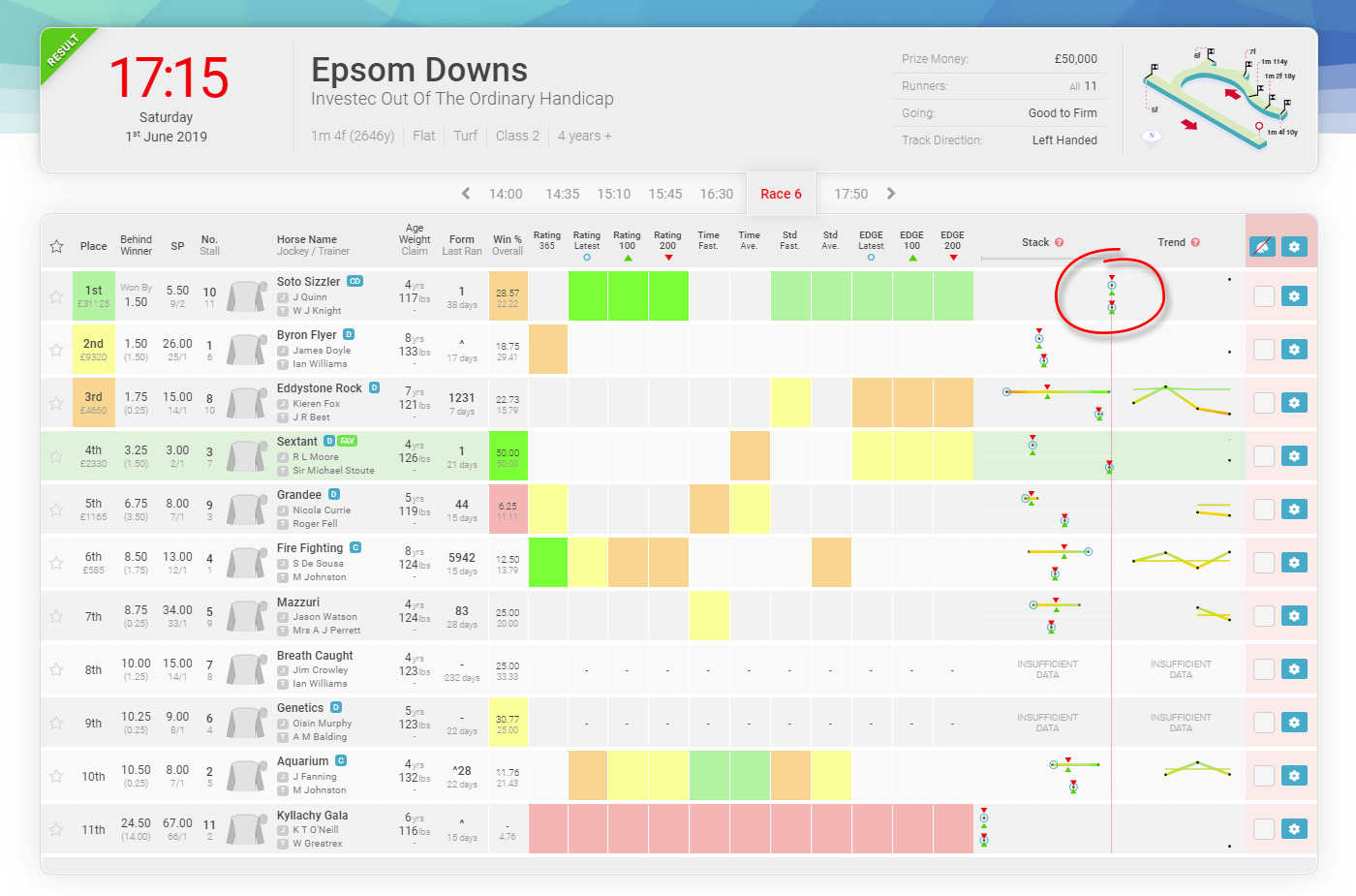
    “Great Stack” Example 1 – 1st June 2019, Epsom Downs at 5:15pm

    In this example 1, you will clearly see that the stack for Soto Sizzler indicates that his form is way out in front of the rest of the field in both Speed and EDGE ratings.
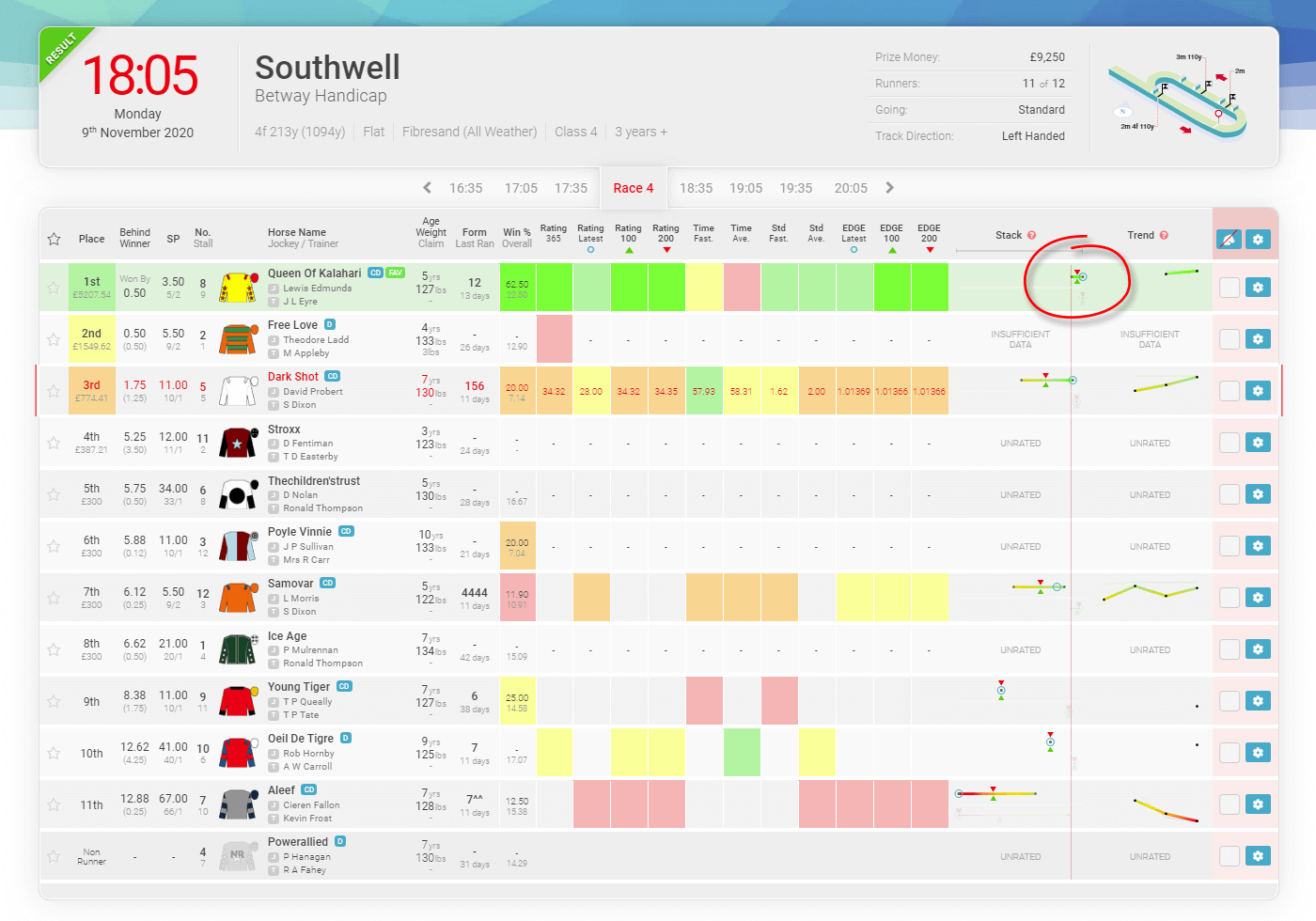
    Sample Great Stack - 2020-11-09 Southwell at 18.05 - TrackMate
    “Great Stack” Example 2 – 9th November 2020, outhwell at 6:05pm

    You will see in example 2 that Queen Of Kalahari’s “worst” run is as good as any of the other runners “best” run and its best run is clearly best of all.

    The stack can also be used to find “poor value” horses and opportunities to “Lay” horses on the exchanges.

    Stack Point Information Popup Examples

    Latest Rating (blue circle)
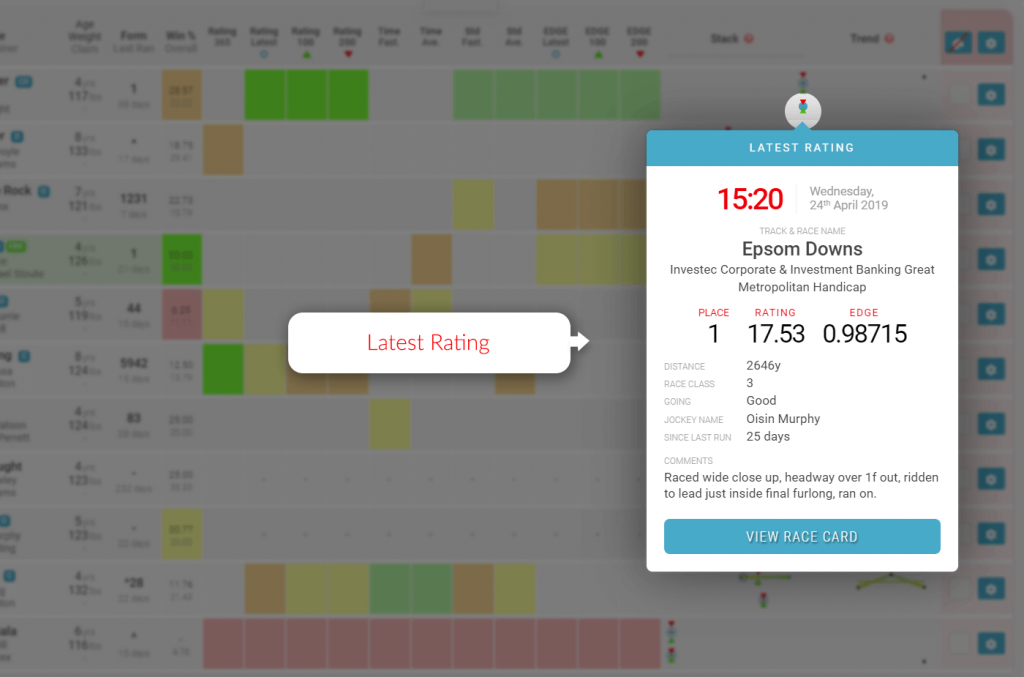
    Samples Stack Popup - Latest Rating - Trackmate
    Sample Stack Point Information Popup – Latest Rating

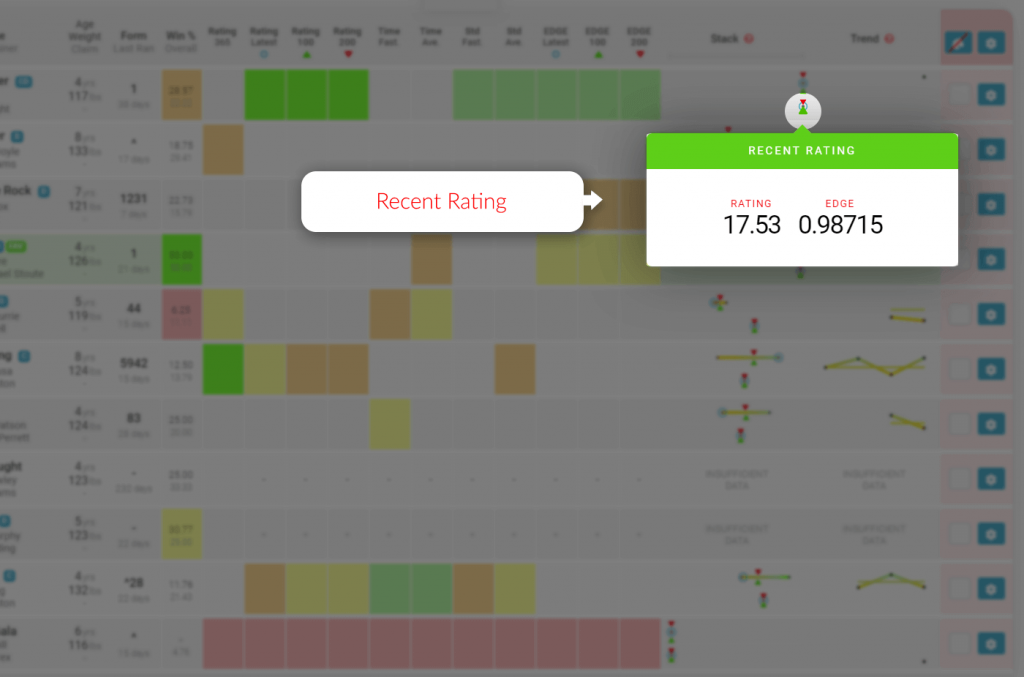
    100 Day Rating (green triangle)

    Samples Stack Popup - Recent Rating - Trackmate
    Sample Stack Point Information Popup – Recent Rating

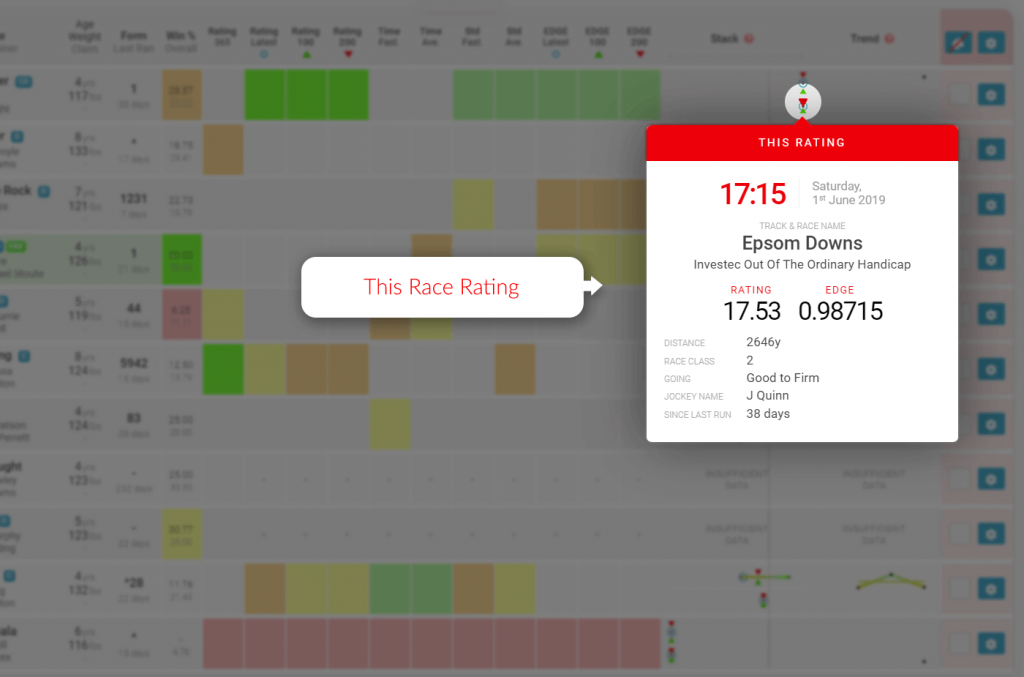
    200 Day Rating (red triangle)

    Samples Stack Popup - This Rating - Trackmate
    Sample Stack Point Information Popup – This Rating

    Best Rating (far right dot)

    Samples Stack Popup - Best Rating - Trackmate
    Sample Stack Point Information Popup – Latest Rating

    Worst Rating (far left dot)

    Samples Stack Popup - Worst Rating - Trackmate
    Sample Stack Point Information Popup – Latest Rating
  • How does TrackMate Work?

    How does TrackMate Work?

    The TrackMate race guides have been designed in such a way to be easy to read and easy to understand. Below are some examples of real race card ratings and how to easily start to pick winners.

    Rating Colours Explained

    We need to start with explaining what the rating colours mean before trying to explain anything else:

    Clear Top
    Top Rated
    2nd Rated
    3rd Rated
    4th Rated
    Rated Last
    No Colour
    Non-Runner
    Not Rated

    Now you understand what the different colours represent… let’s move on.

    How should I be using TrackMate?

    There are many ways to use the TrackMate system and many ways to read the “picture” created by the colour-coded ratings integrated into the card.

    It can be used as your only method of selection or in conjunction with your own race reading abilities and knowledge of form. Both are extremely powerful.

    Remember, you do not have to bet in every race.

    The TrackMate Team

    Waiting for the right opportunity and most importantly, waiting for value is the key to success.

    Here are some examples of the type of picture you may come across:

    The “Messy Race”

    Sample Messy Race - 2019-08-03 Hamilton 17.50 - TrackMate
    Sample “Messy Race” – 3rd August 2019, Hamilton at 5:50pm

    In this race card example, you can see that the colours (ratings) all over the place. Nothing stands out as any better than the others because the colours are spread out across all of the runners.

    With this type of picture we would normally just move on to the next race… but is it worth a closer look? There might be an opportunity lurking somewhere. We are looking for a well-rated horse that represents good value.

    Can we clean up/filter the card and spot some value?

    Possible ways to clean a messy card:

    • Remove poorly rated horses from the ratings.
    • Check the going settings in the Race Card FIlter match today’s conditions.
    • Rate less runs. You can rate 3, 5 or 8.
    • Filter the remaining runners for Surface, Ground and Distance perhaps?

    If after exhausting all options you do not find an obvious or good value selection just move on to the next race.

    You do not need to find lots of selections. Just well rated and good value ones. If there are none that day, be patient, there will always be another race and another… and another!

    The “Standout Selection”

    You will see from this race card picture that there is an obvious contender. It is not hard to spot… green is good!

    Sample Stand Out Race - 2021-01-20 Southwell at 18.00 - TrackMate
    Sample “Standout Selection” – 12th December 2020, Cheltenham at 3:35pm

    The obvious horse to choose in the race above was “Bay Of Naples“. This picture indicates that the horse is:

    • Clear top-rated in “Rating 365”, “Rating Latest”, “Rating 100”, “Rating 200”, “Edge Latest”, “Edge 100” and “Edge 200”.
    • Top rated in “Win %”, “Fastest Standard” and “Average Standard”.
    • The stack best rating is top as is the stack latest.
    • The trend is improving/consistent.

    Everything you want in an investment based on the TrackMate ratings.

    The “Value Bet”

    Sample Value Bet - 2021-01-09 Kempton at 15.30 - TrackMate
    Sample “Value Bet” – 20th January 2021, Southwell at 6pm

    In theory all your bets should be value bets. The race example above is from this year’s ultra competitive Lanzarote hurdle and amazingly the winner “Boreham Bill” was totally unfancied at an incredible price of 66/1 and even bigger on the exchanges!

    In a scenario like this we would prefer the 80% to place and 20% to win staking strategy.

    In a big race like this one you will be able to obtain prices for as many as 6 places on the exchange.

    The “Lay Bet”

    Sample Lay Bet - 2019-01-05 Kempton at 17.15 - TrackMate
    Sample “Lay Bet” – 5th January 2019, Kempton at 5:15pm

    To those of you already familiar with the betting exchanges you will be aware of laying horses. It is essentially acting as the bookmaker and laying odds against the horse winning.

    In the above example the favourite “Luxford” looks like terrible value based on the TrackMate ratings and could potentially be the sort of horse you might want to lay on the exchanges.

    ALWAYS be cautious when using this function on an exchange. Make sure you understand betting exchanges before you attempt to lay horses.