
TrackMate Warning System™

Tag: Ratings

  • TrackMate Warning System™

    TrackMate Warning System™

    The TrackMate Warning System identifies all races deemed as “High Risk” and flags them so you can immediately identify such races and treat them with caution.

    NEW TRACKMATE WARNING SYSTEM FEATURE IS COMING SOON!

    Races will be clearly indicated on the race card when implemented.

    There are no hard and fast rules. There will be plenty of well rated horses that win in all of the race types listed.

    Take extra care when selecting investments from race cards which have been identified as “High Risk”. Do a little extra research into your selection before jumping in.

    The TrackMate Team

    Risk is part of the game, but we try as often as possible to make sure we have the best chance of winning… regularly!

    We try to keep losses as small and infrequent as possible and one of the best ways to do that is to avoid “High Risk” races.

    Here are some of the factors the TrackMate Warning System analyses when identifying “High Risk” races:

    Low-Class Races – Class 6-7 (45-65 in Ireland)

    There is a lot of low-class racing in the UK and there are many more low-grade performers than high-class ones. These races are generally contested by poor quality horses. These animals are likely to be inconsistent and will rarely run two races alike.

    However, there are well handicapped horses out there as well as improvers and course specialists etc.

    Essentially you should be more selective if choosing to invest in this sort of race and we suggest you try to concentrate on very well-rated runners with one of the top jockeys riding who are more likely to get the best performance from the horse.

    “Selling & Claiming” Races

    A “selling race“, or seller, is one in which the winner is put up for auction immediately after the race.

    All of the horses in a Selling Race except the winner, which is auctioned on the racecourse, and all of the horses in a Claiming Race are able to be claimed at a value set against the horse by the trainer when making the entry.

    Usually fairly poor horses. Not really races to be investing in.

    Amateur Riders Races

    Very often both poor horses AND poor jockeys.

    Races with “Little or No Form”

    If a race has little or no form, the runners that are rated will obviously look better than they potentially are.

    Be careful, there can always be a better-unraced or un-rated horse in the mix. We have a top-rated horse who looks great, but can it beat a horse with no form at the top of the betting market? Is it worth the risk?

    Competitive “Big Field” Races

    We are not saying that you should not bet in big field races. There is an old saying in racing… “The bigger the field the bigger the incertainty” this can definitely be true. We just advise a bit of caution when looking at these highly competitive races.

    These races are very difficult to win and even more difficult to predict the winner.

    Races like these vary often have a significant draw bias and there are also many “bad luck” stories from runners who get blocked in their run.

    Again, we are not saying don’t bet in these races but if you do be aware that they are not easy to predict.

    Split stakes win/place or just wait for a better opportunity and enjoy watching the race. You might even find a future winner to stick in your notebook.

    Group 1 & Championship Races

    This might look like a strange one but is highly relevant.

    These days many of the big group races in both the Uk and Ireland have foreign horses running in them.

    These horses will be unrated if they haven’t run in the UK before. They are very difficult to rate against the European horses without the form from previous races.

    Be careful when looking at these races and note any unrated horses in the market for a clue to the chance it has in the race. Big races are also very highly competitive and are contested by only the top horses in the world. Again, not impossible but very hard to pick horses in these races.

    Hunter’s Chases

    Hunter Chases take place at national hunt racecourses, but are only open to horses that have hunter certificates.  Hunter certificates are issued to horses that have hunted for at least four days in the season before racing starts in January.

    National Hunt Flat Races (NH Flat)

    These are generally educational races for future jumpers. They are all young, immature and inexperienced horses.

    Jumpers Bumpers Meetings

    A recent innovation. These meetings are run on All-Weather tracks and were introduced to enable National Hunt horses to race when the weather has been bad and we have lost many meetings due to the weather.

    Definitely NOT races to be betting in.

    If you have any questions or comments with regards to the TrackMate Warning System or ratings click here to contact us and we will get back to you as soon as we can.

    TrackMate does not encourages reckless and unaffordable gambling. We recommend that readers who engage in gambling do so responsibly and set financial limits. If you have a concern about problem gambling, you can contact GamCare on 0845 6000 133 or gamcare.org.uk.


  • Daily Contenders

    Daily Contenders

    This is a list of possible contenders we have picked for today’s races. They have been identified solely using TrackMate’s colour-coded ratings and graphical tools available to all members.

    These contenders are purely intended as an insight into how to read the race card ratings on TrackMate’s system. They are NOT tips or any kind of inside information. So must be treated as just a starting point to help guide you towards reading the ratings for yourselves.

    They should run well though!

    Further explanations on our race guides, ratings and strategies are available on our Guides & Instructions pages. You are also welcome to contact us using our contact form at any time with any questions you may have.

    We are a form guide and ratings service… NOT Tipsters!

    We provide an incredible tool and our unique ratings are integrated into the race cards. This enables members to quickly and easily spot which horses to concentrate on when making their selections for the day.

    The ratings are simple to read and we have extensive TrackMate guides available to help you to learn how to utilise TrackMate to its fullest and understand how you can pick winners.

    There is a lot of racing these days providing us with plenty of opportunities to find profitable bets… so we should be as selective as we can.

    We rate every race, every day so nearly all of these contests will give you a horse that looks like the best in the race. This does not mean you have to back them all.

    Very often the hardest thing when backing horses is deciding which ones to invest in. With up to 60 races a day it can sometimes be very hard to decide. There will often be quite a few horses that look worth an investment.

    If you haven’t looked already you can view today’s contenders here.

  • Don’t Over Complicate Things

    Don’t Over Complicate Things

    TrackMate has been designed to make your selection process quick and easy whether you are new to horse racing or a seasoned pro. To help make sure you don’t over complicate your selection process.

    Many services that offer similar platforms to TrackMate are often so desperate to impress that they invent new ways of representing what is essentially the same information with a new name.

    They publish confusing lists of numbers. Statistics that are nearly always unnecessary and time-consuming to digest and therefore just complicate things.

    At TrackMate we keep what is an incredibly complex ratings system simple.

    TrackMate’s ratings and visual aids are integrated into our unique race guides so each and every race can be assessed within seconds.

    Anything Can Happen!

    There are literally hundreds of variables in the preparation of a race horse. It starts with the trainer and the stable staff:

    • Have they done their job well?
    • Is the horse ready to race?
    • Is it fit?
    • Has it had any problems with its training schedule?
    • How much does it weigh?
    • Did it eat its breakfast this morning?
    • Did it have a good journey to the track?
    • The list goes on and on…

    The truth is, the vast majority of these factors must be taken on trust. It would be almost impossible for anyone to take all of these factors into consideration.

    Horse racing is a very expensive business to be in. Owners and Trainers do not send their horses to the track unless they are in good enough condition to do themselves justice in the race and stay fit and injury free.

    Contrary to popular belief, and we speak with experience, that the costs involved in owning and training a racehorse far outweigh the vast majority of any scullduggery that some people theorise exists in all racing.

    You will never stop horses running that will improve for the run. It’s not often that all the factors are perfect for all the horses in any given race.

    Some may prefer a different surface to race on and some may prefer a different distance.

    So… with all that in mind, what can we summise from the above statements?

    • Most horses in most races are running on their merits. They want to win and definitely want to try and pay for the costs involved in getting to the race.
    • The fitness and well-being of any horse must be taken on trust.
    • Horses will generally improve after one or two runs.

    It is important to realise that there are a lot of poor horses in training.

    They are generally inconsistent performers.

    They rarely win races so the best way to avoid these animals is to try and stay away from poor quality races.

    Read our TrackMate Warning System page for great advice… if you haven’t done so already!

    We have simplified the process of picking value investment opportunities.

    We don’t over complicate the selection process.

    You will quickly spot the most likely contenders in each race using the simple to read, colour-coded ratings on each race card.

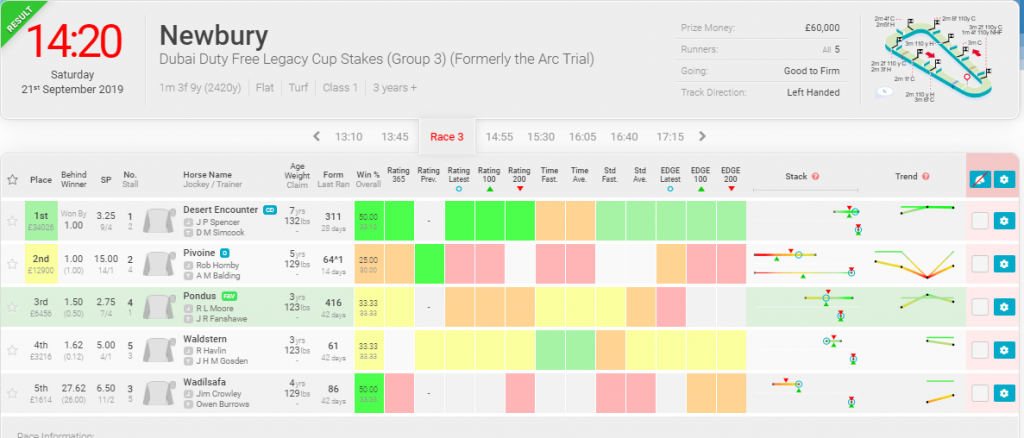
    Here’s a sample race card… so let’s put what we have just learnt in to practice.

    Sample TrackMate Race Card

    It’s not a difficult choice in this race. Green is best… simple.

    But before we jump in blindly there are still a few simple checks we should make before betting our hard-earned cash.

    • Is the price good value? In the race above the answer is clearly yes as it is approx 9/4 (3.25).
    • Will the horse act on the prevailing ground conditions?
    • Has the horse got form at the distance of today’s race?
    • Has the horse won or placed before under the same conditions?
    • Is the race suitable for investment?
    • Is the horse reliable enough in this grade of race?
    • Are enough of the runners in the race rated to make a clear assessment of the race?

    All of this information is available on your race card along with the ratings for each horse.

    Stick to what you have learnt above. Find a system that works for you and don’t waiver from it without good reason. Keep it simple, don’t over complicate things and you won’t go far wrong!

  • The Trend Explained

    The Trend Explained

    The Trend is an incredibly useful tool from the TrackMate rating system. Quickly analyse the Rating profile of all contenders in any race. If your potential selection is improving, declining or consistent in it’s performances you will be able to spot this in no time at all.

    Here are the features explained on this page:

    Sample Trend - TrackMate
    Example “Trend” – Showing trend points, Speed Rating and EDGE Ratings.

    Trend Line

    The TrackMate Trend is a visual representation of the horses ratings to date. This makes it easy to spot form of an improving, consistent or declining contender. Incredibly useful for spotting runs that are “Out of character”

    Trend Points

    Each trend point represents a run with the first rated run being the dot furthest to the left. Information for each race is available by clicking these points/dots.

    How to read the Trend

    The trend displays each horse’s form in the horizontal graphical line or “trend line“. It has been designed so you can easily and speedily ready form. Utilizing an easy to read graphic which clearly shows if the horse’s form is improving, declining, consistent or inconsistent.

    Improving Trend

    When the horizontal trend line is going upwards this is what we refer to as an “improving tend” meaning the result was better than the previous race.

    Declining Trend

    When the horizontal trend line is going downwards this is what we refer to as a “declining tend” meaning the result was worse than the previous race.

    Consistent Trend

    When the horizontal trend line doesn’t go up or down very much this is what we refer to as a “consistent tend” meaning the results are pretty similar. This can be true for part of the line, but the greater proportion represents greater consistency.

    Inconsistent Trend

    When the horizontal trend line goes up and down a lot then this is what we refer to as a “inconsistent tend” meaning the results are erratic. This can be true for part of the line, but the greater proportion represents greater inconsistency.

    Trend Point Information Popups

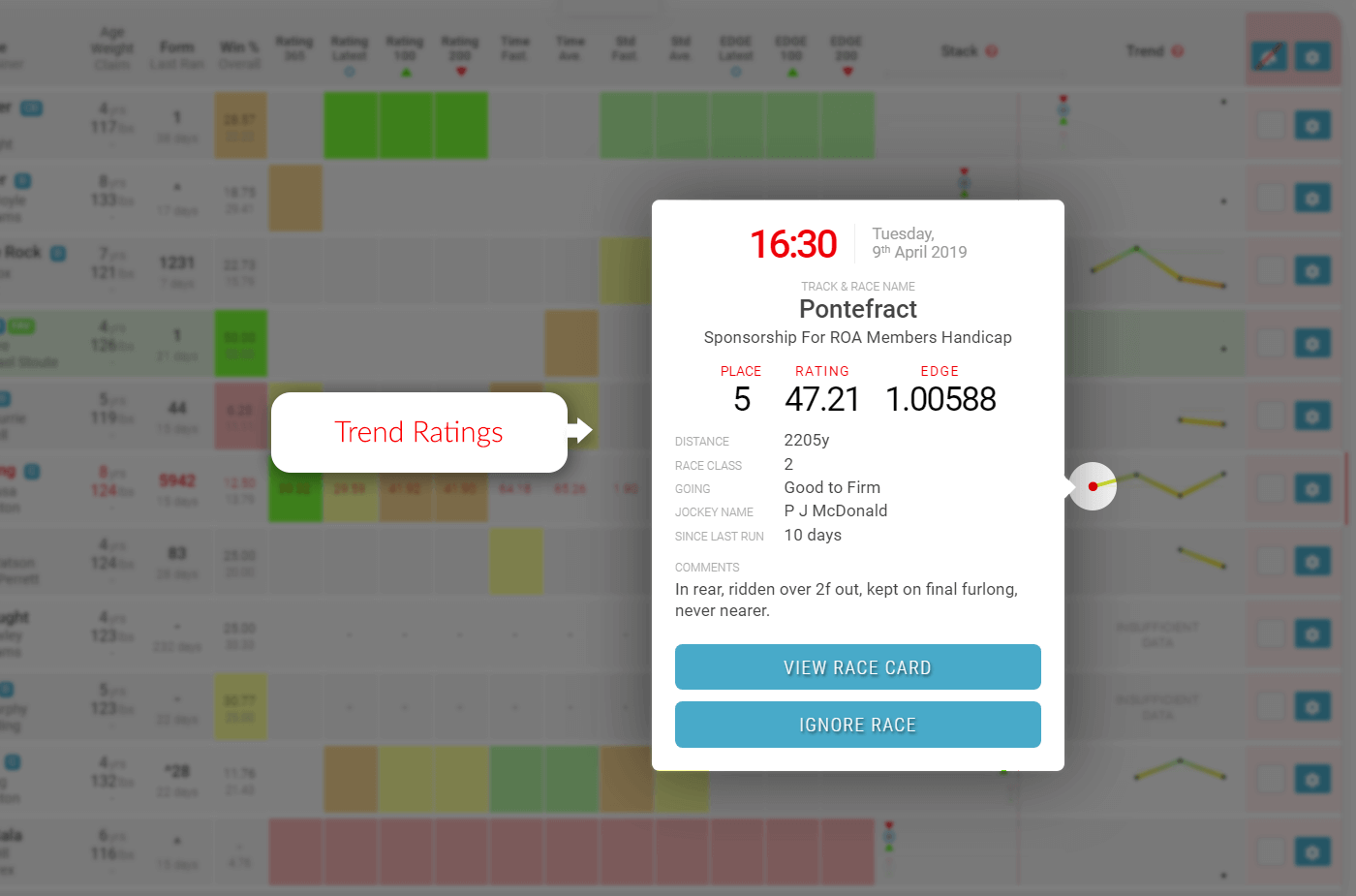
    Each dot or “trend point” represents a race that the horse has taken part in. On hover these points will change to red dots and when clicked will open the information popups.

    Samples Trend Popup - Trackmate
    Sample Race Card Trend Popup

    By clicking on these points you will see a popup with all the details of that particular race. You will have all the information you need; race conditions, race distance, jockey and many more including TrackMate Speed and EDGE ratings achieved for that run.

    Ignore Race Feature

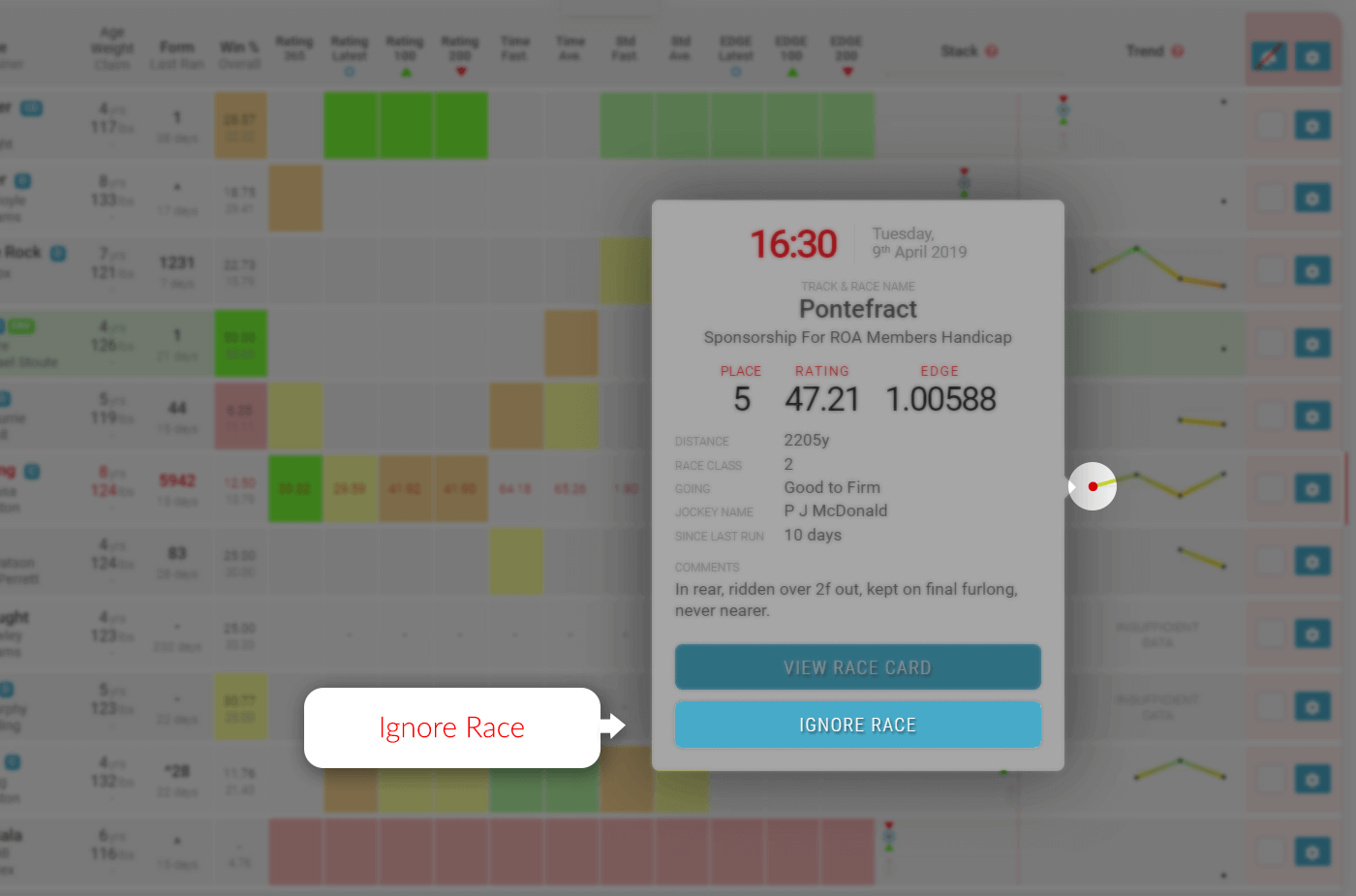
    One of the great features of the TrackMate race card is the ability to “ignore” any of the horses runs for any reason you may have.

    Samples Trend Popup - Ignore Race - Trackmate
    Sample Race Card Trend Popup – Ignore Race Button

    If you decide that you are prepared to forgive a bad run or you know that the race distance just didn’t suit the animal or even if you think the jockey was no good in that race. Just click the trend point and then remove race from the popup.

  • The Stack Explained

    The Stack Explained

    One of the most exciting features of the TrackMate rating system is the stack. An incredible tool for the speedy analysis of the ratings in relation to the other runners in the race. It has many uses and can be an incredibly powerful tool when analysing races. There is a stack for both sets of ratings on every race card.

    On this page you will find explanations for the following:

    The “Stack” is a graphical representation of each horse’s range of performance from the qualifying form.

    • The top stack is speed ratings and is a thicker line.
    • The bottom stack is EDGE ratings and is a thinner line.

    Both stacks have the same rating markers for each horse’s qualify form.

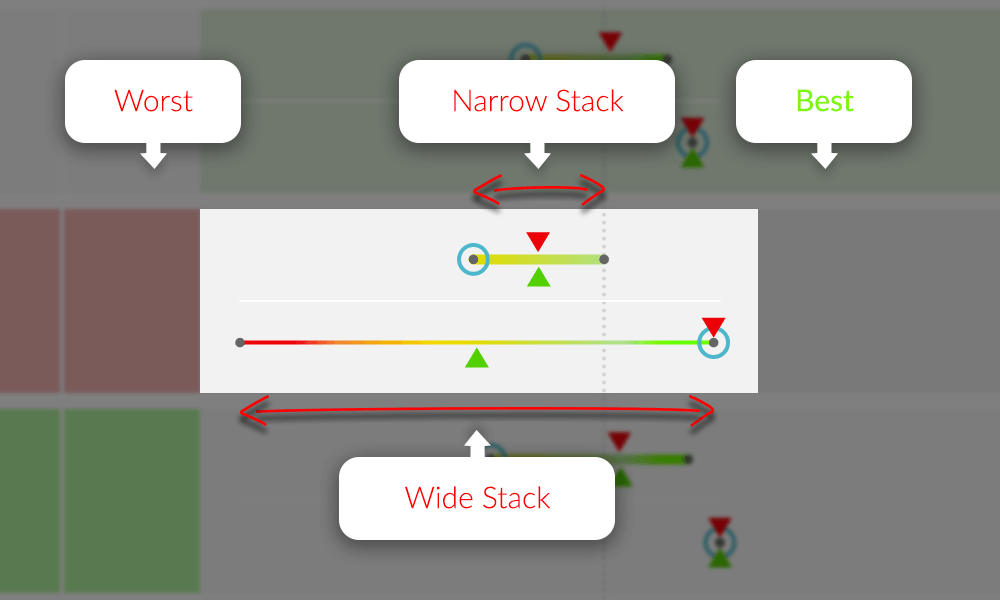
    Sample Stack - TrackMate
    Sample “Stack” – Showing 100, 200 and most recent ratings and the range between worst and best.

    Range of Performance

    The narrower the line is, the more consistent the horse has been as the range between worst and best is less.

    The wider the line, the less consistent the horse has been as the range between worst and best is greater.

    Worst Rating

    The dot on the far left of each horizontal line is the horses worst rating for the qualifying form period.

    Best Rating

    The dot on the far right of each horizontal line is the horses best rating for the qualifying form period.

    100 Day Rating Icon

    The green triangle is the average speed rating for qualifying races for the last 100 days.

    200 Day Rating Icon

    The red triangle is the average speed rating for qualifying races for the last 200 days.

    Latest Rating Icon

    The blue circle is the rating for the last qualifying race.

    Vertical Guide Line

    There is a vertical guide line feature that appears when you hover over the grey guide bar under the stack column title. The line will be red when active as you move left and right over the guide bar. It will then stop moving and change to a grey dotted line when you move off the guide bar.

    This line is extremely useful to get a vertical comparison between all runners stacks in the race making it easier to visualise where the stacks and icons are in relation to each other.

    Great Stacks

    The stack can identify opportunities where horses could be deemed as well above the standard of the rest of the field.

    Here are two example of how to identify a “great stack”

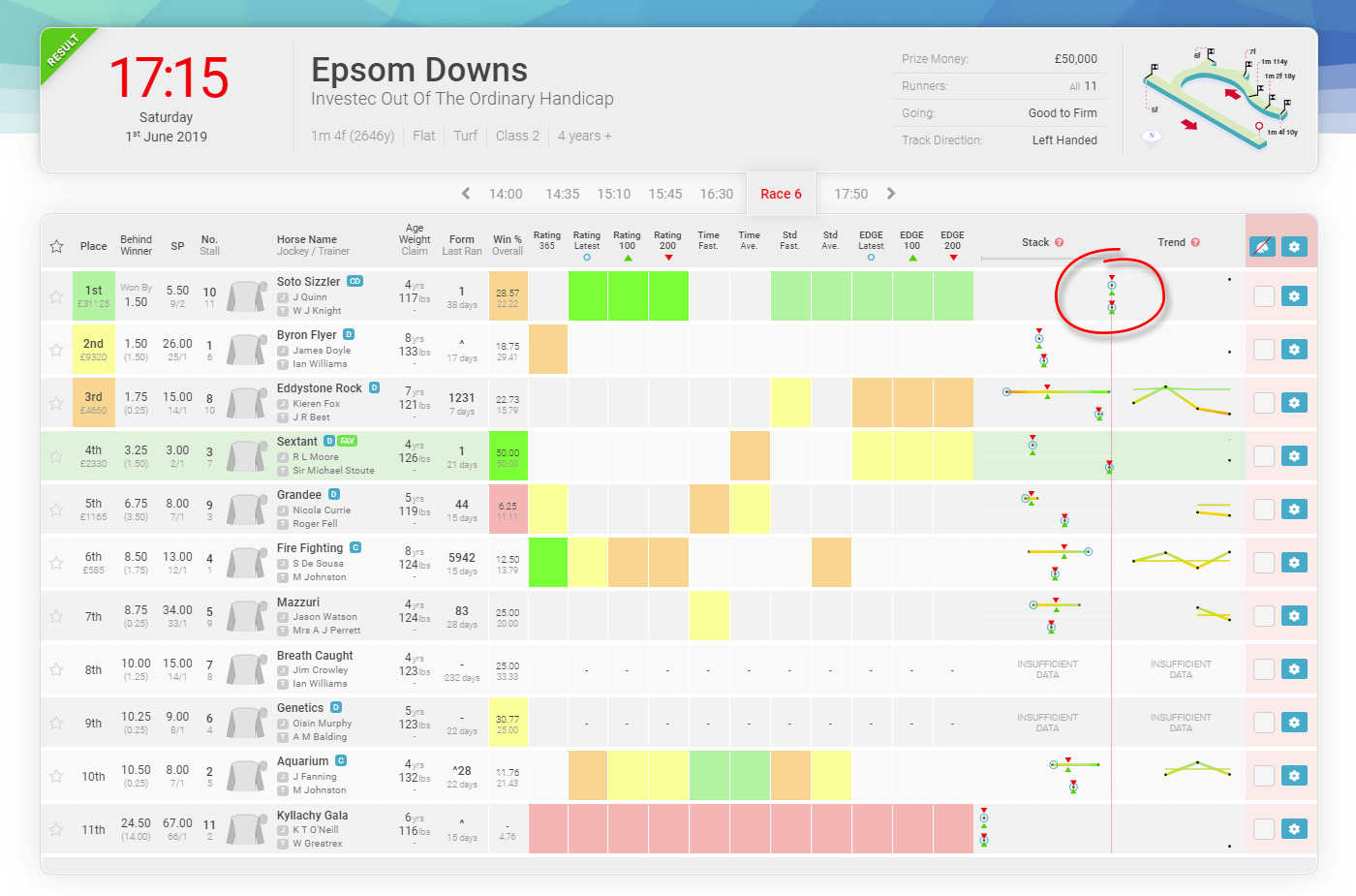
    “Great Stack” Example 1 – 1st June 2019, Epsom Downs at 5:15pm

    In this example 1, you will clearly see that the stack for Soto Sizzler indicates that his form is way out in front of the rest of the field in both Speed and EDGE ratings.

    Sample Great Stack - 2020-11-09 Southwell at 18.05 - TrackMate
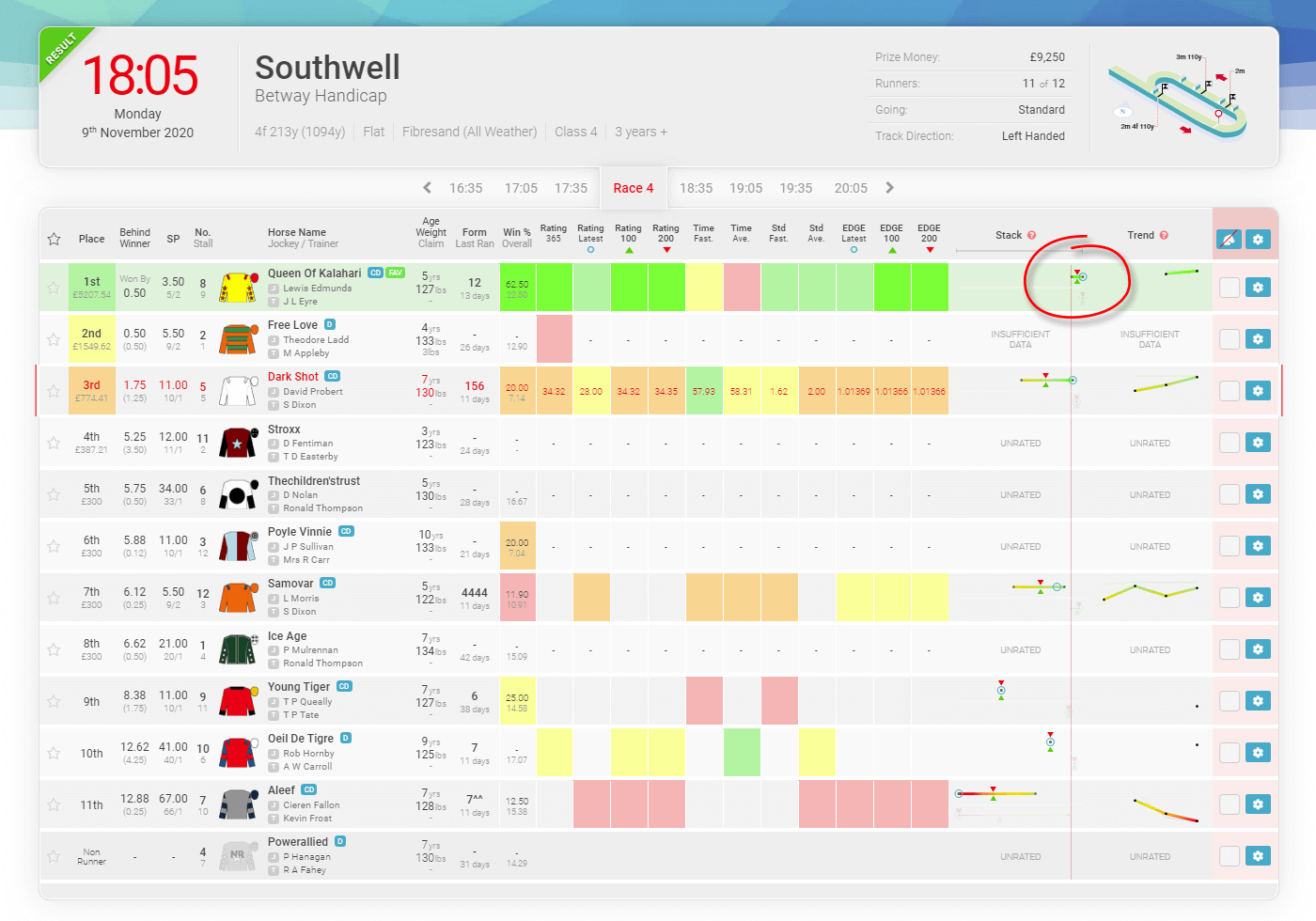
    “Great Stack” Example 2 – 9th November 2020, outhwell at 6:05pm

    You will see in example 2 that Queen Of Kalahari’s “worst” run is as good as any of the other runners “best” run and its best run is clearly best of all.

    The stack can also be used to find “poor value” horses and opportunities to “Lay” horses on the exchanges.

    Stack Point Information Popup Examples

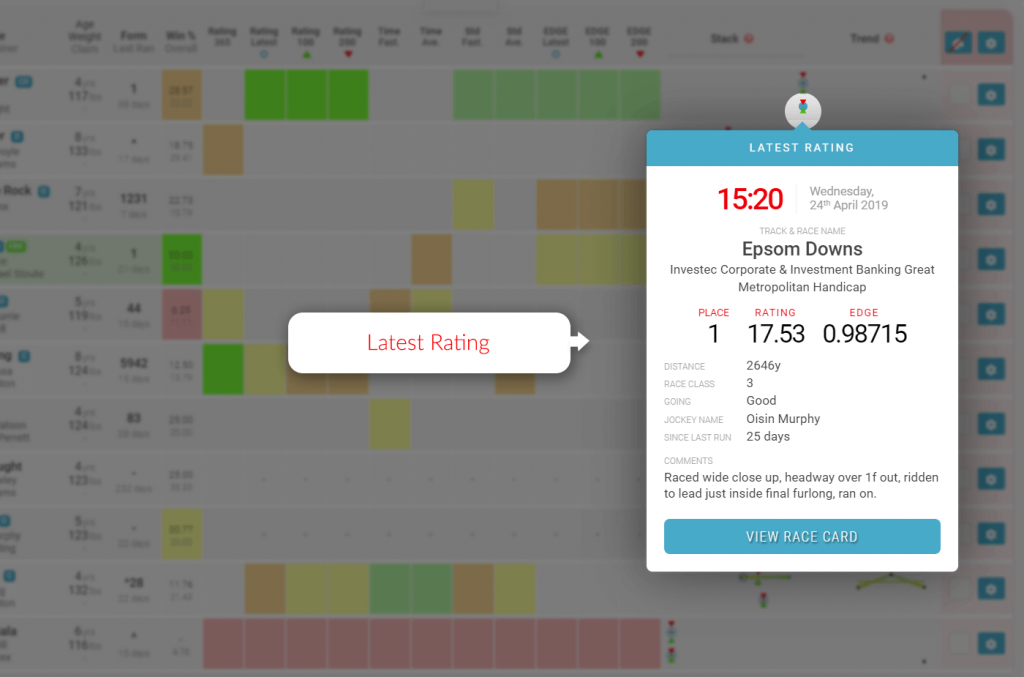
    Latest Rating (blue circle)

    Samples Stack Popup - Latest Rating - Trackmate
    Sample Stack Point Information Popup – Latest Rating

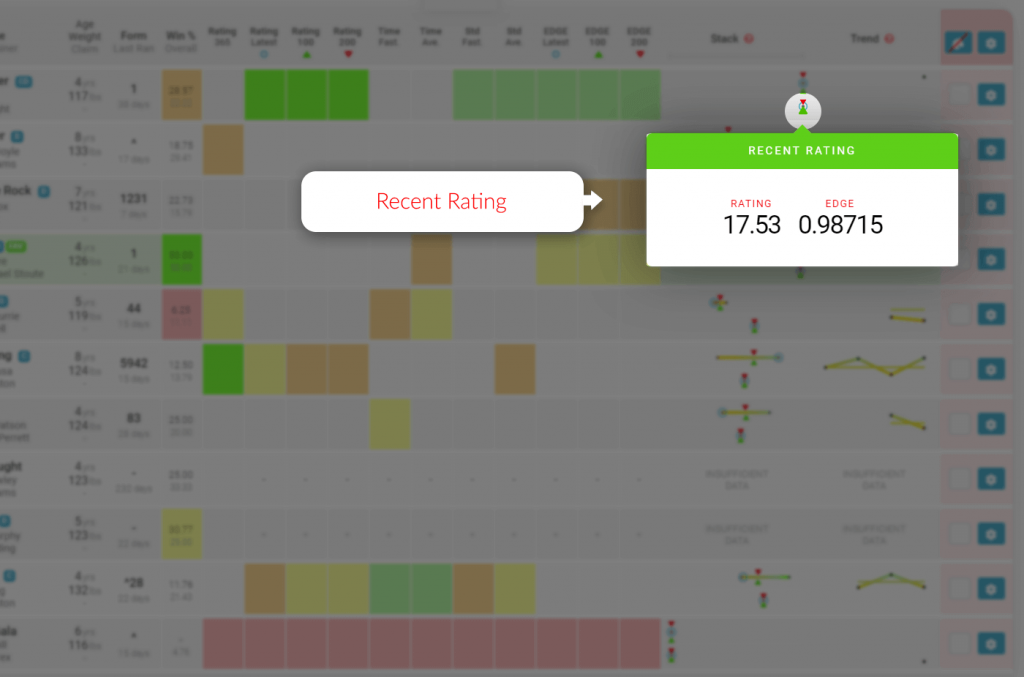
    100 Day Rating (green triangle)

    Samples Stack Popup - Recent Rating - Trackmate
    Sample Stack Point Information Popup – Recent Rating

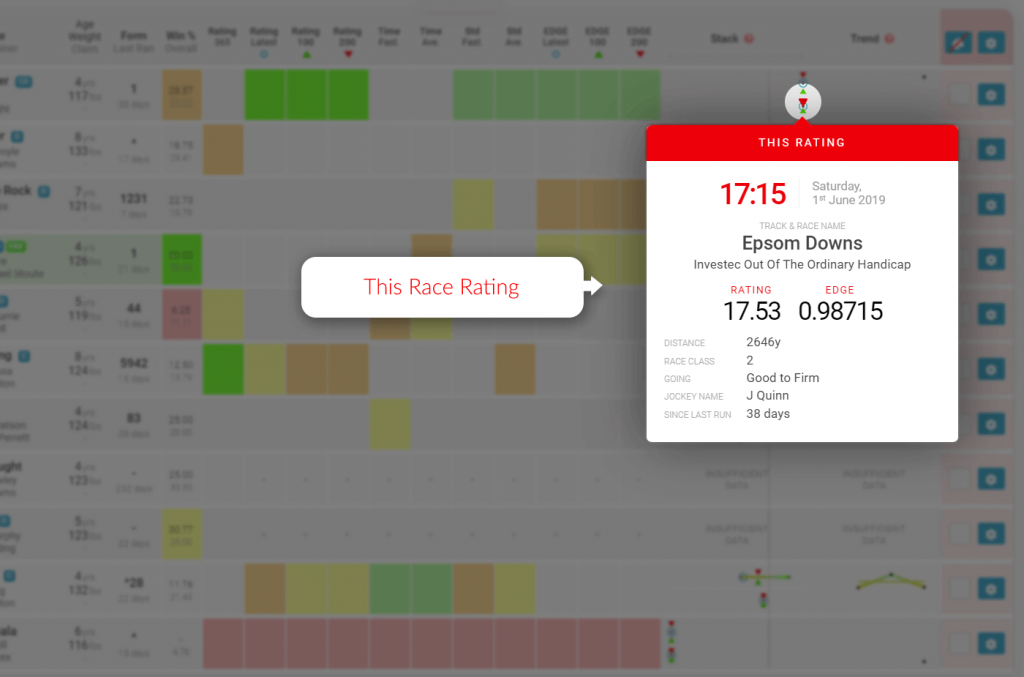
    200 Day Rating (red triangle)

    Samples Stack Popup - This Rating - Trackmate
    Sample Stack Point Information Popup – This Rating

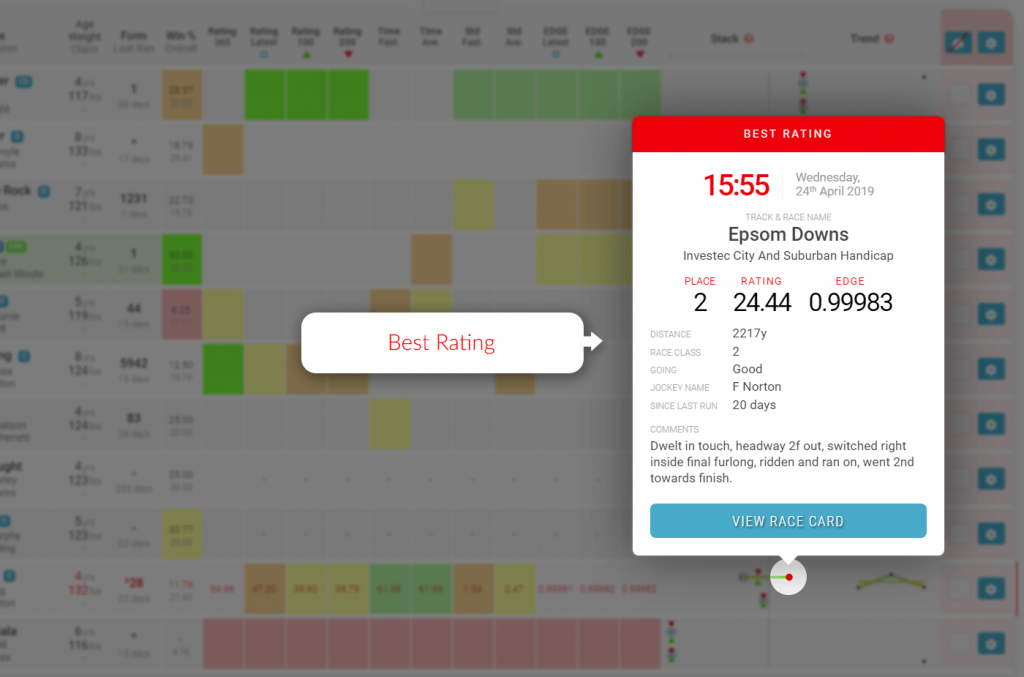
    Best Rating (far right dot)

    Samples Stack Popup - Best Rating - Trackmate
    Sample Stack Point Information Popup – Latest Rating

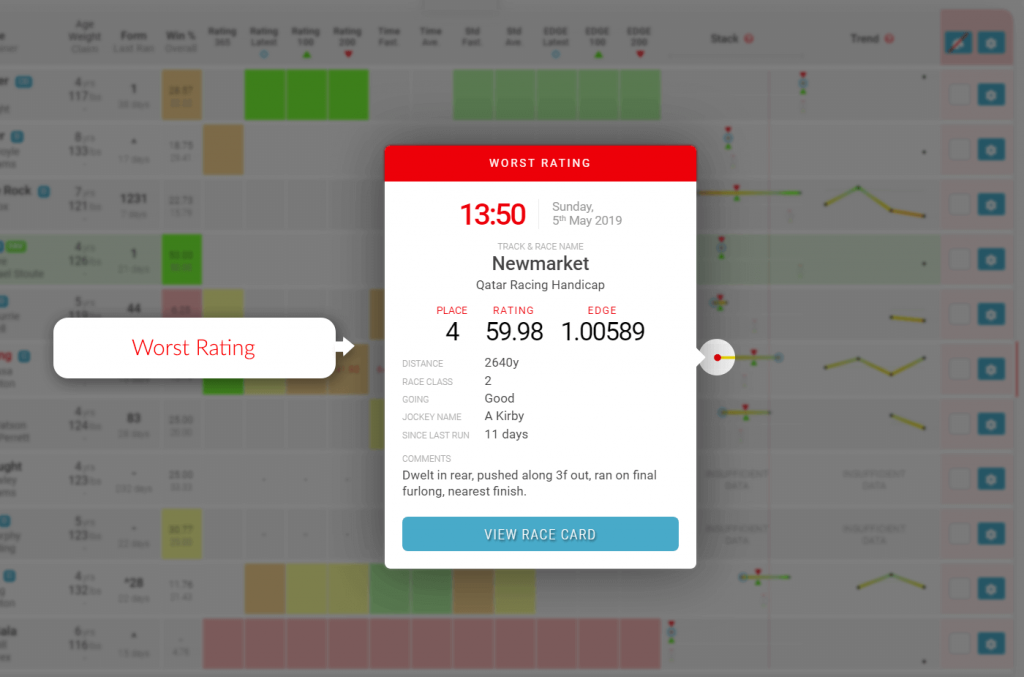
    Worst Rating (far left dot)

    Samples Stack Popup - Worst Rating - Trackmate
    Sample Stack Point Information Popup – Latest Rating
  • How does TrackMate Work?

    How does TrackMate Work?

    The TrackMate race guides have been designed in such a way to be easy to read and easy to understand. Below are some examples of real race card ratings and how to easily start to pick winners.

    Rating Colours Explained

    We need to start with explaining what the rating colours mean before trying to explain anything else:

    Clear Top
    Top Rated
    2nd Rated
    3rd Rated
    4th Rated
    Rated Last
    No Colour
    Non-Runner
    Not Rated

    Now you understand what the different colours represent… let’s move on.

    How should I be using TrackMate?

    There are many ways to use the TrackMate system and many ways to read the “picture” created by the colour-coded ratings integrated into the card.

    It can be used as your only method of selection or in conjunction with your own race reading abilities and knowledge of form. Both are extremely powerful.

    Remember, you do not have to bet in every race.

    The TrackMate Team

    Waiting for the right opportunity and most importantly, waiting for value is the key to success.

    Here are some examples of the type of picture you may come across:

    The “Messy Race”

    Sample Messy Race - 2019-08-03 Hamilton 17.50 - TrackMate
    Sample “Messy Race” – 3rd August 2019, Hamilton at 5:50pm

    In this race card example, you can see that the colours (ratings) all over the place. Nothing stands out as any better than the others because the colours are spread out across all of the runners.

    With this type of picture we would normally just move on to the next race… but is it worth a closer look? There might be an opportunity lurking somewhere. We are looking for a well-rated horse that represents good value.

    Can we clean up/filter the card and spot some value?

    Possible ways to clean a messy card:

    • Remove poorly rated horses from the ratings.
    • Check the going settings in the Race Card FIlter match today’s conditions.
    • Rate less runs. You can rate 3, 5 or 8.
    • Filter the remaining runners for Surface, Ground and Distance perhaps?

    If after exhausting all options you do not find an obvious or good value selection just move on to the next race.

    You do not need to find lots of selections. Just well rated and good value ones. If there are none that day, be patient, there will always be another race and another… and another!

    The “Standout Selection”

    You will see from this race card picture that there is an obvious contender. It is not hard to spot… green is good!

    Sample Stand Out Race - 2021-01-20 Southwell at 18.00 - TrackMate
    Sample “Standout Selection” – 12th December 2020, Cheltenham at 3:35pm

    The obvious horse to choose in the race above was “Bay Of Naples“. This picture indicates that the horse is:

    • Clear top-rated in “Rating 365”, “Rating Latest”, “Rating 100”, “Rating 200”, “Edge Latest”, “Edge 100” and “Edge 200”.
    • Top rated in “Win %”, “Fastest Standard” and “Average Standard”.
    • The stack best rating is top as is the stack latest.
    • The trend is improving/consistent.

    Everything you want in an investment based on the TrackMate ratings.

    The “Value Bet”

    Sample Value Bet - 2021-01-09 Kempton at 15.30 - TrackMate
    Sample “Value Bet” – 20th January 2021, Southwell at 6pm

    In theory all your bets should be value bets. The race example above is from this year’s ultra competitive Lanzarote hurdle and amazingly the winner “Boreham Bill” was totally unfancied at an incredible price of 66/1 and even bigger on the exchanges!

    In a scenario like this we would prefer the 80% to place and 20% to win staking strategy.

    In a big race like this one you will be able to obtain prices for as many as 6 places on the exchange.

    The “Lay Bet”

    Sample Lay Bet - 2019-01-05 Kempton at 17.15 - TrackMate
    Sample “Lay Bet” – 5th January 2019, Kempton at 5:15pm

    To those of you already familiar with the betting exchanges you will be aware of laying horses. It is essentially acting as the bookmaker and laying odds against the horse winning.

    In the above example the favourite “Luxford” looks like terrible value based on the TrackMate ratings and could potentially be the sort of horse you might want to lay on the exchanges.

    ALWAYS be cautious when using this function on an exchange. Make sure you understand betting exchanges before you attempt to lay horses.