Betting For Value

Category: Betting

  • Betting For Value

    Betting For Value

    If you are serious about making racing pay you should be betting for value.

    There should only be two reasons why you are betting on the horses and they are:

    1/ To have fun and enjoy the sport

    2/ To make money (or at least not to lose)

    In order to make money investing in horse racing the single most important thing you must do is bet for value.

    You should be looking for horses that look ‘Overpriced’

    It’s not the ‘Buzz’ of winning short-term that should get you excited but the expectation of building your bankroll in a steady and organised structure.

    The Math is important.

    Ok. So you have a really respectable strike rate of about 30%. That is a pretty impressive wine rate and not easy to achieve.

    The reality though, is that even with a strike rate as good as this, you are unlikely to be a long-term winner !

    Why ?

    Because unless you are regularly backing winners with a price of at least 3/1 and higher you will struggle to make a profit.

    That changes everything or at least it should.

    We are not saying that you should not back shorter-priced horses. What we do suggest though is that you monitor your win rates closely in order to find any potential leaks in your strategy

    By utilizing the TrackMate bankroll management and bet tracking software you can track your profit and loss, strike rates and win rates as well as your ROI.

    These stats are so important to your success and should be used religiously in order to maintain an accurate record of your bets and returns.

    It’s better to miss a winner than back a loser !

    Remember. You should be betting for value.

    It is very tempting to back the really well-rated horses regardless of price. They just look so good !

    But before you back that juicy-looking 2/1 favourite you need to know if it is a long term profitable play?

    What is your strike rate with horses in this price range?

    Is it high enough to warrant an investment or is it best to just let it run?

    By monitoring your ROI and win rates you will over time learn your most profitable angles and price ranges.

    So what should you be looking for when you are making your selections ?

    There are a few criteria that you should be looking for when making your selections.

    • Well rated horses – Use TrackMate ratings to find well-rated horses
    • Choose well-rated races. – Try to select horses in races with plenty of form on offer
    • Try to avoid ‘Dodgy’ races – Races such as Amateur jockey races should be avoided
    • Look for horses with all the race factors in their favour – Does your selection act under the prevailing conditions?

    Once you have made your list of selections we suggest you then check the prices on a site such as oddschecker or your betting exchange of choice.

    This is your opportunity to thin your list based on ‘VALUE’

    Is your 6/4 favourite really worth an investment or do you just let it run?

    Remember you need a very high strike rate to even have a chance of breaking even by backing 6/4 shots !

    We suggest that you try to make as many of your selections as possible Win/Place bets. You should aim for a minimum price of approx evs (2.0) as a target for your place bet and the best price you can achieve in the win market if you can achieve your place bet target.

    Betting for Value – Back to Win and Place for maximum profits

    The best way to profit from horse racing is to back your value selections to both Win and Place and preferably with a betting exchange to achieve the best prices available.

    There is nothing more frustrating than seeing your horses just getting beaten time after time so why not try to profit from these situations?

    Horse racing is after all not an exact science and we are after all dealing with animals!

    The margins between winning and losing are very often very small and you can often miss out by the smallest of margins. In these situations, we firmly believe that the way to combat this is to back as many of our selections with a minimum place price requirement.

    By betting this way and as long as your selections have a fairly good strike rate you will, more than often at least cover your win bet with the place bet.

    Very often, although small in terms of overall profit, the place side of the bet will be profitable in its own right and long term profits are very achievable just from the Place “savers”.

    Over time, this method will almost inevitably result in shorter losing streaks and steady long term profits.

    Use the extra place markets to reduce variance.

    We strongly suggest that you use a betting exchange for your horse racing betting. You are almost guaranteed to achieve much better value on your selections than you would with a bookmaker.

    One of the benefits of the exchanges is the ability to bet on your selections to place only.

    Very often you will find horses that can be backed at very good prices in the place market and we strongly suggest that you should be backing your horses to both win and place.

    Depending upon your level of “tolerance” to losing streaks it is a good idea to sometimes take a look at the extra place markets.

    The exchanges will usually have an extra places market which gives you the ability to cover your win bets with an extra place on offer.

    For example, a 10 runner race would normally pay 3 places. Very often there will be a 4 place market giving you the opportunity to cover your win bet with even less long-term risk.

    Treat your Place bets as full bets.

    When backing a horse to win and place we like to treat the place bet as a full bet rather than part of an E/W bet.

    So for example.

    You are currently staking £10 per ‘point’ on your selections on the betting exchange.

    Your selection is 6.0 (5/1) for the win and 2.2 (5/4) to place.

    You should back this selection £10 to win and £10 to place which is ‘2 points’

    If you are backing to win only you should be staking at 1% of current bankroll or 1 point.

    We strongly suggest that you have a bankroll of at least 100 points (bets) but preferably at least 200.

    A 200 point kitty will give you a bankroll of 100 win/place bets and should be comfortable with a good strategy and selection process.

    A more cautious approach to win/place staking.

    There is a more cautious approach to this form of betting. Remember you should always be betting for value.

    This method places more of your stake in the place market than the win market and the inevitable higher place strike rate becomes more profitable.

    The most common way to split these stakes are 60/40 – 70/30 – 80/20

    This approach is exactly the same as the straight win/place method but uses a slightly more cautious approach to the staking.

    When backing your value selections you should be looking for horses with prices from about 4/1 and higher. These selections will normally have a place price in the 1.8-2.0 + range.

    You will invariably get many more selections that place than win and you should stake accordingly.

    This will reduce your losing streaks and increase returns on your placed selections.

    When betting for value your aim should always be to keep losses to the minimum. By making your place bets as profitable as possible you will see long term growth in your bankroll.

    For example:

    Instead of staking £10 win and £10 place, you would stake £12 to place and £8 to win.

    The place side of these bets will win more often than the win side of the bet.

    This method will improve your place returns but slightly decrease your win returns.

    An even more cautious approach to your staking would be to use just one point per bet and ‘split’ the stake.

    So, when staking 1% of your total bankroll per bet you would just split the stakes as above.

    If your bankroll is £1000 and your stake is 1% or £10 you can split the £10 stake into

    £5 win and £5 place

    £4 win and £6 place

    £3 win and £7 place.

    This will obviously reduce the returns and increase the time it takes to grow your kitty but will be much easier to ‘handle’ the inevitable losing streaks you will encounter.

    Does it really matter how long it takes to grow your bankroll?

    The secret to enjoying your betting is comfort. You cannot and will not win if you are worried or stressed about your bankroll.

    Only bet what you are fully prepared to lose (all of it!)

    Stake your bets in such a way that losing runs are easy to handle and comfortable in terms of losses.

    Read all about losing streaks and how to handle them here.

  • Coping with Losing Streaks

    Coping with Losing Streaks

    You will encounter losing streaks in any system you decide to follow, whether it’s just plain old form study, paid for information, or selections given by computer programs.

    The secret to enduring losing streaks is to stake correctly according to your bankroll size and always have a mentality that you will stick it out. If you are fully prepared to lose your kitty when you start then you must have the balls to see it through to the end.

    There is no such thing as a system without losing runs. It’s going to happen and there is nothing you can do about it.

    We have seen staking plans take kitties down to the last couple of bets only to turn around and end up profitable at the end of the season. If you have staked an amount you are fully prepared to lose in the first place and this worst-case scenario happens you can always start again!

    How Can I Reduce My Losing Streaks?

    This is not an easy question to answer. It is all about comfort and allowing your head to “detach” itself from losing. It will happen regularly and you must be able to cope. If not, then I am afraid this game is probably not for you.

    Estimates longest losing streaks
    We suggest you take the worst case scenario and double it to set your stake size.

    Your estimated longest losing streak can be roughly estimated based on you strike rate and this information is available to you if you use the bet tracking system in your myTrackMate page.

    Just add the odds and your stake size and TrackMate will do the rest.

    It’s All About Comfort

    If you feel comfortable making your bets, everything else gets easier.

    Do not get complacent though. Do not get tempted to start “chasing losses” when in the middle of a losing run. This is a BAD thing to do.

    Stick to your staking plan and you should be ok.

    If you are using a method similar to us, which is 1% of bankroll per bet, you will have at least 100bets before your kitty runs out.

    With careful selection processes, this should be more than enough.

    The “Odds” of your selections.

    Generally speaking the higher the odds of the selections you are backing, the less often they will win.

    There is a lot of knowledge in the market and the odds offered are normally a fairly good indicator of the chances your selection has to win.

    The secret is to find selections that the market look to have priced in your favour and offer good value should your horse win or place.

    “Place Only” Bets

    One way to reduce the length of losing runs is to start your journey with “place” only bets.

    By using a betting exchange you have the ability to back your selections to place only. Although the profits take longer to accumulate, your losing streaks will definitely be shorter and your strike rate higher.

    “Win / Place” Bets

    Another good way of reducing “variance” is to place bets in both the “win” and “place” market. One of the many benefits of the betting exchanges is the ability to back your selections with “weighted” stakes.

    For example: If your selection is trading at 5/1 or 6.0 on the exchange.

    With a bookmaker, generally you would have to back the horse each way in order to get a return for the horse placing and bookmakers are not known for their generosity when it comes to pricing horses with firm place claims

    You should be getting at least 4/1 when betting each way or your return on the place side of the bet is poor value. The minimum return on an e/w bet should be as close to break-even as possible.

    On a betting exchange you would be able to split your stakes and back the horse in the “Place only” market. You would probably be able to achieve anything from 5/4-7/4 place only.

    In this scenario if you placed what we call a 70/30 or 80/20 bet.

    If you split your stake and placed 70% to place and 30% to win. You decrease the variance significantly and as long as your selection places your bet will be profitable.

    You should always be looking for long term slow and steady profits. This is not a get rich quick scheme.

  • Should I bet to Win, Place or Both?

    Should I bet to Win, Place or Both?

    When thinking about what to bet on… DO NOT bet on ANTHING unless you can afford to. Betting on horses should be fun and pressure free. If it is not then please do not bet at all.

    There are no rules when it comes to how you should invest your hard-earned cash when having a bet.

    We strongly believe, the only real way to have any chance of making a profit, is to have a solid staking plan and proper bankroll management.

    It also helps to have a great rating system such as TrackMate to steer you in the right direction when deciding what to invest in.

    Here’s what this page will discuss:

    Win or Place?

    We have many members who bet in all sorts of different ways in order to gain an edge when backing horses.

    Some back mostly “place only” and prefer lower returns but with more consistent and regular “winning” bets. Others bet “win only”, preferring to have slightly lower strike rates but larger returns. Both methods will work and can be very profitable if staked correctly.

    At TrackMate we like to mix it up a bit and we use a combination of the above when making our investments.

    Our standard stake is 1% of our current bankroll with incremental stake increases at pre-set targets. We also set minimum price targets for our investments. For us, this is a minimum price of 2/1 (3.0) on Win bets and Evens (2.0) for Place bets. We have more information on these methods if you read the bankroll management article.

    Win Only Bets

    Many people prefer to only place “win only” bets. This is fine as long as you are staking properly and your bankroll and you can handle long losing runs. This will happen and you need to be prepared.

    We suggest that you place “win only” bets when the selection is too short (low odds) in the market and there is no value in a place bet. Normally these selections will fall into the 2/1 – 4/1 price range.

    Once the price of your selection reaches 4/1 and above you might decide that “win & place” is the way to go.

    Place Only Bets

    There are more options for punters available these days and the betting exchanges are a good option for using a more cautious approach with your bets.

    The number of runner in a race determines the number of places that will be paid. 7 or less runners will normally pay out for top 2 places. 15 or less will normally pay out on the top places. Over 15 runners normally pays out on the top 4 places.

    The ability to back horses to “place only” gives us the opportunity to play a more cautious game when protecting our bankroll.

    Win & Place Bets

    If you think your selection can win the race and the price offered is large enough you might decide to back your selection both to “win” and to “place”.

    This is similar to an “each/way” bet except that if you so desire you can place more on the place side of the bet than on the win side. Potentially locking up a profit as long as your selection places.

    For example:

    If your stake is £5 (recommended with a £500 bankroll) A more cautious approach to backing your 10/1 shot would be to stake £3 to place and £2 to win. You can change the ratio to suit your style of betting. Maybe 80/20 or 70/30 suits you more.

    myTrackMate Profit & Loss Statistics

    Remember you can follow your stats and your “profit & loss” figures in your myTrackMate page where your stats are automatically updated daily.

    This is an incredible tool for you to monitor your bets, streamline your betting techniques, and spot leaks in your strategy. Just add the odds taken and your stake and TrackMate will do the rest! You can read more about how myTrackMate works here.

  • Rain rain go away

    Rain rain go away

    You will hear me go on about this on a regular basis. Not just to help our members with sound advice but also to remind me that just because a horse is well rated does not mean that it will win the race.

    TrackMate is a great tool for just looking at the colours and picking the one with the best ratings but as with anything in life you will miss opportunities and make unnecessary mistakes or losses that could be avoided with just a little investigation.

    All the information you need is available on the TrackMate racecard including the forecast ground conditions.

    Racing League: New $2.3 million series to introduce whip ...

    The Going and the weather

    There are many reasons why well rated horses don’t run to their best all the time.

    Sometimes they just have an off day. We all have them and horses are no different. They could be poorly drawn and literally have no chance from their starting stall or they could meet trouble in running which means they just couldn’t get there in time.

    The main reason for horses not performing at their best is that the ground conditions on the day of the race were unsuitable for the horse.

    Some horses (not many) will be able to perform to their best on most surfaces or ground conditions but the vast majority have a “favoured” surface for them to perform at their best.

    Most horses will go well on a turf surface when the ground is anywhere from “Good” to “Good to Firm” some will prefer it a bit quicker (Firm) and some will appreciate a little bit of juice in the ground (Good to Soft or Yielding).

    The Majority of the time the horses are declared for races that will be suitable for the animal and the Trainers will have normally checked the forecast ground conditions as a matter of course.

    You should always check the ground conditions before you invest. Often the Weather changes and with it the ground conditions.

    It is not unheard of for the going to change from “good to firm” to “Soft” in the space of a couple of hours when it rains heavily.

    If your selection has never run well with the ground softer than “good” then it is highly unlikely that today will be any different.

    Sometimes it will be beneficial for the trainer to still run the horse under conditions that are not suitable but will help with the horses’ fitness. This is not great for the punters.

    As a Trainer, sometimes it is a good idea to run a horse with conditions less than ideal in order to allow the handicapper to reduce the horse’s official rating which means that in the future the horse will carry less weight.

    Conclusion

    Rain sucks !

    In my experience and from many years of observation it is the best policy in the long run to stop all betting activities while the ground conditions are worse than good to soft. Period.

    The majority of horses will act on ground in the range from “good to soft” to “good to firm” and this is the range of ground conditions we should be betting in.

    This is particularly important on days when the going has changed during the course of the meeting.

    “Heavy” ground is the Devils spawn and should be avoided at all costs during the Flat racing season

    We would even suggest no bets during the National Hunt season when the ground is “Heavy”.

    TrackMate Tip

    Make use of your Notebook / Horse Tracking system that is provided for TrackMate members.

    Very often, well rated horses who run poorly on unsuitable ground will run a big race next time out even if not so well rated.

    Each race is rated individually in the TrackMate system and ratings will differ depending on the form of the other horses in the race.

    Have a look at the Trend, is there an obvious bad rating that is affecting the horses overall rating? If there is, try removing the race from the ratings (click race in trend to remove run) and see how this changes the “Picture” of the race.

  • Don’t Over Complicate Things

    Don’t Over Complicate Things

    TrackMate has been designed to make your selection process quick and easy whether you are new to horse racing or a seasoned pro. To help make sure you don’t over complicate your selection process.

    Many services that offer similar platforms to TrackMate are often so desperate to impress that they invent new ways of representing what is essentially the same information with a new name.

    They publish confusing lists of numbers. Statistics that are nearly always unnecessary and time-consuming to digest and therefore just complicate things.

    At TrackMate we keep what is an incredibly complex ratings system simple.

    TrackMate’s ratings and visual aids are integrated into our unique race guides so each and every race can be assessed within seconds.

    Anything Can Happen!

    There are literally hundreds of variables in the preparation of a race horse. It starts with the trainer and the stable staff:

    • Have they done their job well?
    • Is the horse ready to race?
    • Is it fit?
    • Has it had any problems with its training schedule?
    • How much does it weigh?
    • Did it eat its breakfast this morning?
    • Did it have a good journey to the track?
    • The list goes on and on…

    The truth is, the vast majority of these factors must be taken on trust. It would be almost impossible for anyone to take all of these factors into consideration.

    Horse racing is a very expensive business to be in. Owners and Trainers do not send their horses to the track unless they are in good enough condition to do themselves justice in the race and stay fit and injury free.

    Contrary to popular belief, and we speak with experience, that the costs involved in owning and training a racehorse far outweigh the vast majority of any scullduggery that some people theorise exists in all racing.

    You will never stop horses running that will improve for the run. It’s not often that all the factors are perfect for all the horses in any given race.

    Some may prefer a different surface to race on and some may prefer a different distance.

    So… with all that in mind, what can we summise from the above statements?

    • Most horses in most races are running on their merits. They want to win and definitely want to try and pay for the costs involved in getting to the race.
    • The fitness and well-being of any horse must be taken on trust.
    • Horses will generally improve after one or two runs.

    It is important to realise that there are a lot of poor horses in training.

    They are generally inconsistent performers.

    They rarely win races so the best way to avoid these animals is to try and stay away from poor quality races.

    Read our TrackMate Warning System page for great advice… if you haven’t done so already!

    We have simplified the process of picking value investment opportunities.

    We don’t over complicate the selection process.

    You will quickly spot the most likely contenders in each race using the simple to read, colour-coded ratings on each race card.

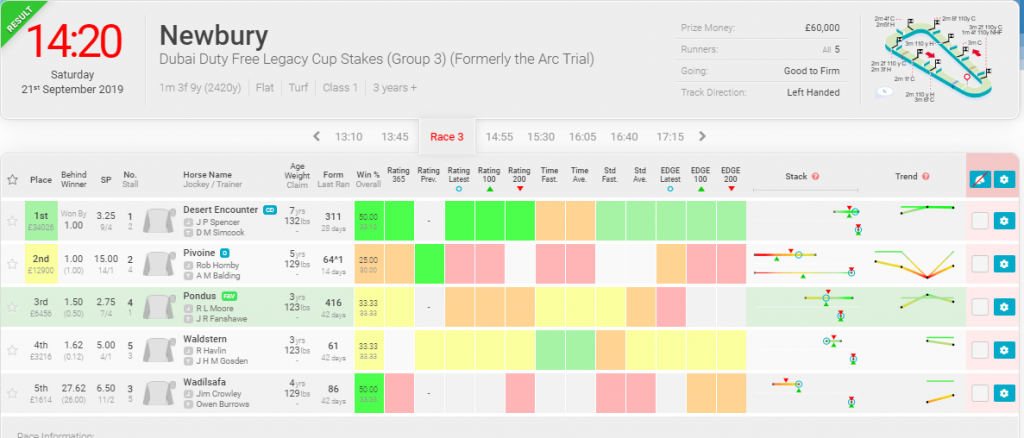
    Here’s a sample race card… so let’s put what we have just learnt in to practice.

    Sample TrackMate Race Card

    It’s not a difficult choice in this race. Green is best… simple.

    But before we jump in blindly there are still a few simple checks we should make before betting our hard-earned cash.

    • Is the price good value? In the race above the answer is clearly yes as it is approx 9/4 (3.25).
    • Will the horse act on the prevailing ground conditions?
    • Has the horse got form at the distance of today’s race?
    • Has the horse won or placed before under the same conditions?
    • Is the race suitable for investment?
    • Is the horse reliable enough in this grade of race?
    • Are enough of the runners in the race rated to make a clear assessment of the race?

    All of this information is available on your race card along with the ratings for each horse.

    Stick to what you have learnt above. Find a system that works for you and don’t waiver from it without good reason. Keep it simple, don’t over complicate things and you won’t go far wrong!

  • Staking & Bankroll Management

    Staking & Bankroll Management

    Many members ask us what is the best method for bankroll management and implementing a good solid staking plan. We will provide with you all the information you need to make good decisions with your staking and bankroll management.

    If you are investing your hard-earned money into horse racing you should be doing it for fun. At the same time, you should treat it as an investment that you would rather not lose. By doing this you will already have an advantage against most punters out there.

    • Bankroll Management – Increase profitability and reduce risk by staking correctly
    • Bankroll size – How big should your bankroll be.
    • Staking Plans – Decide correctly and strategically how to stake your investments
    • Losing runs – learn how to stake correctly for risk reduction
    • Bet tracking – Use your MyTm page as a base for bankroll management and bet analysis.

    Bankroll Management

    A Common Mistake

    The first and most important thing to understand is that you must be prepared to lose your WHOLE KITTY.

    If you are not, you cannot stake correctly.

    You would be amazed at how many people, when asked how much of their bankroll they are prepared to lose say anything other than 100%.

    It should be about enjoying the experience and having fun without pressure.

    There is no point in a staking plan that allows for a 100 bet losing sequence if you are not mentally prepared to lose 100 points.

    Having a £100 bankroll but only being prepared to lose £50 is just silly.

    Decide how much you are prepared to invest into a Horse racing Kitty with the knowledge that you could lose it all.

    Bankroll Size

    Firstly. You should not bet on anything if you cannot afford to lose the money in the first place. Please, please think before you bet and if you feel you have a problem do not join our service. Betting on the horses is not an exact science and you are highly likely to lose.

    Betting should be fun. Even if you take it seriously, as many of our members do. Feeling the pressure of every losing bet is no good for you or your profitability.

    We strongly suggest that you use a betting bank of at least 100 bets (points).

    You must be willing to continue with your staking plan. Even if you have lost half or even most of your kitty.

    Losing runs happen. If at the start of your journey, you are prepared to lose your whole bankroll, this should not affect your staking strategy. Remember you can always start again.

    If you lose your entire bankroll due to a terrible run, you should have the ability to shrug it off and start again.

    Take the opportunity of looking back at your selection processes and or staking plan and try to figure out why your selections have not been performing.

    Staking Plans

    There are literally hundreds of staking plans available out there these days.

    At TrackMate we advocate a simple but highly effective staking plan strategy of betting 1% of our initial betting bank on each selection.

    There are two highly effective strategies you can use when deciding when to increase stakes.

    • Set your stake at 1% of your bankroll every day. Keep all bets the same size for that day and reset to 1% of the new balance the following day.
    • Set your stakes at 1% of initial bankroll and only increase stakes when your bankroll hits preset milestones.

    For example:

    Conservative compounding staking plan

    Starting bankroll is £200

    Bet size should be £2 per race and you should stick to this until your kitty reaches £300 or busts (100 bets)

    When your bankroll hits £300 you increase stakes to £3 (still 1% of the kitty) when your kitty hits £400 you start staking at £4 and so on.

    If you hit a losing run and your kitty hits the starting point of £200 again you drop back to £2 stakes.

    In this strategy as your bankroll increases so does your ability to absorb longer losing sequences. By the time you have made 50% profit. Your balance is now 150 bets deep.

    This is a sensible and structured approach to staking.

    Aggressive compounding staking plan

    Although this is still a fairly conservative staking plan as your bankroll should still start at at least 100 bets it is just slightly different to our more cautious approach above.

    This staking plan allows for daily stake sizes to be determined by the daily balance as long it’s above your bankroll starting size.

    As long as you are in profit the stake is set daily at 1% of current bankroll balance.

    If you are not in profit you level stake 1% of starting balance.

    For example:

    Starting balance is £200

    Bet size should be £2 per race and you should stick to this until you are in profit or your kitty busts (100 bets).

    As soon as you are in profit, your stakes increase in line with your balance but stay at 1%.

    If your kitty reaches £210. Your stakes the following day would be £2.10

    If your kitty drops back to £200 or below you resort to level staking £2 until you are in profit again.

    This is an incredibly profitable staking plan.

    These rules are not set in stone but if you follow this practice you will get a lot of fun for your small initial investment.

    Who knows maybe next season you will be able to start with a much larger starting kitty!

    losing runs

    There are so many variables to consider and endless unforeseen events occur which could alter the outcome of a horse race so bankroll preservation should be top of your list.

    You can see from the below table the potential losing sequences you can have with the specified strike rates. It is always best to have as big a bankroll as possible and start with small stakes.

    This image has an empty alt attribute; its file name is Estimated-Longest-Losing-Run-Ready-Reckoner.jpg

    As you can see. Even a 35% strike rate, which is incredibly high can endure losing sequences of up to 20 consecutive bets and we would always double this number at least in order to comfortably cover these inevitable runs.

    It happens. Get used to it.

    Bet Tracking

    One of the most important ways to maintain a proper bankroll management strategy is to incorporate a strict routine for logging your bets and results.

    How else can you keep track of all your investments.

    By keeping a record of all your bets you have the ability to spot “leaks” in your strategy and correct them when you spot them.

    You will find on your personal myTrackMAte page that all bets and stakes that you log in your MYslips are trannsfered automatically into and logged into your bet history page.

    All bets in this log are automatically updated daily with results and will keep a record of your profit/Loss figures as well as your strike rate and ROI.

    This incredible tool is available for all TM members and will help you manage your bets better than ever before.